

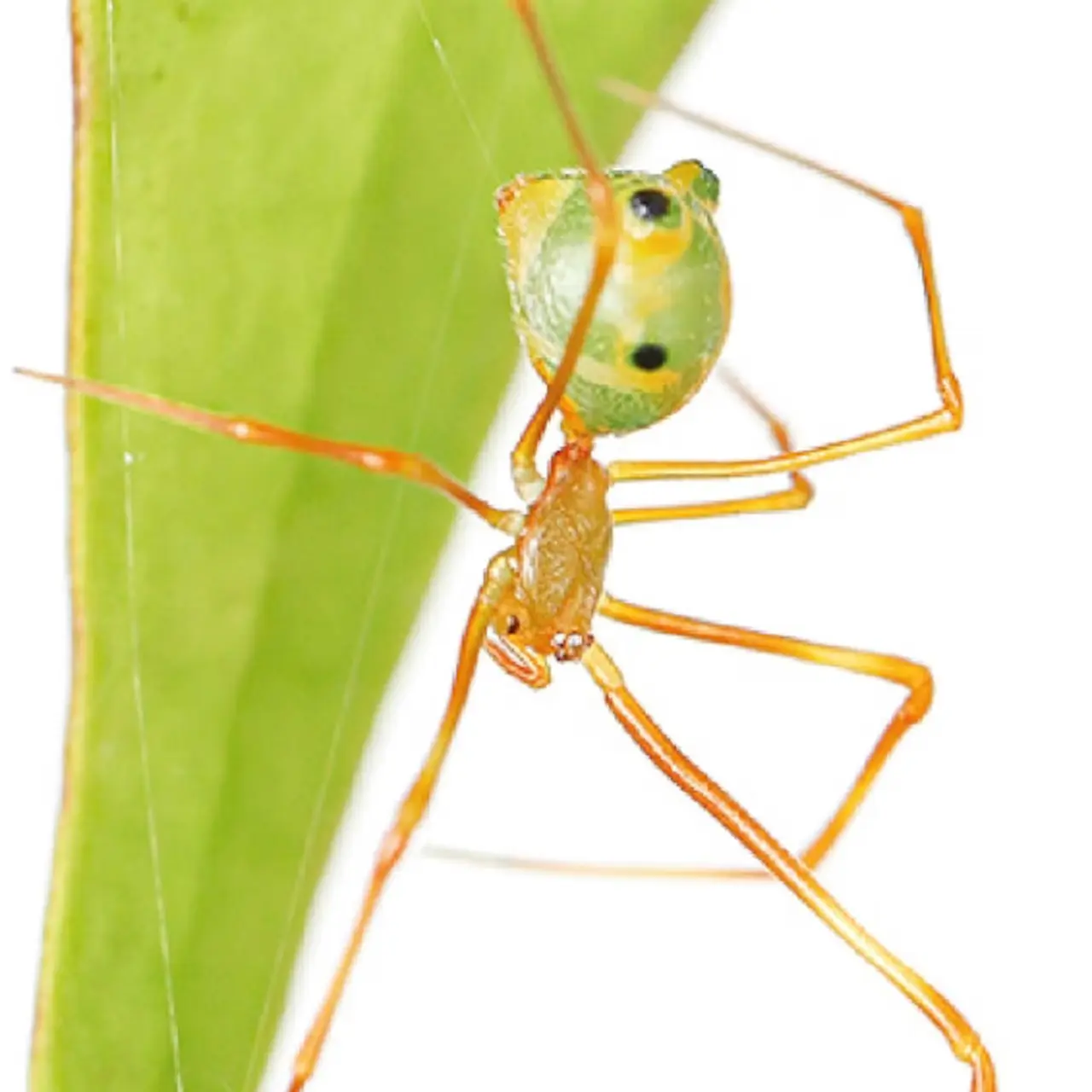
Scientists have discovered a remarkable new spider in the rainforests of Cape York Peninsula, Australia, that hunts one of the region’s most aggressive insects in an astonishing way.
Nicknamed the ballista spider, this previously undescribed species appears to prey exclusively on green tree ants—fierce insects known for their painful bite and ability to spray irritating acid into wounds.
Even more extraordinary, the spider catches them using a spring-loaded silk trap unlike anything previously documented in spiders.
The discovery was published in the journal Current Biology.
An Unexpected Discovery
In 2023, biomedical researcher and spider taxonomist Greg Anderson was searching for spiders in Australia’s rainforest when he noticed something unusual.
A tiny brown spider, about the size of a penny, climbed down from its web and attached a silk thread to a nearby leaf. It repeated the process several times, tightening and reinforcing the silk until it formed a highly tensioned conical snare.
After finishing its work, the spider quietly returned to its web and waited.
Soon afterward, a green tree ant walked onto the leaf.
The ant examined the silk strand and immediately began biting it.
The moment the thread snapped, the stored tension was released.
The ant was launched through the air like a projectile and straight into the spider’s web.
Entangled in sticky silk, the struggling ant quickly became the spider’s meal.
Too Fast for the Human Eye
The entire event happened so quickly that Anderson could barely understand what he had witnessed.
To investigate further, he returned several years later with entomologist Ajay Narendra from Macquarie University.
Using high-speed cameras, the researchers filmed the spiders hunting at night.
Frame-by-frame analysis revealed just how incredible the trap really is.
As Narendra explained:
“The ant was literally there in one frame and gone in the next.”
The launch occurred almost instantaneously.
A Hunting Strategy Never Seen Before
Many spiders have evolved unusual hunting techniques.
Examples include:
- Net-casting spiders, which throw silk nets over prey.
- Slingshot spiders, which stretch their webs under tension and launch themselves together with the web.
However, scientists had never before observed a spider building a separate spring-loaded trap that launches its prey into the web.
This makes the ballista spider’s hunting strategy unique among all known spiders.
An Extremely Powerful Biological Catapult
After measuring the silk trap’s performance, researchers made an astonishing discovery.
Gram for gram, the spider’s snare stores more energy than any other biological catapult yet measured.
Their calculations suggest that:
- One kilogram of this silk trap could briefly release nearly 12 megawatts of power.
- That amount of energy could temporarily power thousands of homes.
Even more astonishing was the launch speed.
The ants were accelerated to speeds of up to 1,367 meters per second, roughly one and a half times faster than a rifle bullet.
A Spider With an Extremely Specialized Diet
The researchers were surprised not only by the trap’s speed but also by its selectivity.
Throughout all of their observations:
- Only green tree ants interacted with the trap.
- No other insects triggered it.
- No other prey species were captured.
Specialists that hunt only one species are exceptionally rare in nature.
Green tree ants are extremely abundant along Australia’s tropical coast, living in large colonies. Scientists believe the spider evolved this highly specialized hunting strategy to exploit this reliable food source.
How Does the Spider Trick the Ants?
One mystery remains.
Why do green tree ants attack the silk thread in the first place?
Researchers suspect the spider coats the trigger thread with chemical signals or pheromones that specifically attract—or even irritate—green tree ants.
The chemicals may convince the ants that the strand is something they should attack.
By biting through the silk, the ants unknowingly activate the trap themselves.
Scientists plan to analyze the silk chemically to test this hypothesis.
More Research Still to Come
The spider has not yet received an official scientific name.
Researchers still need to determine:
- Its formal classification.
- Its evolutionary relationships.
- The exact chemicals used in the trap.
- How this extraordinary behavior evolved.
A Reminder That Nature Still Holds Surprises
The discovery highlights how much remains unknown about life on Earth.
As entomologist Sarah Crews noted, this remarkable spider may have been living in plain sight for years, unnoticed simply because no one had carefully watched its behavior.
The ballista spider demonstrates that even today, patient observation in the wild can reveal entirely new behaviors—and sometimes entirely new species—that reshape our understanding of the natural world.