

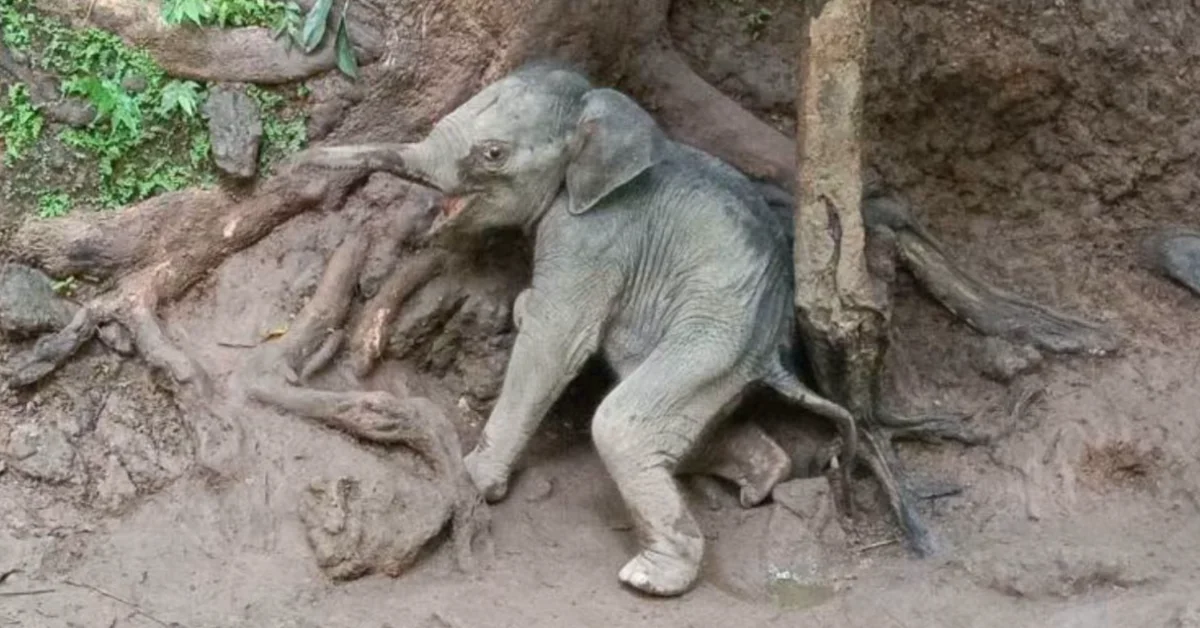
On July 30, residents near Sai Yok National Park in Kanchanaburi, Thailand, reported seeing a young elephant wandering without its herd.
Park rangers immediately began searching the area. Later that day, they discovered the tiny calf lying near the banks of the Huai Mae Nam Noi River.
The baby elephant was weak, severely dehydrated and in critical condition.
Officials believed that powerful currents caused by recent storms may have swept the calf downstream, separating it from its family.
Only Two Weeks Old
The elephant weighed just 88 pounds, suggesting that it was approximately two weeks old.
For an animal so young, being separated from its mother was especially dangerous. Baby elephants depend on their mothers for milk, protection, warmth and guidance.
Rangers estimated that the calf may have been stranded near the river for around two days before being found.
By then, exhaustion, hunger and dehydration had taken a serious toll.
Waiting for the Herd to Return
Wildlife experts generally try to reunite young animals with their families whenever possible.
Rather than immediately removing the calf, the rangers remained nearby throughout the night, listening and watching for signs that its herd might return.
The baby repeatedly cried out, but no elephants answered.
As the hours passed, it became clear that waiting any longer could place the calf’s life at even greater risk.
A Difficult Rescue Through the Storm
The rangers carefully transported the elephant to the headquarters of Sai Yok National Park.
Reaching the calf had not been easy. Rescue workers had to move through heavy rain, rough terrain and strong river currents to bring the animal to safety.
Once the calf arrived, veterinarians began treating it for dehydration and malnourishment.
They also cared for wounds and abrasions around its mouth and trunk, injuries likely caused during its time alone near the river.
Around-the-Clock Care
The young elephant was placed in a temporary enclosure where veterinary teams could monitor it continuously.
It received fluids, nourishment and specialized medical attention throughout the day and night.
At the time of the latest update, the calf’s condition had stabilized, though it remained under close observation.
Specialist veterinarians were assigned to oversee every stage of its recovery.
Protecting an Endangered Species
Indian elephants are classified as endangered, making every individual important to the survival of the species.
Thailand has expanded efforts to protect wild elephant populations through camera traps, GPS tracking, drone monitoring and wildlife crossings designed to reduce collisions with vehicles.
These measures also help conservation teams respond more quickly when vulnerable animals are injured, displaced or separated from their herds.
A Tiny Survivor With a Second Chance
The calf’s future is still uncertain, but its rescue has already given it something it did not have beside the river: a chance.
Thanks to the residents who reported the sighting, the rangers who stayed through the night and the veterinarians providing constant care, the young elephant is no longer facing the struggle alone.
For now, it is resting, recovering and surrounded by people determined to help it grow stronger.