

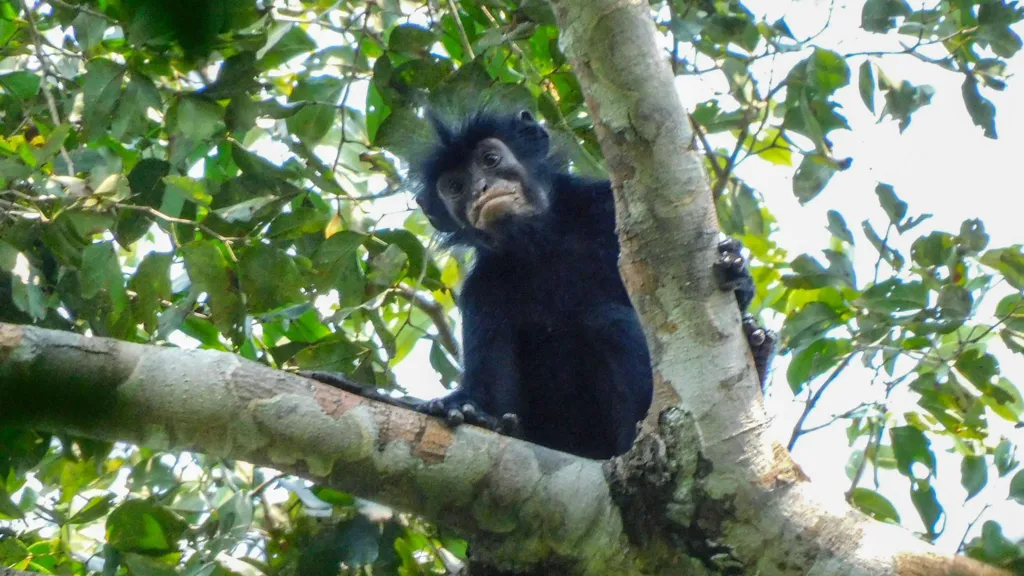
High in the dense tropical canopy of the Democratic Republic of Congo, scientists have confirmed the existence of a remarkable new monkey species.
Covered in dark fur, the primate has a striking black face framed by vivid pinkish-orange lips. Its unusual appearance makes it instantly memorable, yet the animal remained almost entirely unknown to science for years.
The monkey lives in the forests of Lomami National Park, where thick vegetation and towering trees make wildlife difficult to observe.
A Mystery That Began With One Photograph
Conservationists first reported seeing the unusual primate in 2008.
At the time, they managed to capture only a single blurry image. The photograph offered an intriguing glimpse, but it was not enough to determine whether the animal represented a previously undocumented species.
A decade later, another sighting renewed interest in the mysterious monkey.
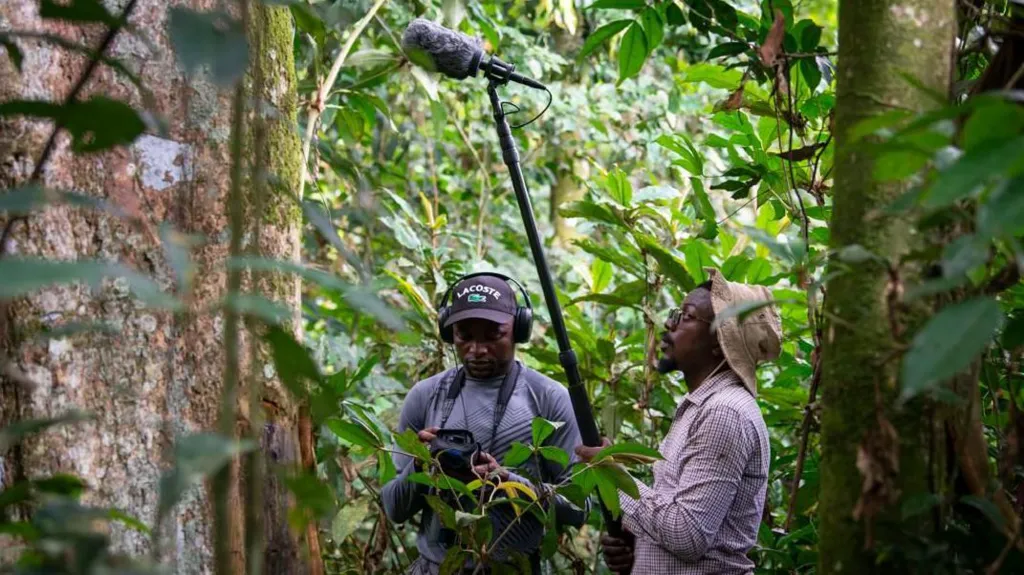
An international research team then began a detailed investigation, combining field observations, sound recordings, photography and genetic analysis.
Their work eventually confirmed that the animal was scientifically distinct.
An Exceptionally Rare Discovery
The finding is especially significant because new African monkey species are rarely documented.
This is only the fifth such species to be formally identified in the past 75 years.
The research was led in part by Junior Amboko, a doctoral student who helped organize the search through the remote forest. For the scientists involved, seeing the animal clearly for the first time was an extraordinary moment.
They were looking into the face of a creature known to local communities but almost entirely unfamiliar to the wider scientific world.
Known Locally as Likweli
Although the monkey was new to science, some people living near the forest already knew of its existence.
Local communities call it Likweli.
Even among nearby villages, however, sightings were uncommon. Researchers interviewed residents across 52 communities, yet people in only eight villages reported having seen the monkey.
Its elusive nature may explain why it remained undocumented for so long. The animals are shy and spend much of their time concealed among branches high above the forest floor.
Often, their voices reveal their presence before their bodies can be seen.
A Voice That Echoes Through the Trees
The newly identified monkey produces a deep, resonant roar that travels through the rainforest.
Researchers frequently heard the calls while struggling to locate the animals themselves.
This distinctive vocalization may help members of the species communicate across long distances in the dense canopy, where visibility is limited.
The monkey was formally named Colobus congoensis, honoring the rich natural diversity of the country where it was found.
A Life Without Thumbs
The species belongs to the colobus monkey group, whose members have reduced or absent thumbs.
These tree-dwelling herbivores spend much of their lives feeding on leaves, fruit and other plant material in the canopy.
Their eating habits may also support the health of the forest. By consuming and dispersing plant material, colobus monkeys are believed to contribute to seed processing, germination and the continued renewal of rainforest ecosystems.
The Mystery of Its Bright Face
Scientists are still unsure why the monkey has such vivid facial coloring.
Its bright lips may help individuals recognize one another among the shadows of the canopy. The markings could also play a role in attracting mates or communicating social signals.
For now, the reason remains one of many unanswered questions surrounding the species.
Researchers still need to learn how the monkeys behave, how large their population is and exactly how much forest they occupy.
A Species Already Facing Danger
Early evidence suggests that the Likweli monkey is both rare and limited to a relatively small area.
It may depend on very specific forest conditions and food sources, making it vulnerable to habitat disturbance. Hunting for meat also poses a serious threat.
Now that the monkey has been formally recognized as a distinct species, conservationists hope it can receive stronger legal protection.
A New Name, and a Chance to Survive
The discovery of Colobus congoensis is not simply the addition of another name to a scientific list.
It is proof that even large mammals can remain hidden in some of the world’s most complex forests. It also highlights how much remains unknown about the wildlife living in remote regions.
For generations, the Likweli monkey quietly moved through the treetops, heard more often than seen.
Now that science has finally recognized it, researchers hope the discovery will mark not only the beginning of greater understanding—but also a stronger effort to protect its future.