

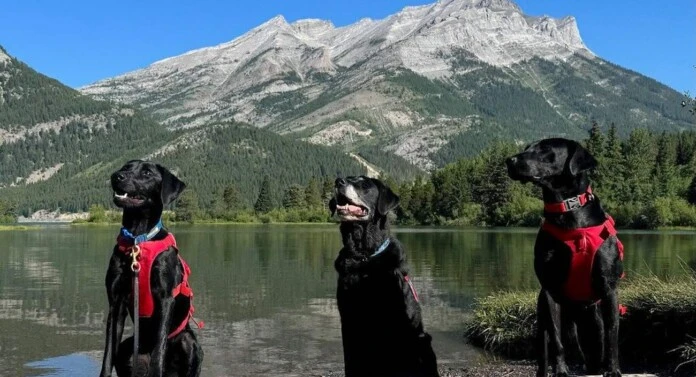
Across Alberta, a specially trained team is helping defend rivers and lakes from destructive invasive mussels.
But these conservation officers do not wear uniforms or carry equipment.
They have four paws, powerful noses and an extraordinary ability to detect what the human eye can easily miss.
Hilo, Jane and Winnie—two black Labradors and a Labrador cross—work alongside provincial inspectors to prevent zebra mussels and golden mussels from entering Alberta’s waterways.
The Dogs Behind the Detection
For more than a decade, conservation dogs have assisted at boat inspection stations throughout the province.
All watercraft traveling through designated checkpoints must stop for an examination. Inspectors search boats, trailers and equipment for signs of invasive species that may have been carried from another lake or river.
The dogs provide an additional layer of protection.
Their sensitive noses can detect the scent of developing mussels and larvae hidden in damp, dark areas of a boat—places that may be difficult for inspectors to reach or examine visually.
Some young mussels are so small that they feel like little more than sandpaper when touched.
Searching Where Humans Cannot See
Invasive mussels can hide inside motors, compartments, ropes and other equipment that retains moisture.
Because they are often nearly invisible, even a careful human inspection may not find every trace.
The conservation dogs help guide inspectors toward suspicious areas, making the entire process faster and more thorough.
Their work has become increasingly important as golden mussels have appeared in new regions, raising concerns that they could eventually spread into western Canada.
Why These Mussels Are So Dangerous
Zebra and golden mussels are filter feeders originally found in parts of Asia.
Once introduced into a new ecosystem, they reproduce rapidly and consume large quantities of microscopic food from the water.
This can leave less food for native fish, insects and other aquatic species. Over time, the mussels can disrupt entire food chains and alter the natural balance of lakes and rivers.
They also attach themselves to pipes, docks, boats and water infrastructure, creating expensive and difficult-to-manage infestations.
Once firmly established, removing them can be nearly impossible.
A Rewarding Job for the Dogs
For Hilo, Jane and Winnie, each inspection feels like a game.
Whenever one of the dogs successfully identifies the scent of mussels, they are rewarded with a favorite toy. The search gives them physical exercise, mental stimulation and the excitement of completing an important task.
Their handlers carefully turn that natural desire to sniff and search into a valuable conservation skill.
To the dogs, it may feel like play.
To Alberta’s environmental teams, it is serious protection.
Guarding More Than Boats
The dogs’ role is continuing to expand.
In addition to inspecting watercraft, they are being trained to search shorelines, docks and other areas near the water for early signs of invasive mussels.
Finding even a small colony before it spreads could help prevent years of ecological damage and millions of dollars in control costs.
Four Paws on the Front Line
Alberta’s conservation dogs prove that some of the most effective environmental tools can come with wagging tails.
With every boat they inspect and every shoreline they search, Hilo, Jane and Winnie are helping protect the province’s waterways from an almost invisible enemy.
Their work may begin with a scent, but its impact reaches across entire ecosystems.