
For decades, calling someone a “birdbrain” has implied that they’re foolish or unintelligent. But modern science has completely overturned that stereotype. Birds possess remarkable cognitive abilities, and many species perform tasks once thought possible only for humans or other primates.
Here are some of the strongest examples.
Corvids: Nature’s Master Problem-Solvers
Corvids—including crows, ravens, and jays—are among the smartest animals on Earth.
Scientists have discovered they can:
- make and use tools,
- solve complex puzzles,
- learn by watching other birds,
- recognize individual human faces,
- remember people who treated them well—or badly,
- hold grudges for years,
- understand cause and effect.
Researchers have even shown that crows understand statistical inference, meaning they can predict likely outcomes based on available information.
They also display an understanding of geometry, demonstrating reasoning abilities once believed to be unique to humans.
Crow “funerals”
When a crow dies, other crows often gather around the body.
Scientists don’t believe these are funerals in the human sense, but the gatherings appear to help birds:
- identify danger,
- learn about predators,
- exchange information.
Either way, it’s remarkably sophisticated social behavior.
Songbirds Help Scientists Understand Human Language
Songbirds don’t simply sing instinctively—they learn their songs.
This process is surprisingly similar to how human babies learn to speak.
Research shows that both birds and humans use:
- specialized brain circuits,
- motor neurons,
- practice through imitation,
- feedback to improve vocal performance.
Birds produce sound using an organ called the syrinx, while humans use the larynx.
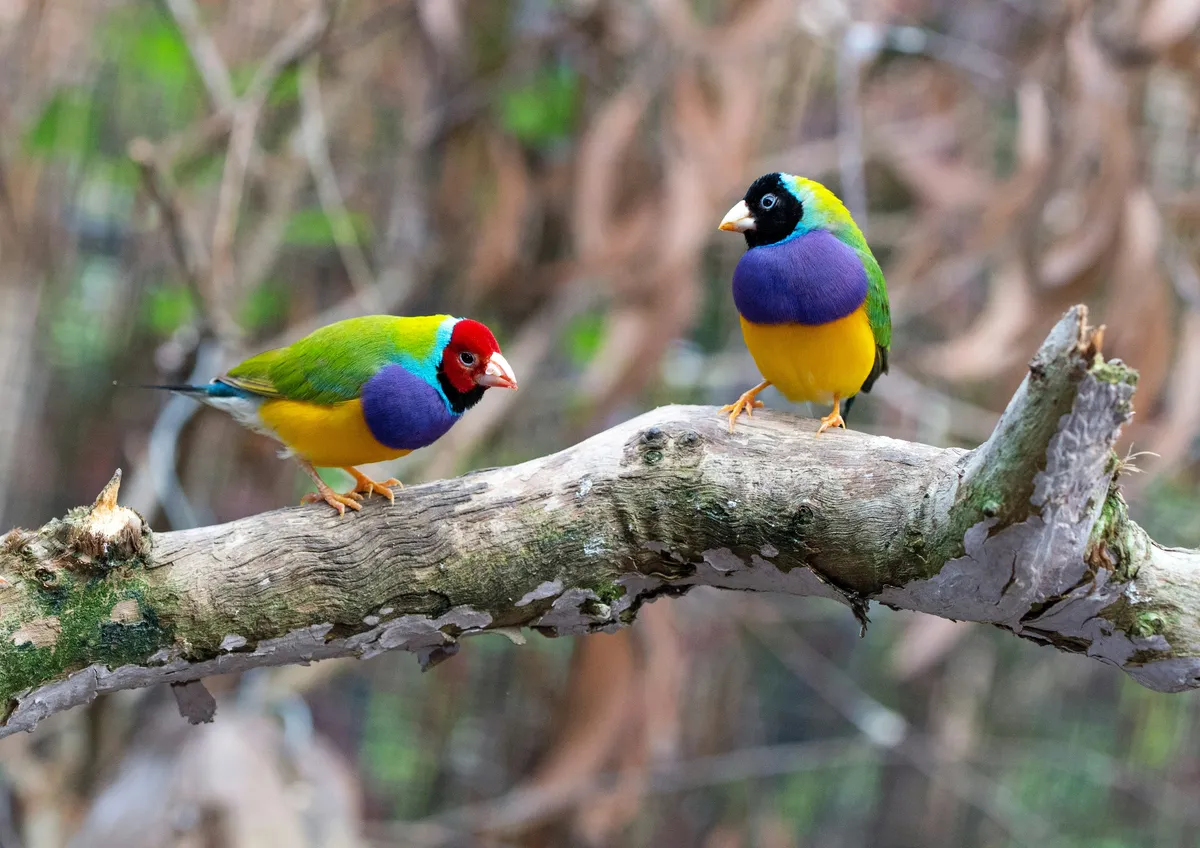
Zebra finches and language learning
Zebra finches are known as closed-ended learners.
This means:
- they learn one song while young,
- after maturity they cannot learn another.
Scientists believe something similar happens in humans.
Children easily absorb their first language because their brains are highly adaptable.
Later in life, those learning circuits become less flexible, helping explain why mastering a foreign language’s pronunciation becomes much harder as adults.
Interestingly, zebra finches have even been shown to have favorite colors, suggesting individual preferences.
Birdsong Does More Than Attract Mates
Birdsong serves many important purposes.
Heat calls
Zebra finch parents produce special heat calls when temperatures are high.
Unhatched chicks hear these calls while still inside the egg.
These sounds influence the chicks’ development, preparing them for hotter environments before they even hatch.
Roosters and social order
A rooster’s morning crow isn’t simply an alarm clock.
It helps establish dominance and maintain the flock’s pecking order, reducing conflict within the group.
Chicks understand the “Bouba-Kiki effect”
Three-day-old chicks have demonstrated an ability shared with humans called the Bouba-Kiki effect.
Both humans and chicks naturally associate:
- “Bouba” with rounded shapes,
- “Kiki” with sharp, spiky shapes.
This suggests some aspects of sound-symbol association may be deeply rooted in biology.
Pigeons Are Extraordinary Navigators
Pigeons are often overlooked, but they possess remarkable abilities.
Studies suggest they may:
- dream while sleeping,
- solve problems similarly to some artificial intelligence systems,
- navigate across hundreds of kilometers,
- recognize visual patterns extremely well.
War heroes
Pigeons have literally saved lives.
During the World Wars they carried messages across battlefields when radio communication failed.
In the United Kingdom:
- 32 pigeons have received the Dickin Medal, the highest military award for animals.
Only dogs have received more.
Built-in compass
Pigeons navigate using Earth’s magnetic field.
Scientists are still investigating exactly how this works.
Evidence suggests magnetoreception may involve:
- the brain,
- the eyes,
- the beak,
- and possibly specialized magnetic cells in the liver.
This internal navigation system allows pigeons to find their way home over enormous distances.
Parrots: Masters of Communication
Parrots are famous for talking, but some do much more than imitate sounds.
Alex the African Grey
Alex, studied by psychologist Dr. Irene Pepperberg, learned approximately 100 words.
He demonstrated understanding of:
- colors,
- numbers,
- shapes,
- categories,
- “same” and “different.”
Before dying in 2007, Alex famously said:
“You be good. I love you. See you tomorrow.”
His final words became one of the most memorable moments in animal cognition research.
Einstein
Another African grey parrot named Einstein reportedly learned around 200 words, demonstrating just how sophisticated parrots can become.
Keas: The World’s Cleverest Troublemakers
New Zealand’s kea is famous for curiosity and intelligence.
One kea named Bruce lost half of his upper beak but learned to compensate by using small stones while grooming himself—an extraordinary example of innovation.
Keas have also become notorious for:
- stealing objects,
- dismantling equipment,
- solving puzzles,
- investigating anything new.
Road cone pranksters
In 2018, keas repeatedly moved traffic cones along New Zealand roads.
Whether they were simply playing or trying to encourage drivers to stop and feed them remains unknown.
To distract them, wildlife managers created roadside enrichment areas—essentially playgrounds full of stimulating objects—which successfully reduced the birds’ interference with traffic.
Why “Birdbrain” Is Wrong
Scientists once underestimated birds because they have relatively small brains.
Modern neuroscience has shown that brain organization and neuron density matter more than overall size.
Many birds pack enormous numbers of neurons into compact brains, giving them impressive processing power.
Birds have demonstrated abilities including:
- tool use,
- planning,
- memory,
- language learning,
- numerical understanding,
- navigation,
- social learning,
- emotional recognition,
- problem-solving.