

All life on Earth can be traced back to a single ancient organism known as LUCA (Last Universal Common Ancestor), which lived around 4.2 billion years ago. Over billions of years, evolution produced the incredible diversity of life we see today—from elephants and dolphins to bats and humans.
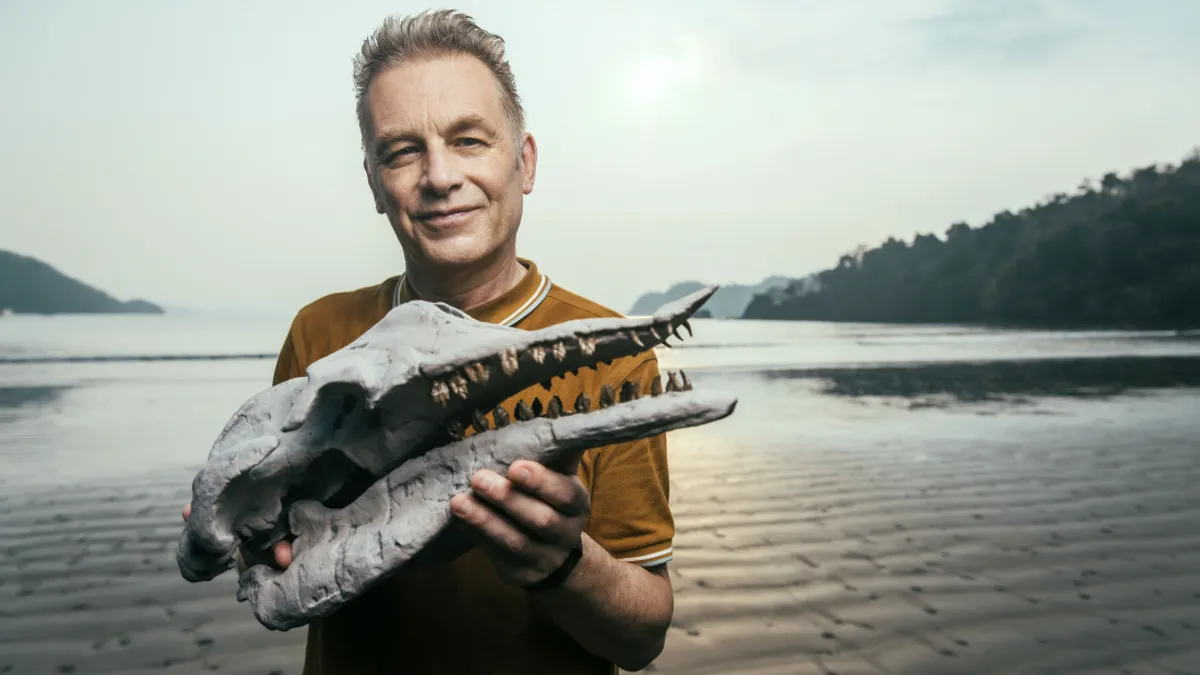
The BBC series Evolution, presented by Chris Packham, explores this journey by following the evolutionary history of five modern animals: the elephant, ostrich, bat, horse, and dolphin.
One of the series’ most surprising ideas is that one of the most important innovations in evolution was the development of a through-gut—a digestive system with a mouth at one end and an anus at the other.
Life Before the Anus
Around 570 million years ago, during the Ediacaran Period, many of the earliest complex animals had what scientists call a blind gut.
A blind gut has only one opening:
- Food enters through the opening.
- Waste leaves through the same opening.
Because food couldn’t be eaten while digestion was still taking place, these animals fed slowly and had limited energy available for growth.
The Evolutionary Breakthrough
Eventually, genetic mutations produced animals with:
- a mouth at one end,
- an anus at the other.
This created a through-gut, allowing food to move continuously through the digestive system.
According to Chris Packham:
“The minute you’ve got a through-gut you can eat almost constantly.”
This meant animals could:
- consume more food,
- extract more energy,
- grow larger,
- become more active,
- develop more complex bodies.
The First Ecological Revolution
During the Ediacaran, the seafloor was covered by thick microbial mats made of bacteria and other microorganisms.
These mats formed the foundation of the ecosystem.
The new through-gut animals began grazing on these microbial mats much more efficiently than earlier animals.
As the mats disappeared:
- many organisms that depended on them lost their food source,
- numerous Ediacaran species vanished.
Some scientists believe this ecological transformation may have contributed to Earth’s first major extinction event, although this remains a leading hypothesis rather than a proven fact.
Why the Anus Led to the Head
Once animals had:
- a mouth,
- an anus,
they naturally moved forward while feeding.
To find food efficiently, it became advantageous to place sensory organs near the mouth:
- eyes,
- smell,
- taste,
- touch.
These organs also needed to communicate quickly with the nervous system.
As a result:
- the brain,
- sensory organs,
- and mouth
became concentrated at one end of the body, forming the head.
Packham summarizes this idea with the memorable phrase:
“No anus, no head.”
While humorous, it reflects an important evolutionary principle: the development of a through-gut encouraged the evolution of head-first movement and the concentration of sensory organs.
Why This Matters
The evolution of the head allowed animals to:
- actively search for food,
- escape predators,
- hunt prey,
- process information more efficiently,
- develop increasingly complex behaviors.
This innovation paved the way for the evolution of vertebrates, including fish, amphibians, reptiles, birds, mammals, and eventually humans.
LUCA: Our Most Ancient Ancestor
LUCA stands for Last Universal Common Ancestor.
It was not the first living organism, but it is the most recent ancestor shared by:
- bacteria,
- archaea,
- plants,
- fungi,
- animals,
- humans.
Every living organism today can trace its evolutionary history back to LUCA.
Other Evolutionary Stories in the Series
The BBC series also explores:
- how fish gills evolved into parts of the human ear,
- how bats developed powered flight and echolocation,
- how mammals rose after the extinction of dinosaurs,
- how ancient viruses helped shape the brain,
- how animals first adapted to life on land.
The Main Message
Chris Packham emphasizes that humans are not the final goal of evolution.
Evolution is an ongoing process, and every species alive today is simply one branch on the vast tree of life.
As he explains:
“We’re not the be-all and end-all of evolution, and it hasn’t stopped. We’re just part of a story that’s going to be told over many more billions of years.”
Conclusion
The article highlights how one seemingly simple anatomical innovation—the evolution of a digestive tract with separate entrances and exits—may have transformed life on Earth. It allowed animals to eat more efficiently, obtain more energy, develop larger and more active bodies, and eventually evolve heads with concentrated sensory organs and brains. This innovation helped reshape Earth’s ecosystems and set the stage for the extraordinary diversity of animal life that exists today. The story serves as a reminder that humans are just one small chapter in the much larger history of life on Earth.