

A groundbreaking ocean expedition off the coast of Argentina has revealed 28 species completely new to science, highlighting just how little we know about the deep ocean.
Scientists explored waters stretching from Buenos Aires to Tierra del Fuego — and what they found exceeded all expectations.
A Deep-Sea World Teeming With Life
The expedition was led by researchers from the University of Buenos Aires and Argentina’s National Scientific and Technical Research Council, working aboard a vessel operated by the Schmidt Ocean Institute.
Using the remotely operated vehicle SuBastian, the team explored the largest known Bathelia candida coral reef in the global ocean. Remarkably, the reef — roughly the size of Vatican City — supports a thriving ecosystem of fish, crustaceans, octopuses and newly identified species.
Dr. María Emilia Bravo, the expedition’s chief scientist, said the team did not expect such extraordinary biodiversity.
“We were not expecting to see this level of biodiversity in the Argentine deep sea,” she said. “We opened a window into our country’s biodiversity only to find there are so many more windows left to be opened.”
In addition to the coral reef, researchers documented Argentina’s first deep-water whale fall — the remains of a whale that create a unique ecosystem on the ocean floor.
A Rare Encounter: The Giant Phantom Jellyfish
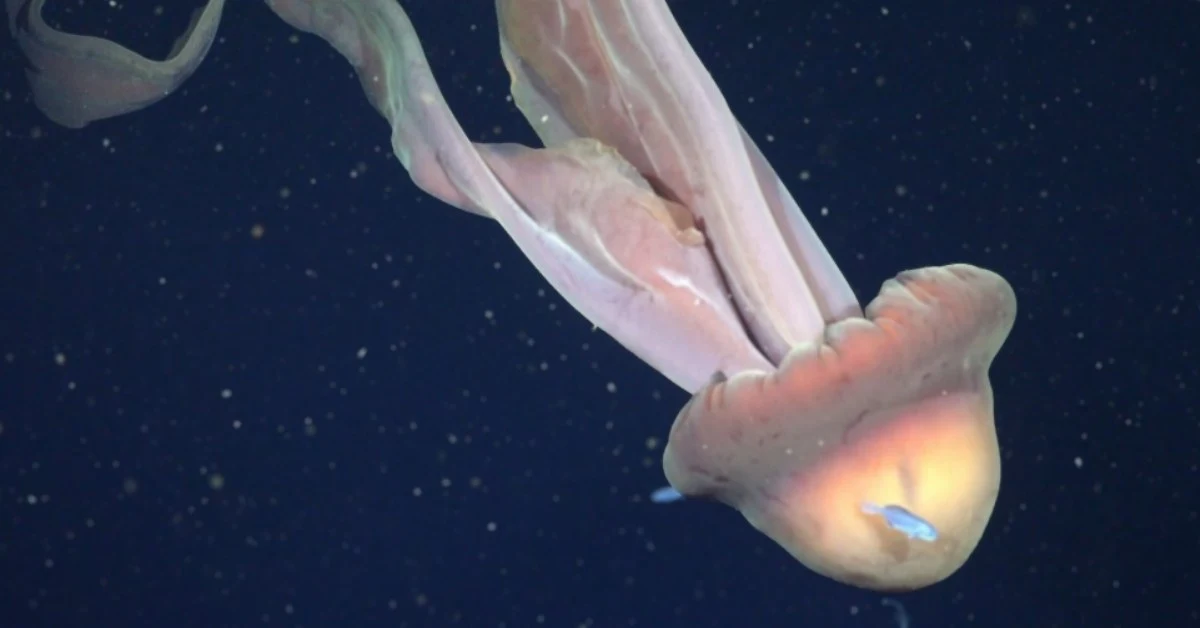
One of the most breathtaking moments came when the team encountered the extremely rare Giant phantom jellyfish (Stygiomedusa gigantea).
This deep-sea jelly can grow as long as a school bus, with ribbon-like arms stretching up to 33 feet. Despite its size, it remains one of the ocean’s most elusive creatures.
First collected in 1899 and officially recognized decades later, it has been spotted only about 120 times worldwide — less than once per year on average.
When the jellyfish appeared on the vessel’s screens, the control room fell silent.
“There was a mixture of excitement and disbelief,” Bravo told The New York Times. “Its ethereal and delicate presence in such an extreme environment was deeply surprising.”
The jelly’s long arms even made it difficult to maneuver the ROV, forcing the team to proceed with extreme caution.
A Year of Major Discoveries
This latest expedition builds on a series of major breakthroughs by the Schmidt Ocean Institute.
- August 2025: A livestream from Argentina’s Mar del Plata Canyon went viral, drawing over 17.5 million views. Scientists identified 40 species new to science, including previously unknown sea anemones, sea cucumbers, corals and crinoids.
- Two months later: The institute’s 100th expedition yielded 30 additional new species and hundreds of first-time regional records off Uruguay.
- By October: Researchers published findings on new black corals, iridescent scale worms, sea stars and even a so-called “death ball sponge.”
Executive director Dr. Jyotika Virmani emphasized how much remains undiscovered.
“With every expedition to the deep sea, we find the ocean is full of life — as much as we see on land, and perhaps more because the Ocean contains 98% of the living space on this planet.”
Why It Matters
The deep ocean covers most of Earth, yet scientists have explored only a tiny fraction of it. Discoveries like these not only expand our understanding of marine biodiversity but also highlight how interconnected and fragile these ecosystems are.
In short, the Argentine deep sea has proven to be far richer than anyone anticipated — and researchers believe this is just the beginning.