

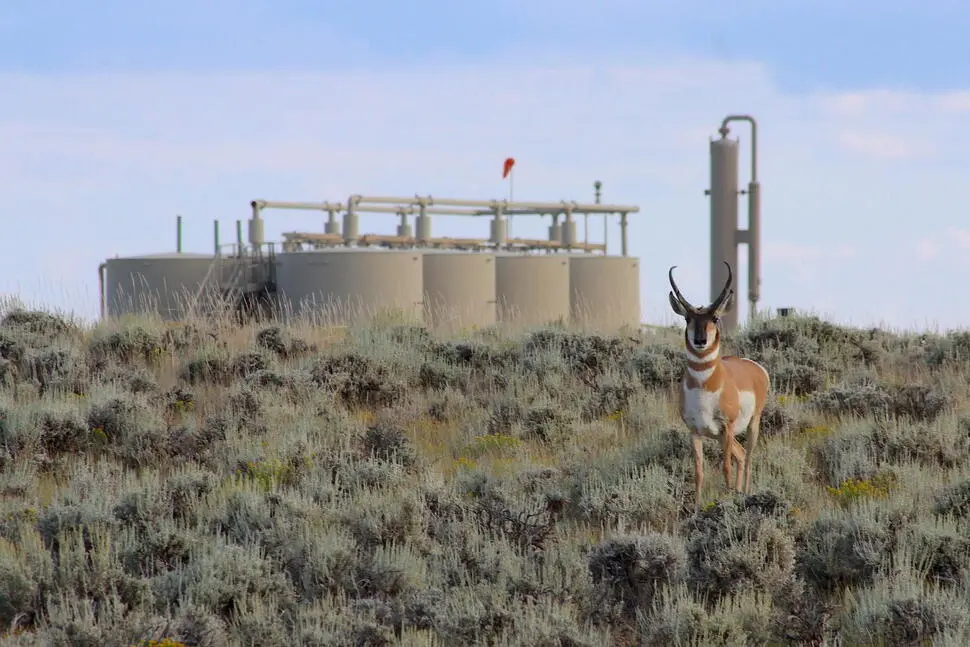
For more than two decades, conservationists have been watching Wyoming’s long effort to protect one of the state’s most remarkable wildlife journeys: the long-distance migration of pronghorn traveling between Interstate 80 and Grand Teton National Park.
Some of these animals move as far as 150 miles each season, following a route known as the Path of the Pronghorn. The corridor carries them across a landscape increasingly shaped by roads, fences, energy development and private land.
Conservation biologist Joel Berger has followed the issue for years. In the early 2000s, when he lived in Jackson Hole, he was one of the strongest voices calling for protections to keep the migration route open. At the time, large natural gas developments in the Pinedale Anticline and Jonah field were expanding, raising concerns about whether pronghorn could continue making their ancient journey.
In 2003, Berger wrote a paper asking whether it was acceptable to allow a species to disappear from a national park. His concern was that if the corridor was blocked, pronghorn might eventually vanish from Grand Teton National Park.
For years, protection efforts moved slowly. Some officials were hesitant to safeguard the southern parts of the route, and resistance came from county leaders, federal land managers and industries worried about development limits.
A major step came in 2008, when the U.S. Forest Service protected about 47,000 acres in the northern portion of the corridor through a Bridger-Teton National Forest plan amendment. But broader protections for the full route remained stalled.
Now, after years of debate, Wyoming has reached a major point in its state-led process to designate the migration corridor. A working group appointed by Gov. Mark Gordon has completed its review and agreed on recommendations that will soon go to the governor for a final decision.
For Berger, the progress is long overdue but encouraging. After nearly 25 years of discussion, he said it was good to see Wyoming formally recognize the importance of migration corridors.
The working group’s meeting in Pinedale was described by supporters as historic. It marked the first time Wyoming had gone through the full designation process under the state’s executive order, and the first time the state had attempted such a process for pronghorn.
The 11-member group included representatives from conservation, agriculture, mining, oil and gas, local government and other interests. Although disagreements remained, none of the members voted completely against moving forward with the corridor designation.
Eight members fully supported designation. One oil and gas representative supported moving forward with serious reservations, while representatives from agriculture and mining supported it with reservations.
Some county and industry concerns remained through the end. Sublette County Commissioner Lynn Bernard said his county still wanted to maintain control over its own land-use decisions.
Still, the fact that the group reached a recommendation at all was seen as a significant achievement. Supporters said the plan balances wildlife protection with economic concerns and avoids being overly restrictive toward development.
The recommendations will now be cleaned up and sent to Gov. Gordon, who will decide whether to formally designate the corridor.
The process has been long and complicated. More than seven years ago, an earlier effort by the Wyoming Game and Fish Department to protect the Sublette Pronghorn Herd’s migration route was stopped after pushback from extractive industries, counties and agriculture groups. In response, Gordon created a new migration policy through executive order, establishing the working group process now nearing completion.
Wyoming has not yet announced which migration route will go through the designation process next. The state has many mapped routes for mule deer and pronghorn, including the Wyoming Range Mule Deer Herd corridor, which entered the process in 2019 but remains unresolved.
For now, the pronghorn corridor has moved closer than ever to formal state recognition. After decades of uncertainty, one of Wyoming’s most iconic migrations may finally receive the protection conservationists have long sought.