

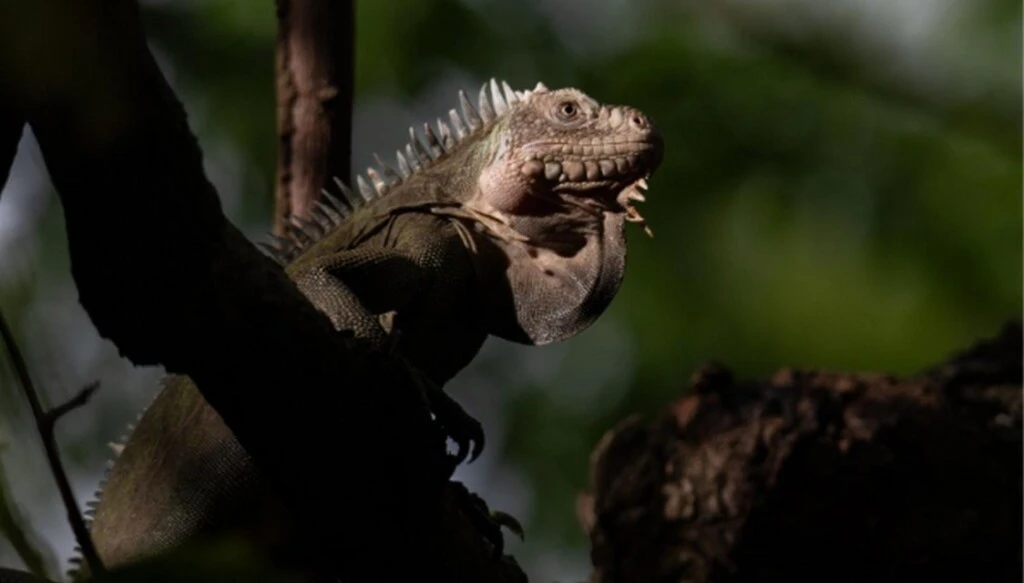
Prickly Pear East, a tiny uninhabited islet in the Caribbean, may not look like a destination for romance — but for the Lesser Antillean iguana, it has become exactly that.
Through an ambitious conservation effort that involved carefully coordinated relocations across the Caribbean, scientists have successfully rebuilt a thriving iguana population on the island. Today, their numbers are climbing at an encouraging pace.
The Lesser Antillean iguana is listed as Critically Endangered and has vanished from much of its former range throughout the Eastern Caribbean. Fewer than 20,000 adult iguanas remain in the wild, and that number has continued to decline.
One of the greatest threats to the species is the spread of invasive iguanas, particularly the common green, or striped-tailed, iguana. These larger lizards can grow up to two meters long, reproduce quickly and outcompete native iguanas for food and habitat. Researchers have also linked them to diseases that weaken and kill the Lesser Antillean iguana.
By 2016, invasive iguanas were spreading rapidly across mainland Anguilla. In response, conservationists with the Anguilla National Trust made a bold move: they relocated the island’s last remaining Lesser Antillean iguanas — just 23 individuals — to Prickly Pear East, a nearby islet free from invasive species.
While the relocation protected the iguanas, it introduced a new risk. With such a small founding group, inbreeding could threaten the population’s future. To address this, the conservation team partnered with Dominica’s Forestry, Wildlife & Parks Division, requesting young iguanas to strengthen genetic diversity. The Dominican government approved the plan, and the necessary permits were secured.
In early 2021, ten juvenile Lesser Antillean iguanas made the journey from Dominica to Anguilla, accompanied by conservation experts. Once released on Prickly Pear East, the newcomers quickly became part of the growing colony — and part of the species’ survival story.
Fewer than five years later, survey results have confirmed just how successful the effort has been. More than 300 adult and adolescent iguanas are now living on the islet. Prickly Pear East has become one of only five locations worldwide where the species is considered stable and flourishing, free from invasive competitors.
“Thanks to the generosity of our colleagues in Dominica and funding from the UK Government through Darwin Plus, the Lesser Antillean iguana is recovering in Anguilla,” said Jenny Daltry, Caribbean Alliance Director for Fauna & Flora and Re:wild. “Prickly Pear East now stands as a symbol of what’s possible when native species are given the chance to recover.”
Building on this momentum, conservationists have established a second protected site on mainland Anguilla. Fountain National Park has been surrounded by a pest-resistant fence designed to keep out invasive species such as cats, dogs and green iguanas. If plans stay on track, Lesser Antillean iguanas will be reintroduced there in 2026, with some individuals relocated from Prickly Pear East.
Community involvement has played a vital role throughout the project. From the beginning, Anguilla residents helped by reporting iguana sightings, assisting researchers in locating remaining animals. Volunteers also supported captive care, genetic testing and both major translocations in 2016 and 2021, working alongside partners from Dominica.
“This isn’t just a story about iguanas rebuilding their population,” said Farah Mukhida, Executive Director of the Anguilla National Trust. “It’s also a story about people coming together to protect and restore an important piece of Anguilla’s natural heritage.”