

Caves form easily in karst landscapes, and many of the world’s longest, largest — and least-explored — cave systems are found across East and Southeast Asia.
That’s certainly true in Cambodia’s Battambang province, where researchers faced a challenging journey just to reach them. The team first climbed steep, forested limestone outcrops before squeezing through narrow crevices and crawlspaces to access the hidden cave networks.
What they found inside was extraordinary.
The caves were teeming with life — some species native only to these underground environments, and others, like a large reticulated python, simply passing through. As the distant calls of endangered silvered langurs faded behind them, the team began encountering species never before described by science.
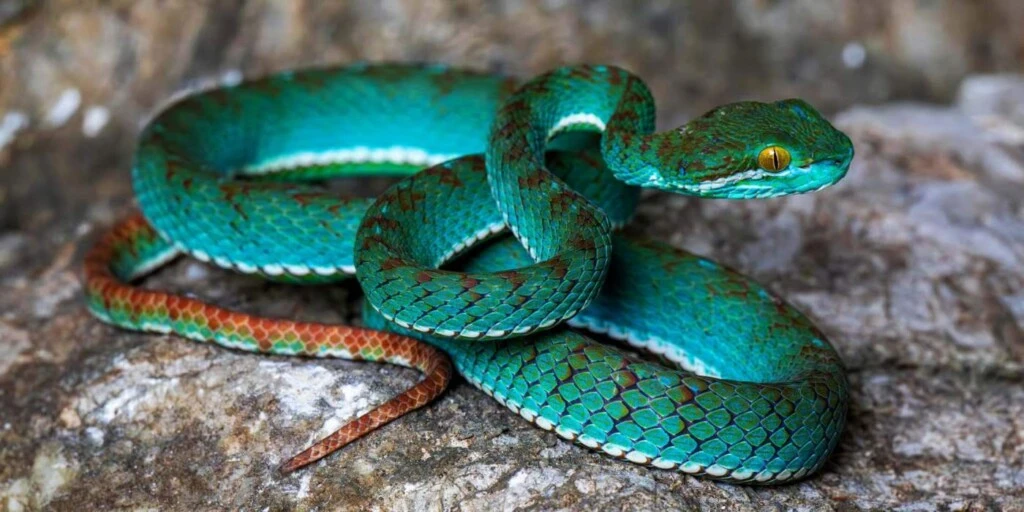
Among the most striking discoveries was a new species of pit viper from the Trimeresurus genus. Known for their triangular heads, these highly venomous snakes use heat-sensitive pits near their nostrils to detect warm-blooded prey. The species is currently being formally described.
Researchers also identified four populations of a striped bent-toed gecko as a new species, now named Cyrtodactylus kampingpoiensis. Although grouped as a single species for now, scientists believe the isolated populations may be evolving separately — and future genetic studies could reveal that they are actually multiple distinct species.
Another newly discovered gecko was given a dramatic name inspired by mythology — after Shiva, the Hindu god associated with destruction.
Fauna & Flora International, which led the expedition, is now working with local partners to protect Cambodia’s karst landscapes. The organization has recently released guidelines aimed at promoting sustainable management of cave ecosystems.
These guidelines focus on:
- Protecting bat colonies
- Preserving rare and endemic cave species
- Supporting sustainable guano harvesting
- Encouraging responsible tourism
“Cambodia’s karst areas are a treasure trove of scientific secrets waiting to be uncovered,” said Sothearen Thi, Karst Biodiversity Coordinator at Fauna & Flora.
“But without sustainable management, we may never discover what these areas truly hold. These landscapes face many human-driven threats, and important species could disappear before we even know they exist.”
The hope is that through conservation and careful stewardship, these hidden ecosystems — and the remarkable life within them — can be protected for generations to come.