

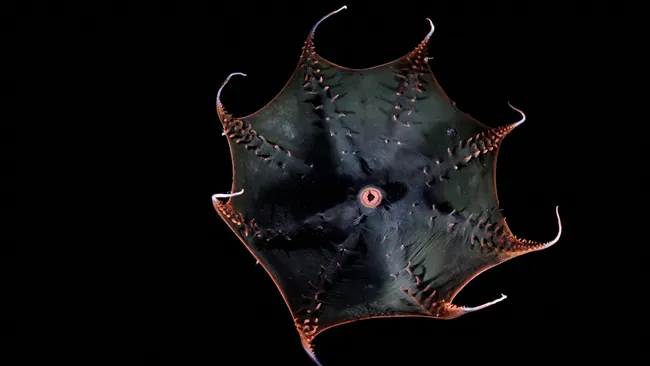
The genetic link between squids and octopuses may just be found in the vampire squid genome.
For years, scientists studying cephalopods have struggled to answer a key evolutionary question: how did squid-like ancestors eventually evolve into modern octopuses? It turns out the clue has been drifting through the deep ocean all this time.
The mysterious vampire squid (Vampyroteuthis infernalis) — known for its eerie glowing eyes, deep red coloring, and eight octopus-like arms — has now offered long-awaited genetic insight into this evolutionary puzzle.
In a study published on Nov. 27 in the journal iScience, researchers successfully sequenced the vampire squid’s genome. They found that its chromosomes closely resemble those of squids and cuttlefish, even though the species is classified within the octopus lineage. This suggests the vampire squid preserves genetic features similar to those of the shared ancestor of squids and octopuses, which lived roughly 300 million years ago. Because of this, scientists have described the species as a “living fossil.”
Although vampire squids sit on the octopus side of the cephalopod family tree, they split from other octopus relatives extremely early in evolutionary history, said study lead author Oleg Simakov of the University of Vienna in an email to Live Science.
The research team analyzed DNA from a tissue sample taken from a vampire squid accidentally caught as bycatch during a research expedition in the western Pacific Ocean. Due to the animal’s rarity, no additional samples were available for comparison. Using a high-resolution sequencing platform called PacBio, the scientists compared the vampire squid’s genome to those of other cephalopods, including the common octopus, the curled octopus, and the argonaut.
The results revealed an enormous genome — about 11 billion base pairs long — making it nearly four times larger than the human genome and the largest cephalopod genome sequenced so far.
Unlike modern octopuses, whose chromosomes undergo frequent rearrangement, the vampire squid’s DNA has remained largely unchanged over time. Its genome retains a structure similar to ancient squid, essentially making it an octopus in form but a squid at the genetic level.
The species has a long history of confusing scientists. When first identified in 1903, it was classified as an octopus because of the webbing between its arms. By the 1950s, however, researchers realized it didn’t fit neatly into either squid or octopus categories and placed it into its own order, Vampyromorphida — named for the cloak-like appearance that gives it a vampire-inspired look.
Experts say the new findings help explain why vampire squids retain so many ancestral traits. Bruce Robison, a senior scientist at the Monterey Bay Aquarium Research Institute who was not involved in the study, said the results clarify a long-standing mystery in cephalopod evolution.
Sequencing the genome is especially valuable, Robison added, because vampire squids are extremely difficult to study. They live in deep, hard-to-reach waters, are solitary and rare, and do not survive well in captivity.
“People often assume you can simply dive down and find one,” Robison said. “That’s really not how it works.”
He noted that scientists have long suspected vampire squids would hold key evolutionary clues. Not only are they fascinating creatures, he said, but they also seem to be “guarding secrets” that are only now coming to light.