

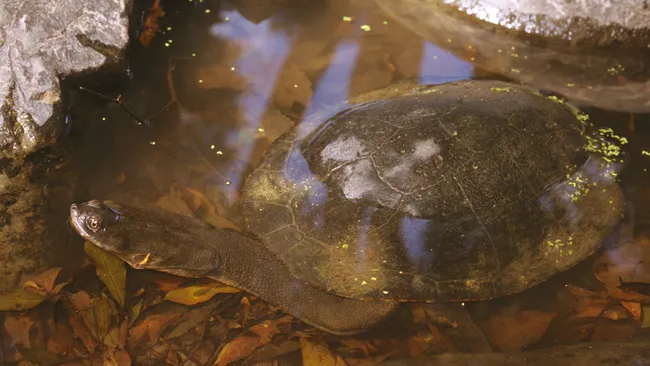
Turtle shells evolved over the course of 300 million years, but self-defense wasn’t the initial driver, researchers think.
Many people grow up believing that all turtles can pull their heads into their shells when danger strikes. But that familiar image isn’t true for every turtle — and it also isn’t the reason shells evolved in the first place.
According to experts, only certain kinds of turtles have the ability to retract their heads. And while shells do offer protection today, fossil evidence shows they originally developed for entirely different purposes.
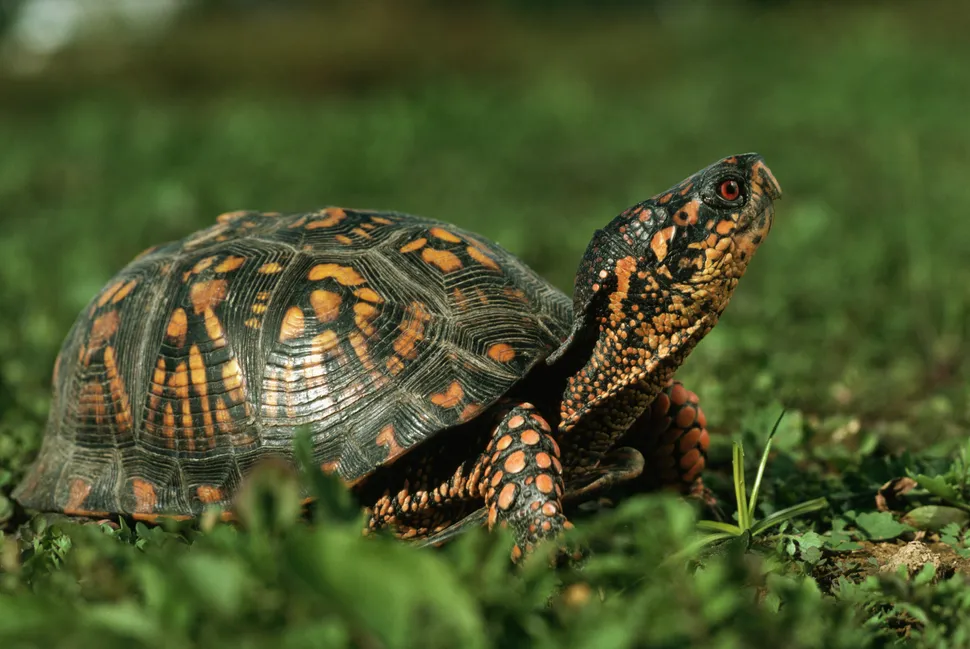
Tortoises are a well-known example of turtles that can withdraw their heads into their shells. This land-dwelling group appeared around 50 million years ago, said Tyler Lyson, senior curator of vertebrate paleontology at the Denver Museum of Nature and Science. Because tortoises move slowly, their shells serve as a primary defense against predators. Their high-domed shells create enough internal space for most species to fully tuck in their heads.
Some semi-terrestrial turtles that divide their time between land and water can do this as well.
“Turtles use two main strategies to hide their heads,” explained Jason Head, a professor of vertebrate evolution and ecology at the University of Cambridge. Side-neck turtles bend their long necks sideways, folding them along the shell, while snake-neck, or S-neck, turtles curve their necks backward and pull them into the shoulder area.
A familiar example is the eastern box turtle (Terrapene carolina carolina), which has a hinged lower shell, or plastron, allowing it to seal itself completely inside.
Sea turtles, however, lack this ability. Their shells are streamlined and lightweight, leaving no room to retract the head. This design reduces drag and helps them swim quickly to escape predators, Head said.
How turtle shells came to be
Understanding why some turtles can retract their heads requires looking back nearly 300 million years to the origins of the turtle shell.
“The shell is incredibly complex, made up of more than 50 bones,” Lyson said. Importantly, fossil evidence shows that the shell is part of the turtle’s skeleton rather than an external covering. What appears today as a single structure actually evolved in stages from separate skeletal components.
The earliest signs of shell development appear in Eunotosaurus africanus, a reptile that lived in southern Africa about 260 million years ago. Fossils reveal broadened ribs, which researchers believe helped support powerful muscles used for burrowing underground to avoid extreme heat.
Later discoveries added more pieces to the puzzle. In Germany, scientists uncovered Pappochelys, a 240-million-year-old animal with expanded upper ribs and thickened belly ribs, called gastralia. By around 220 million years ago, an aquatic species known as Odontochelys, found in China, had developed a complete plastron — the solid lower plate of the shell — formed in part from these gastralia.
Lyson and other researchers suggest that the plastron may have functioned as ballast, helping early turtles dive deeper in the water. It may also have provided protection from predators approaching from below.

The earliest fully enclosed shell appears in fossils of Proganochelys, dating back roughly 210 million years. In this species, thickened ribs fused with dermal bone to form a closed upper shell, or carapace, connected to the plastron. Openings for the head were created where shoulder bones linked the top and bottom portions of the shell.
Most scientists believe these ancient reptiles eventually gave rise to modern turtles, though similar rib structures evolved independently in other animals as well. As Head noted, the evolutionary story of turtles is still being refined as new fossils come to light.
Although turtle shells arose in response to a range of early evolutionary pressures, their main role today is defense. “The function we see now doesn’t always reflect why a feature evolved in the first place,” Lyson said. “Protection came later, once the shell was fully formed.”
That tough, adaptable shell has helped turtles persist for nearly 300 million years — long enough to survive three of Earth’s five mass extinction events.
“When we look at the fossil record, we can see where dinosaurs disappear,” Lyson said. “And turtles just keep going.”