

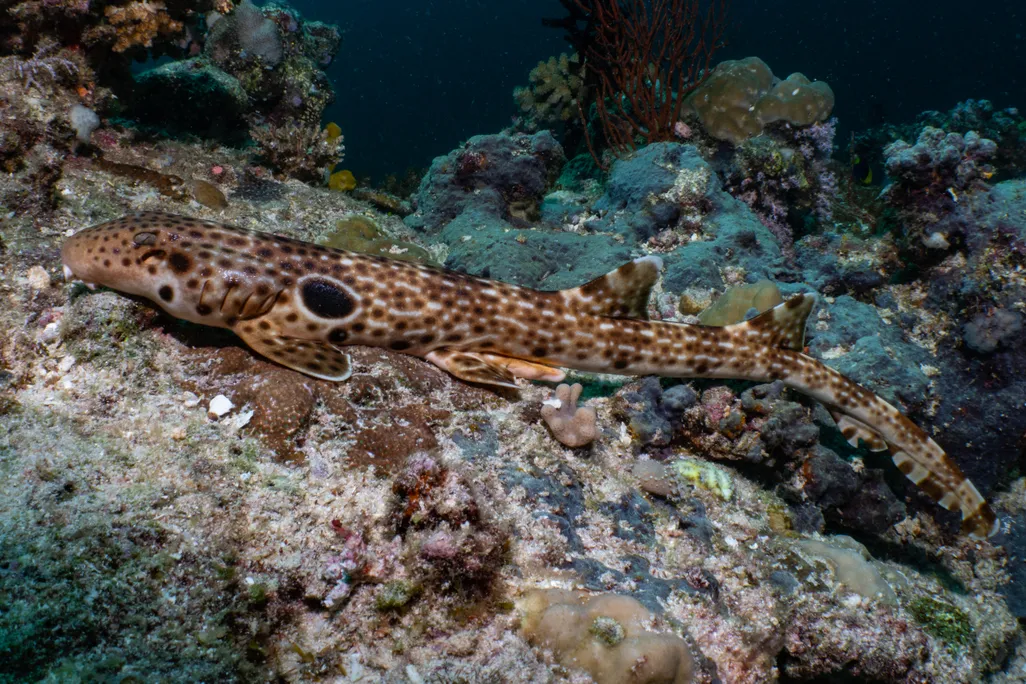
The creature belongs to a unique group of sharks whose members can use their strong pectoral fins like legs to get around
For generations, people living along the southeastern coast of Papua New Guinea have been familiar with a small shark capable of moving across exposed coral reefs during low tide. Locally known as kadedekedewa, a name that roughly translates to “lazy shark” or “dog shark,” the animal earned its nickname because of the slow, waddling way it moves using its fins.
Scientists have now confirmed that this unusual creature is a previously unknown species. Officially named Hemiscyllium dudgeonae, or Dudgeon’s walking shark, it joins a rare group of sharks that use their muscular pectoral fins almost like legs to crawl across shallow reefs around Australia and New Guinea.
The discovery was described in a study published on June 15 in the Journal of the Ocean Science Foundation. It represents the first newly identified species within the Hemiscyllium genus since 2013.
The shark was named in honor of marine ecologist Christine Dudgeon from Australia’s University of the Sunshine Coast, who first encountered the animal in March 2025 while conducting fieldwork in the shallow coastal waters of Milne Bay, southeastern Papua New Guinea.
At the time, Dudgeon and her research team were searching for the leopard epaulette shark, also known as Michael’s epaulette shark. Instead, she noticed a shark roughly 2.5 feet (75 centimeters) long slowly moving across the seafloor.
To safely examine the animal, Dudgeon directed her dive light in front of it, causing it to stop moving. She carefully approached, gently picked it up, turned it upside down, and secured its tail beneath her arm, a common handling technique that temporarily calms many shark species.
She then passed the specimen to lead researcher Jess Blakeway, another ecologist from the University of the Sunshine Coast, who was waiting aboard a nearby research vessel. Blakeway immediately recognized that the shark’s markings did not match those of the species they had been looking for.
Instead of the familiar leopard-like pattern, this shark displayed a distinctive combination of spots and short markings. Blakeway later remarked that the pattern reminded her of Braille or Morse code, making it unlike any known walking shark.
Encouraged by the discovery, the researchers spent several more days surveying nearby reefs. During that time they located twelve individuals. Biological samples were collected from nine before they were released back into the wild, while three specimens were retained for detailed scientific examination.
Subsequent DNA analysis confirmed that the sharks were genetically distinct from every previously recognized walking shark species, providing strong evidence that they represented an entirely new species.
Although much remains unknown about Hemiscyllium dudgeonae, researchers believe its distribution is relatively limited. Individuals were found between the Amphlett Islands and the Trobriand Islands, north of Milne Bay. Scientists suspect the species also inhabits surrounding island groups, including the D’Entrecasteaux Islands and possibly waters extending toward Muyua Island, approximately 170 miles (275 kilometers) northeast of Milne Bay.
Like other walking sharks, the newly discovered species appears to prefer shallow coastal habitats, where it spends much of its time among seagrass beds and scattered coral formations.
Blakeway noted that scientists often associate unexplored biodiversity with the deep ocean, but discoveries like this demonstrate that even relatively shallow marine environments continue to hide species unknown to science.
Walking sharks are commonly referred to as epaulette sharks because of the prominent black markings located behind their gills. These markings resemble decorative shoulder ornaments, known as epaulettes, found on military uniforms. The eye-like spots also serve an important defensive purpose by making predators believe they are facing a much larger animal.
Despite only recently being recognized by science, the new shark may already face significant conservation challenges. Coastal ecosystems in Papua New Guinea are increasingly threatened by climate change, coral bleaching, habitat degradation, expanding coastal development, and the growth of palm oil plantations.
Before this discovery, scientists recognized nine species of walking sharks worldwide. Two of those species, including the leopard epaulette shark originally being surveyed during the expedition, are already listed as Vulnerable by the International Union for Conservation of Nature (IUCN).
Researchers plan to return to Papua New Guinea later this year to continue studying the new species, gather additional ecological data, and better understand its population size and habitat requirements. The information collected could support future recommendations for the shark to receive official conservation status, such as Vulnerable or Endangered.
According to Blakeway, the discovery highlights both the remarkable biodiversity of Papua New Guinea and the urgent need to protect it. Without effective conservation measures, this newly identified species could face local extinction before scientists have fully understood its role in the marine ecosystem.