

For generations, the familiar explanation for how honeybees create a queen has been simple: feed a young larva royal jelly and she develops into royalty.
New research suggests the process is more complicated.
Scientists have found that the special chamber in which a future queen develops may also help determine her fate. The wax surrounding the larva differs physically and chemically from the material used in ordinary worker cells, and experiments suggest those differences can strongly affect survival and development.
Queen Bees Grow Up in Special Chambers
Most honeybee larvae develop inside the familiar six-sided cells that make up a hive.
These standard cells are used primarily for worker bees, while other hexagonal cells produce male drones.
Future queens, however, receive something entirely different.
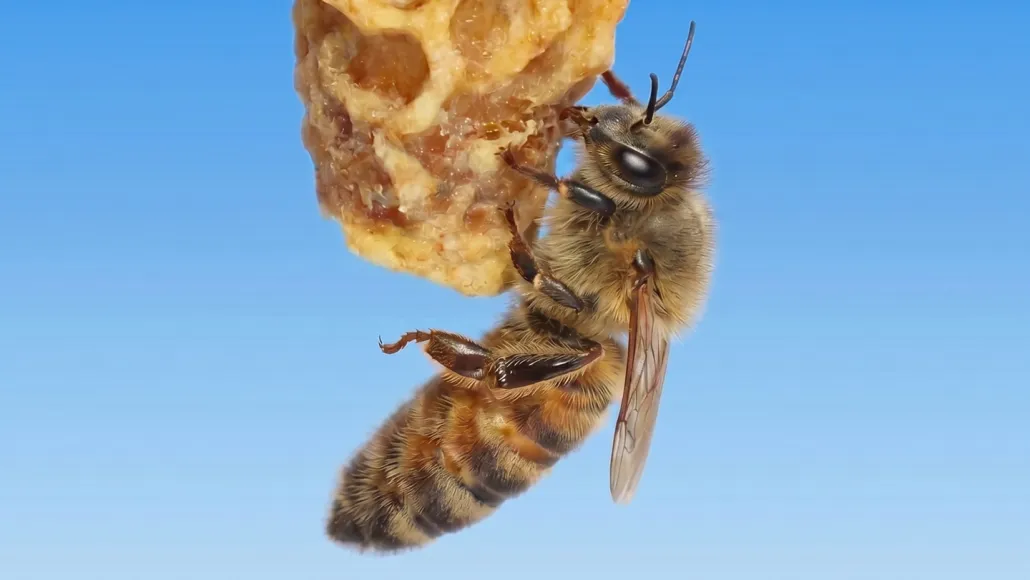
When a colony needs a new queen, worker bees construct larger, peanut-shaped chambers specifically for queen development.
Researchers involved in the new study describe these structures as “royal cribs.”
A fertilized egg is placed inside, and specialized nurse bees provide the developing larva with royal jelly.
Scientists Wondered Whether the Cell Itself Mattered
Boris Baer, an insect biologist at the University of California, Riverside, had long been familiar with the traditional explanation that royal jelly drives queen development.
But years of observing honeybees made him wonder why colonies invest so much effort in constructing specialized queen cells if the food alone is responsible.
That question led researchers to investigate whether the physical environment surrounding a developing queen might also influence her transformation.
Their results, published in Nature, suggest it does.
Queen-Cell Wax Is Different
The research team studied both western honeybees (Apis mellifera) and eastern honeybees (Apis cerana).
When they compared ordinary worker cells with queen cells, they found significant differences in the wax.
Wax from the queen chambers was softer and less dense.
Its chemical composition was also different.
That suggests the bees are not simply building a larger version of an ordinary cell. They appear to be producing a specialized material for future queens.
Specialized Nurses Build the Royal Cells
A subset of worker bees, described by the researchers as “royal nurses,” takes particular responsibility for caring for developing queens.
These bees spend more time constructing queen cells than ordinary workers spend making standard brood cells.
Researchers also found that the bodies of the royal nurses were warmer.
That extra warmth slightly raises the temperature around the developing queen and may also make the wax easier to manipulate, although the researchers did not directly test that possibility.
Royal Nurses Show Different Gene Activity
The differences went deeper than behavior.
Scientists found unusual patterns of gene activity in royal nurse bees.
Those patterns suggest that these workers may be biologically specialized for modifying and producing the wax used in queen development.
For Baer, the findings indicate that division of labor inside a hive may be more complex than previously recognized.
Wax-Swap Experiments Produced Striking Results
To test whether queen-cell wax actually affects development, researchers conducted an experiment in which they changed the wax surrounding young queen larvae.
Newly hatched larvae were removed from queen cells and placed in small plastic queen cups.
The cups were returned to the hive, where nurse bees continued feeding the larvae royal jelly for four days.
Researchers then covered the developing larvae with different types of wax.
Some received wax taken from queen cells, while others were capped using wax from ordinary worker cells.
Worker-Cell Wax Dramatically Increased Death Rates
The difference was substantial.
Nearly two-thirds of the queen larvae covered with worker-cell wax died.
That was approximately twice the mortality rate seen among larvae given wax from queen cells.
The surviving bees also developed differently.
Queens raised beneath natural queen-cell wax more closely resembled queens allowed to develop normally in their original chambers.
Those raised beneath worker-cell wax became smaller pupae.
Royal Jelly May Be Only Part of the Story
The experiment suggests that feeding alone does not fully explain queen development.
Even though all of the larvae received royal jelly, the type of wax surrounding them had a major influence on their survival and growth.
Baer said the evidence points toward worker bees doing more than simply feeding a future queen.
Instead, the colony may be actively creating the conditions needed to shape her development.
Bees May Be “Engineering” Their Queens
The researchers describe the process as a kind of biological engineering.
The hive does not simply select a larva and provide richer food.
Specialized workers build a different chamber, use distinct wax, maintain slightly different conditions and devote additional effort to caring for the developing queen.
Together, those factors may create a developmental environment unlike anything experienced by ordinary worker larvae.
The Exact Mechanism Remains a Mystery
Scientists still do not know precisely how the wax influences a growing queen.
One possibility involves chemicals or scents contained in the chamber walls.
Kai Wang, a bee scientist at the Chinese Academy of Agricultural Sciences and a co-author of the study, is especially interested in whether odors within queen cells influence development.
Those chemical signals might affect the larva’s senses or prepare her for later behaviors such as mating and reproduction.
Could the Future Queen Communicate With Her Nurses?
Another unanswered question is whether some of the chemical signals come from the developing queen herself.
If so, the larva might not simply be a passive recipient of care.
She could potentially influence the workers constructing and maintaining her chamber.
That would suggest an even more complicated relationship between a future queen and the bees surrounding her.
A Hive May Be More Complex Than Scientists Realized
Honeybee colonies are often described as “superorganisms” because thousands of individuals cooperate in ways that allow the entire hive to function almost like a single living system.
The new findings add another layer to that idea.
Specialized workers may collectively shape the next generation not only through feeding but also by controlling the physical and chemical environment in which young bees develop.
Rethinking How a Queen Gets Her Crown
Royal jelly still plays an important role in queen development.
But the new study suggests the famous substance may be only one part of a much larger biological process.
The queen’s chamber, the chemistry of its wax and the specialized workers responsible for building it may all contribute to turning an ordinary fertilized egg into the most important bee in the colony.
What once seemed like a simple story about a special diet is beginning to look much more like an extraordinary example of collective engineering inside the hive.