

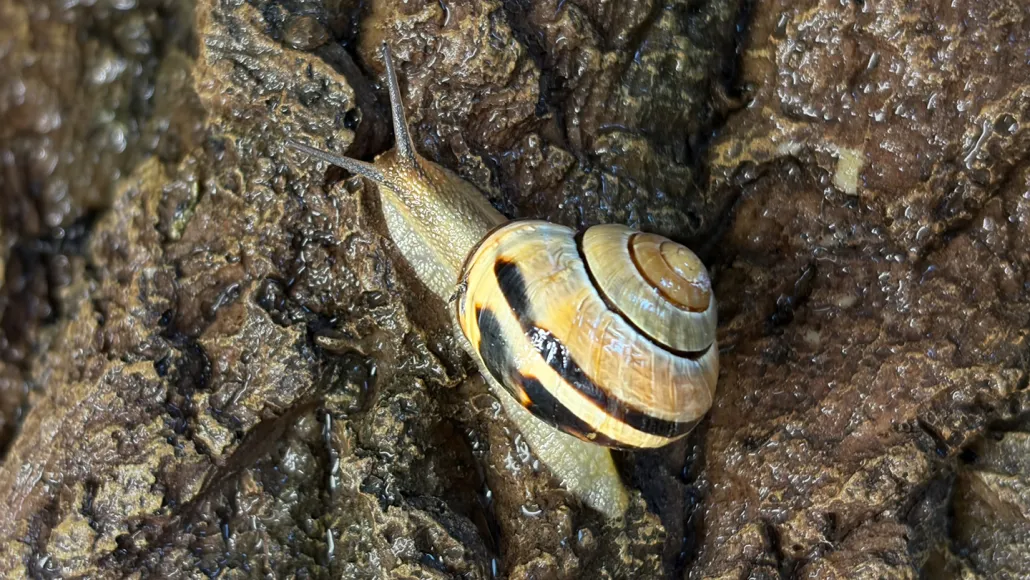
Snail slime might look like one simple, sticky substance, but new research shows it is far more sophisticated than it appears.
Scientists studying grove snails have discovered that the animals can produce five distinct varieties of mucus, each designed for a different purpose.
By adjusting ingredients such as calcium and proteins, the snails can transform their mucus from a slippery lubricant into a powerful adhesive, protective foam or hardened seal.
The discovery, published in Science, could eventually inspire new materials capable of changing their physical properties depending on how they are used.
Snail Slime Has More Than One Job
Mucus performs a remarkable variety of functions throughout the animal kingdom.
Some animals use it for defense, while others rely on it for movement, feeding or gripping surfaces.
Grove snails (Cepaea nemoralis) appear to take that versatility even further.
Researchers found that the same animal can create several different mucus formulas with properties that sometimes seem completely opposite.
One type reduces friction and helps the snail glide across surfaces, while another acts as an adhesive strong enough to hold the animal firmly in place.
A Scientist Wanted to Know What Made the Slimes Different
Biochemist Franziska Jehle of the Max Planck Institute of Colloids and Interfaces in Potsdam, Germany, became interested after observing how land snails used mucus to stick themselves to surfaces.
She wanted to understand how that adhesive substance differed from the slippery mucus the same animals use while moving.
The question was intriguing because the two materials perform opposing tasks.
One helps the snail slide.
The other prevents it from moving at all.
Researchers Collected Slime in Several Ways
To investigate, Jehle and her colleagues collected different kinds of mucus produced by grove snails under varying circumstances.
Lubricating slime was gathered from glass containers after the snails crawled across them.
Sticky mucus was collected from around shell openings after snails attached themselves to surfaces inside their enclosures.
Researchers also gently stimulated the animals to trigger defensive mucus production.
The different samples were then examined for their structure and chemical composition.
The Snails Produce Five Distinct Slimes
The experiments revealed five separate types of mucus.
One is an iridescent adhesive that helps the snail remain attached to surfaces.
Another serves as a lubricant underneath its muscular foot, allowing the animal to move smoothly.
A third creates an epiphragm — a thin protective barrier that seals the entrance to the shell during periods of hibernation or inactivity.
The snails can also produce two defensive varieties: a bubbly foam and a thick yellow mucus.
Calcium Appears to Be a Key Ingredient
The researchers discovered that calcium concentration varied dramatically between the different mucus types.
The stiff epiphragm contained the most calcium, measuring about 420 milligrams per gram.
That was almost 17 times the concentration detected in the mucus used for movement.
The finding suggests that snails can dramatically alter the behavior of their slime simply by changing how much calcium they add.
Proteins Also Help Change the Recipe
Chemical analysis showed that the different slimes contained many of the same structural proteins, with collagen-like proteins playing a prominent role.
However, the quantity of protein varied.
The two defensive mucus types contained particularly high concentrations.
This suggests the snail does not necessarily need an entirely different chemical recipe for every slime.
Instead, it may modify a basic formula by adjusting the balance of proteins, calcium and other components.
Snail Glands Store Large Amounts of Calcium
When researchers examined mucus-producing glands in the snail’s foot under a powerful microscope, they found dense stores of calcium carbonate.
The team believes the animals can regulate how much calcium is released into different mucus types.
They may even be able to control the chemical form in which the calcium appears.
For example, both adhesive mucus and the epiphragm contain reinforcement from calcite, a crystalline form of calcium carbonate.
Calcium Can Turn Soft Slime Into Stronger Material
Calcium is commonly associated with rigid biological structures such as shells and bones.
But the study suggests it can also play a much more flexible role.
Within mucus, calcium can link molecules together, altering how stiff, sticky or durable the material becomes.
That ability allows the snail to produce substances with radically different mechanical properties using variations of the same basic biological ingredients.
Snail Slime Could Inspire New Materials
The discovery may have applications far beyond understanding snail biology.
Biomaterials researchers are interested in substances that can change how they behave depending on their environment or the forces applied to them.
One particularly interesting example is the snail’s lubricating mucus.
The material reportedly becomes more fluid when placed under stress but returns to a more solid-like state when relaxed.
That combination could be useful for materials that need to flow easily during application but remain securely in position afterward.
Possible Uses Include Wound Care and Protective Coatings
Materials inspired by snail mucus could eventually have applications in medicine and engineering.
Researchers suggest similar substances might be useful for wound or tissue repair, where a material needs to spread across an area before remaining firmly in place.
They could also potentially be adapted for protective coatings or specialized adhesives.
Much more research will be needed before those ideas can become practical technologies.
Scientists Still Want to Know How Snails Make It
The next challenge is understanding exactly how the animals manufacture and assemble their different mucus varieties.
Jehle and her colleagues are now examining snail glands and tissues more closely to determine how the ingredients are produced, stored and combined.
Learning how snails switch from slippery lubricant to powerful adhesive or hardened seal could provide valuable clues for designing synthetic materials with similarly adaptable properties.
A Surprisingly Sophisticated Slime Factory
To humans, snail mucus may seem like little more than a trail of slime left across a garden path.
For the snail, however, it is an extraordinarily versatile biological tool.
By subtly changing its chemical recipe, the animal can create five materials for movement, attachment, protection and defense.
What looks like simple slime is actually a sophisticated natural material system — one that scientists are only beginning to understand.