

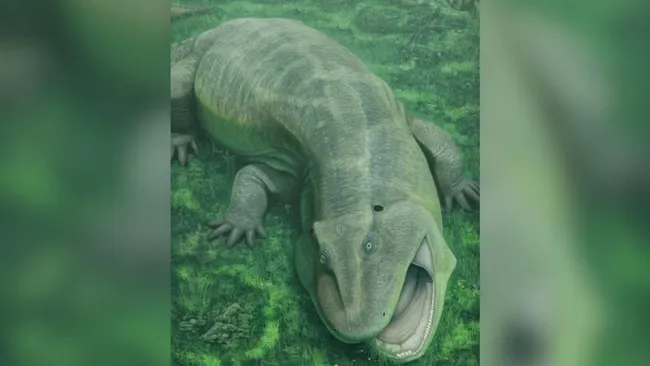
Paleontologists have uncovered a bizarre prehistoric animal with a twisted jaw and sideways-facing teeth — a creature so unusual that it was already considered a “living fossil” even during its own lifetime.
The newly described species, Tanyka amnicola, lived around 275 million years ago during the Permian period. Researchers say the aquatic animal belonged to an ancient branch of tetrapods, the group of four-limbed vertebrates that eventually gave rise to reptiles, birds, mammals and amphibians.
The findings were published in the scientific journal Proceedings of the Royal Society B.
An Ancient Survivor
Even though Tanyka lived long before the dinosaurs appeared, it was already an evolutionary relic.
By the Permian period, many early tetrapod lineages — known as stem tetrapods — had already gone extinct. But the lineage that produced Tanyka somehow persisted while newer and more modern tetrapods were evolving.
Lead researcher Jason Pardo from Field Museum compared the creature to modern evolutionary oddities like the platypus — species that retain traits from ancient branches of the evolutionary tree.
Fossils Found in Brazil
Scientists identified the species from nine fossilized lower jawbones discovered in a dry riverbed in northeastern Brazil.
Each jawbone measured about 6 inches (15 centimeters) long. Because only jaw fossils have been found so far, much about the animal remains unknown.
However, based on related species, researchers believe Tanyka may have looked somewhat like a large salamander with an elongated snout, reaching up to 3 feet (about 91 cm) in length.
The surrounding rock formations suggest it likely lived in freshwater lakes, indicating an aquatic lifestyle.
The Mystery of the Twisted Jaw
The most striking feature of Tanyka amnicola is its unusual jaw structure.
Instead of teeth pointing upward — as seen in most tetrapods — the lower jaw is twisted, causing the teeth to stick outward to the sides.
At first, researchers suspected the shape might be a deformation caused by fossilization. But after examining multiple well-preserved specimens, they confirmed the twist was natural.
A Unique Feeding Style
The inner side of the jaw contained a dense layer of tiny tooth-like structures called denticles, forming a grinding surface.
This unusual anatomy suggests the animal may have had a feeding strategy unlike other early tetrapods.
Researchers believe Tanyka likely ate:
- Small aquatic invertebrates
- Possibly plant material
If confirmed, this would be unusual because most known stem tetrapods were carnivores.
A Window Into an Ancient Ecosystem
When Tanyka lived, Brazil was part of the massive southern supercontinent Gondwana. Discoveries like this help scientists reconstruct ancient ecosystems and understand how early vertebrates interacted.
The species may reveal clues about:
- Early freshwater food webs
- How ancient tetrapods diversified
- What animals lived in Gondwana’s lakes and rivers
Even though scientists have only uncovered fragments of its skeleton, Tanyka amnicola offers a fascinating glimpse into a forgotten branch of vertebrate evolution — and proves that Earth’s prehistoric past was filled with creatures far stranger than previously imagined.