

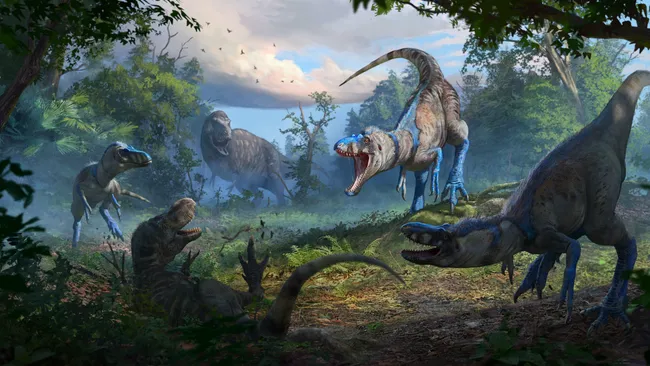
An argument over whether fossils from several small dinosaurs represent a juvenile Tyrannosaurus rex or smaller adults of a separate species may finally be settled.
New Fossil Evidence Confirms “Nanotyrannus” Was a Distinct Dinosaur — Not a Teenage T. rex
After decades of fierce debate among paleontologists, a groundbreaking new study has finally provided the most convincing evidence yet that Nanotyrannus — the so-called “mini T. rex” — was not a juvenile Tyrannosaurus rex, but a distinct species of tyrannosaur in its own right.
The discovery centers on a remarkably complete fossil from Montana’s Hell Creek Formation — part of the famed “Dueling Dinosaurs” specimen — that is rewriting what we know about the late Cretaceous predators that roamed North America 67 million years ago.
A Debate Four Decades in the Making
The controversy began in 1942, when a small tyrannosaur skull was uncovered in Montana and later named Nanotyrannus lancensis in 1988. For years, many experts dismissed it as the skull of a teenage T. rex, arguing that differences in size and bone structure were simply signs of immaturity.
“This has been one of the most controversial topics in all of dinosaur paleontology,” said study co-author Dr. Lindsay Zanno, a paleontologist at North Carolina State University and the North Carolina Museum of Natural Sciences.
Other finds, including a well-preserved skeleton nicknamed Jane, seemed to add fuel to both sides of the debate. Was Jane a teenage T. rex or proof that Nanotyrannus really existed as a smaller, sleeker predator living alongside its giant cousin?
The ‘Dueling Dinosaurs’ Reveal Their Secrets
Now, Zanno and co-author Dr. James Napoli of Stony Brook University have examined a new, nearly complete tyrannosaur skeleton entombed alongside a Triceratops — possibly locked in combat when both perished.
Their findings, published in Nature (Oct. 30), provide compelling evidence that the smaller tyrannosaur was a fully grown adult, not a juvenile T. rex.
By studying growth rings in the fossil’s bones, the team determined that the animal was around 20 years old at the time of death — near full maturity. Spinal fusion and bone histology confirmed that the skeleton belonged to an adult individual.
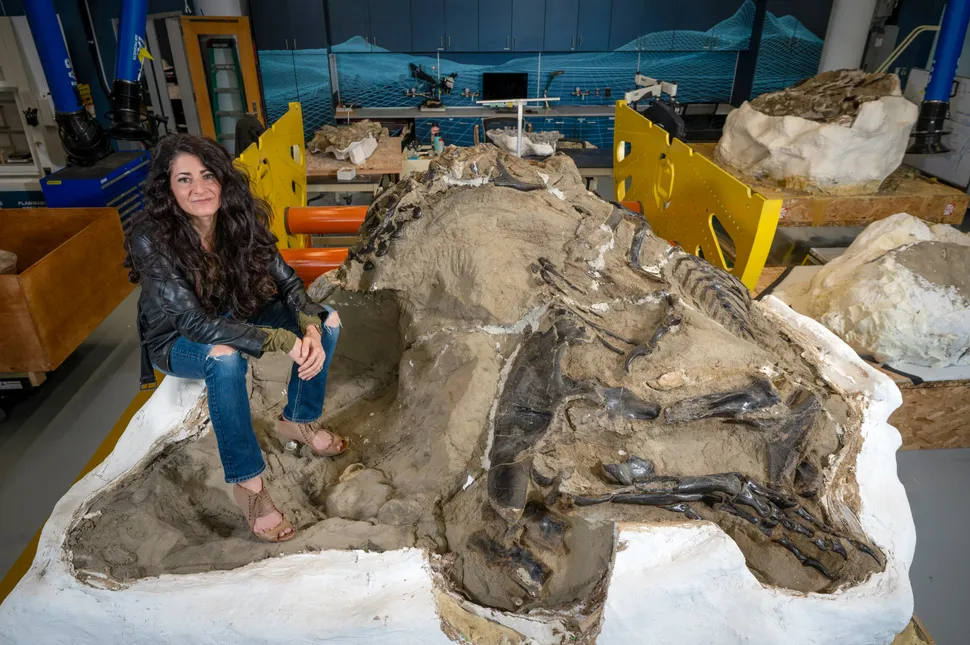
“We were able to take a thin section of the limb bones and determine that it was nearly full-grown — even though it was only half the length and about one-tenth the mass of an adult T. rex,” Zanno explained.
Small but Fierce: The Case for Nanotyrannus
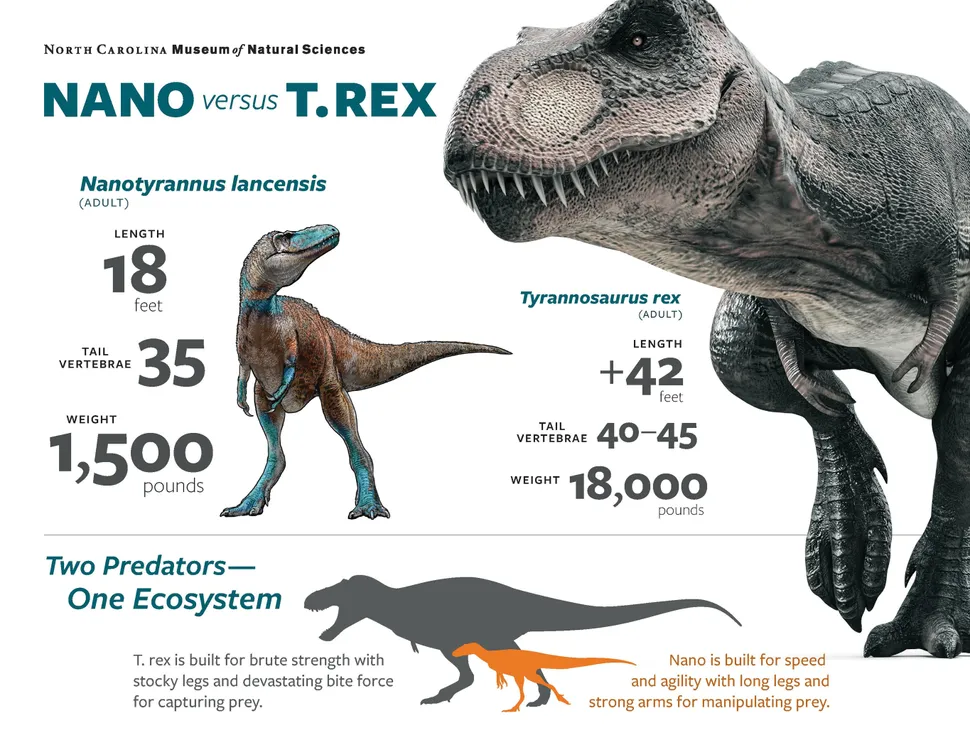
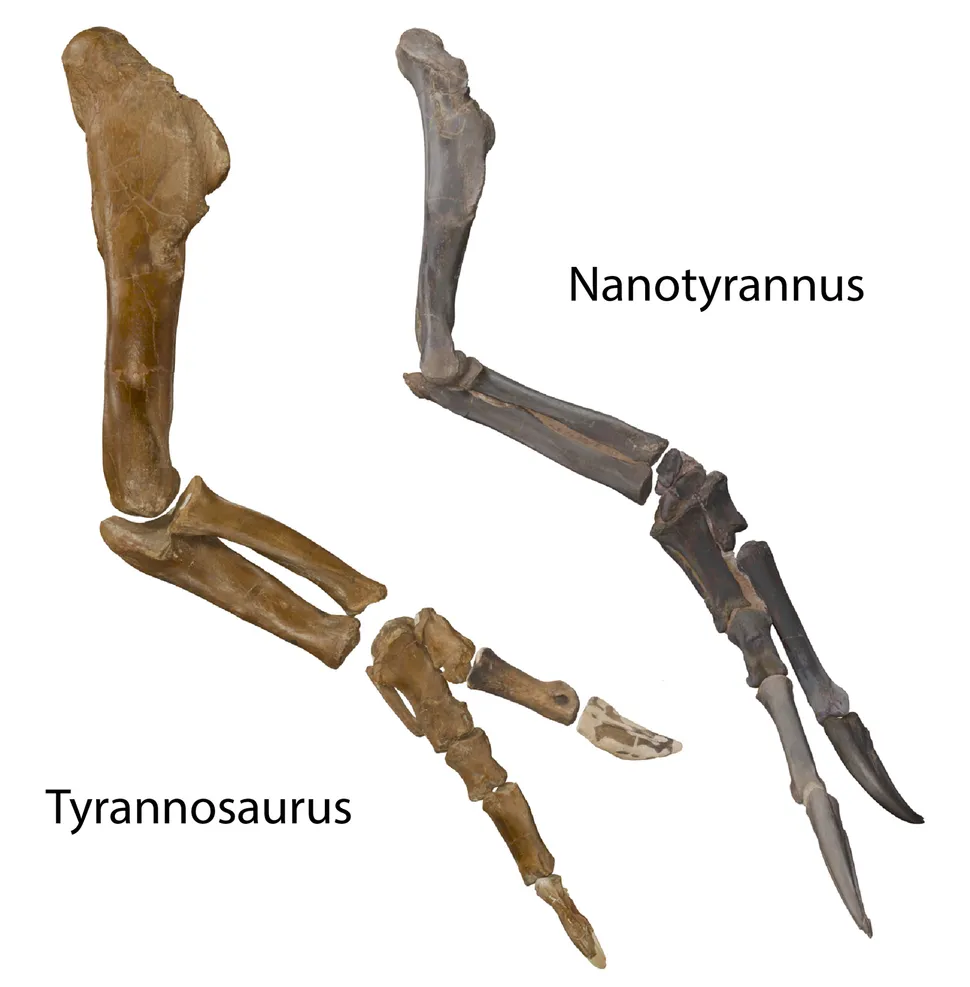
The differences between the two species go beyond size. The newfound specimen, believed to be N. lancensis, had:
- Larger forelimbs relative to its body
- More teeth packed into a narrower jaw
- Distinct skull nerve patterns
- Fewer tail vertebrae than T. rex
Weighing around 1,500 pounds (700 kilograms) — compared to a T. rex’s 15,000 pounds — Nanotyrannus was a nimble hunter, built for speed and agility.
While T. rex used brute force, crushing bones with its massive bite, Nanotyrannus likely relied on swift pursuit and precision, using its enlarged claws and longer arms to grasp prey.
“This was a sleek, fast, and deadly predator,” said Zanno. “Its ecology would have been completely different from the heavy-set, bone-crushing T. rex.”
A Shift in the Scientific Consensus
For years, many paleontologists rejected the idea of a “mini tyrant.” But the new evidence is changing minds.
“This really looks like an adult small skeleton,” said Dr. Dave Hone, a paleontologist at Queen Mary University of London. “It’s a big deal — we finally have an adult specimen that clearly isn’t T. rex.”
Dr. Steve Brusatte, of the University of Edinburgh, echoed that view:
“I’ve long believed the smaller tyrannosaurs were juveniles of T. rex, but this new fossil proves otherwise. The case for Nanotyrannus as a distinct species looks strong — I’d say proven beyond a reasonable doubt.”
Even Dr. Thomas Carr, who has long maintained that all these specimens were young T. rex, conceded, “They’ve shown decisively that the dueler is a small adult tyrannosaur.”
Carr still believes the animal should be renamed Tyrannosaurus lancensis, placing it as a close sister species rather than a completely separate genus.
The Mystery of “Jane” and a New Species
The researchers also reexamined Jane, another famous small tyrannosaur fossil, and found anatomical differences from both T. rex and N. lancensis. These include a unique sinus pattern and skull shape — leading the team to propose a second species, Nanotyrannus lethaeus, named after the mythological River Lethe.
However, this suggestion remains controversial. Some paleontologists, including Brusatte, argue that Jane was still growing and could easily represent a young T. rex.
A New Look at Late Cretaceous Ecosystems
If Zanno and Napoli’s conclusions hold, it means that multiple tyrannosaur species — not just T. rex — coexisted in western North America during the final million years before the mass extinction event.
“I don’t see a problem with that,” said Hone. “It actually makes sense — ecosystems usually support more than one large carnivore.”
This revelation forces a reexamination of T. rex growth and biology. For decades, scientists used “Nanotyrannus” fossils as benchmarks for how T. rex aged and developed. If those fossils belonged to different species, long-held models of T. rex growth now need revising.
“We have to rethink what we know about T. rex life history,” said Zanno. “For years, we’ve based our understanding on fossils that may not have been T. rex at all.”
A New Era for Tyrannosaur Science
The discovery is being hailed as a landmark moment in paleontology — one that may reshape our understanding of dinosaur evolution in North America.
“The overarching mic drop of this paper,” Brusatte said, “is that Nanotyrannus is real — a distinct species — and that realization forces a fundamental reassessment of tyrannosaur classification and evolution.”
For now, the “little tyrant” has stepped out of the shadow of T. rex — proving that even among the giants of the Cretaceous, there was room for more than one apex predator.