


Researchers have gained groundbreaking insights into rhinoceros evolution and the longevity of the North Atlantic Land Bridge after analyzing the perfectly preserved fossils of a “frosty” Arctic rhino discovered nearly four decades ago.
The fossils were first uncovered inside a 14-mile-wide impact crater on Devon Island in the Canadian High Arctic in 1986, but it has taken decades of careful study to unlock their secrets. The newly analyzed remains belong to a previously unknown species of hornless rhinoceros, which lived approximately 23 million years ago during the early Miocene epoch. Scientists have named the animal Epiatheracerium itjilik, with “itjilik” meaning “frost” in Inuktitut — a nod to both the Arctic conditions where the fossils were found and the remarkable preservation of the specimen.
According to Marisa Gilbert, a paleobiologist at the Canadian Museum of Nature (CMN) and co-author of the study, the fossil bones are in “incredible condition.” She explained, “They are three-dimensionally preserved and have only been partially replaced by minerals. About 75% of the skeleton was discovered, which is incredibly complete for a fossil.” This completeness has allowed researchers to reconstruct the rhino’s anatomy in detail, from its cranium and lower jaw to its teeth and limb bones.
The crater where the fossils were preserved formed after an asteroid or comet impact around the same time that E. itjilik lived. Water quickly filled the crater, creating a lake that protected the rhino’s remains from decay. At that time, the High Arctic was much warmer than today, with temperate forests dominating the landscape — a stark contrast to the frozen tundra of the present day.
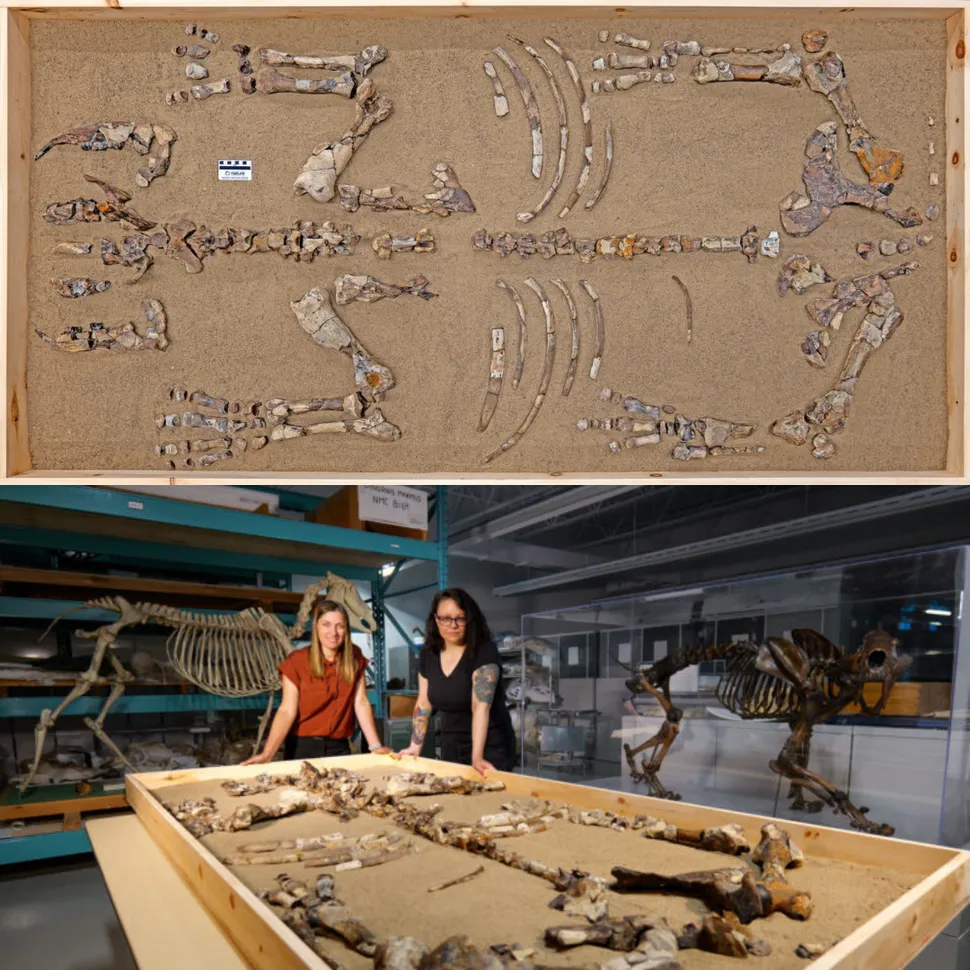
Over millions of years, freeze-thaw cycles gradually pushed the fossils closer to the surface, eventually allowing researchers to recover them. Subsequent expeditions to the crater also unearthed fossils of Puijila darwini, a walking seal that likely shared its habitat with the Arctic rhino. Together, these finds paint a vivid picture of a lush Arctic ecosystem populated by a diverse array of creatures.
By analyzing the characteristics of E. itjilik’s teeth, skull, and skeleton and comparing them to 57 extinct and living rhino species, researchers determined its evolutionary place. The study suggests that this Arctic rhino was most closely related to rhinos that lived in Europe before 23 million years ago. True modern rhinos (Rhinocerotidae) evolved about 40 million years ago in North America and Southeast Asia and eventually spread to every continent except South America and Antarctica. Danielle Fraser, the study’s lead author and head of paleobiology at CMN, said, “Today there are only five species of rhinos in Africa and Asia, but in the past they were found in Europe and North America, with more than 50 species known from the fossil record.”
Remarkably, E. itjilik is the northernmost rhinoceros ever discovered. Its presence in the High Arctic also provides new evidence about the North Atlantic Land Bridge, a former connection between Europe and North America via Greenland. While some studies have suggested the bridge disappeared around 56 million years ago, the arrival of rhinos in North America by 23 million years ago indicates that the land bridge likely persisted until at least the early Miocene. Fraser emphasized, “Our reconstructions of rhino evolution show that the North Atlantic played a much more important role in their evolution than previously thought.”
The discovery of E. itjilik not only fills gaps in the rhinoceros evolutionary tree but also provides insight into how ancient mammals dispersed across continents. Its fossils, preserved in extraordinary detail, offer a rare glimpse into life in a warm, forested Arctic and underscore the importance of long-standing land connections in shaping the distribution of species.
“This Arctic rhino gives us a snapshot of an ecosystem long gone and reminds us how much we still have to learn about the Earth’s past,” Fraser said. “Every fossil is a story waiting to be told, and this one has rewritten part of the history of rhinoceroses and the ancient North Atlantic.”