

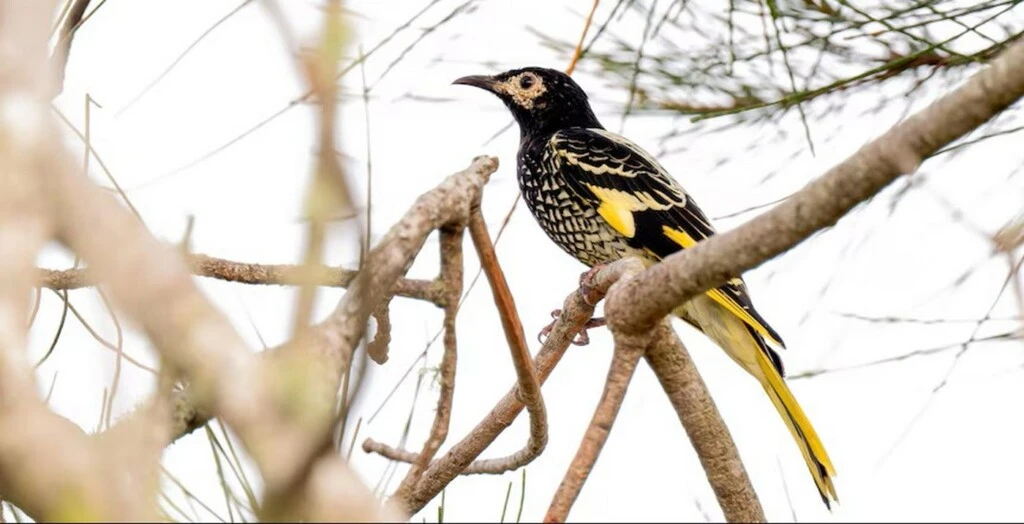
The critically endangered regent honeyeater has declined to 300 or fewer birds in the wild, and that drop has created an unexpected problem. Young males living in isolation have been found copying the calls of other honeyeaters and even entirely different bird species instead of learning the traditional song of their own kind.
That is a serious issue because the regent honeyeater’s song plays an important role in courtship. If males no longer sing the correct tune, it could become even harder for the species to reproduce and recover.
To address the problem, scientists at the Australian National University began giving captive birds what were essentially music lessons. Starting in 2021, the team played recordings of the species’ traditional call, known as the “Blue Mountains Typical,” which comes from the bird’s natural habitat in the highlands of New South Wales.
Researchers found that some wild birds were singing only fragments of this original song, likely because they had grown up with little contact with older regent honeyeaters who could teach them properly.
After early success with audio recordings, the conservation team took the effort a step further. According to behavioral ecologist Joy Tripovich, they brought wild adult males into nearby aviaries so younger captive birds could learn directly from a live tutor.
Tripovich explained that the breakthrough came from recreating what normally happens in nature, where young birds pick up songs through close interaction with experienced adults.
She said the first time the method worked was an unforgettable moment for the team, because hearing the young birds finally reproduce the proper wild song felt like a major victory.
Over time, the team refined the process and even learned how many young birds one adult tutor could effectively teach. Their results suggested that a single teacher could successfully pass the song on to about four or five students.
Now, the birds that master the correct song are being released into the wild, with researchers hoping they will help restore the natural calls of the regent honeyeater population.