

What used to be the old Buxton dump still shows signs of its past, but today it has transformed into a tangled, independent patch of woodland dominated by willow and birch. In summer, it is ringed with wildflowers and now supports around 870 recorded species, most of them insects. That richness is no accident, since willow and birch are two of the most valuable early-colonising trees for invertebrate life in Britain.
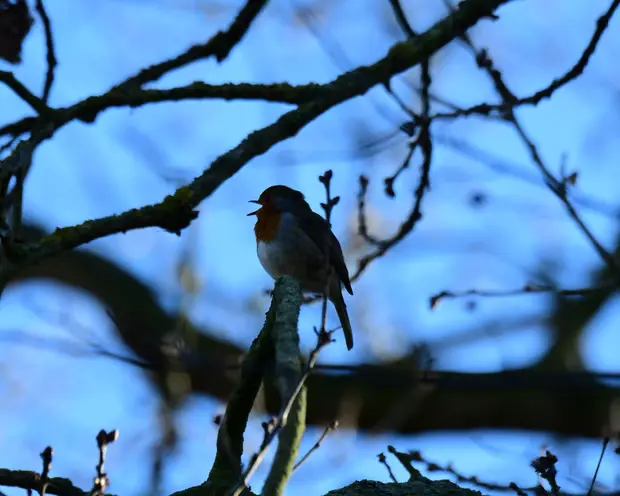
Where insects thrive, birds usually follow, because so much birdsong is powered by a diet rich in invertebrates. On a recent dawn walk, we identified 20 bird species already singing in early spring. Among them were song thrushes, mistle thrushes, dunnocks, wrens, bullfinches and greenfinches — several of which appear on the British Trust for Ornithology’s red or amber conservation lists.
To be honest, the phrase “dawn chorus” is not quite exact. One participant in the walk, who monitors badgers with his partner, pointed out that the singing really starts around 3:40 in the morning and reaches its peak by about 4:30, well before sunrise. And while “chorus” does fit in one sense, it also deserves a closer look.
These birds are not simply singing for beauty; they are announcing territory and trying to attract mates, so there is rivalry in the sound. Still, as Bernie Krause explored in The Great Animal Orchestra, the wider soundscape of a place often reflects a deeper kind of balance. Each species occupies its own part of the acoustic spectrum, and over countless generations natural communities have effectively learned to share the air. In that way, Hogshaw is harmonious in more than just a musical sense.
That is why it is so discouraging that High Peak borough council has introduced a jarring note into Hogshaw’s living symphony. The council deserves credit for recognising that Britain faces a nature emergency. Yet at the same time, it has shown no willingness to properly protect Hogshaw, instead wanting to keep it in a “land bank” for future development. Much of the site belongs to the council, and no other comparable urban area nearby supports such a wealth of wildlife. If a declaration of emergency is not followed by meaningful, restorative action, what does it really amount to?