

A Dangerous Discovery Beneath the Surface
Underwater photographers and free divers recently came across a mobula ray in serious trouble off the coast of Baja California, Mexico.
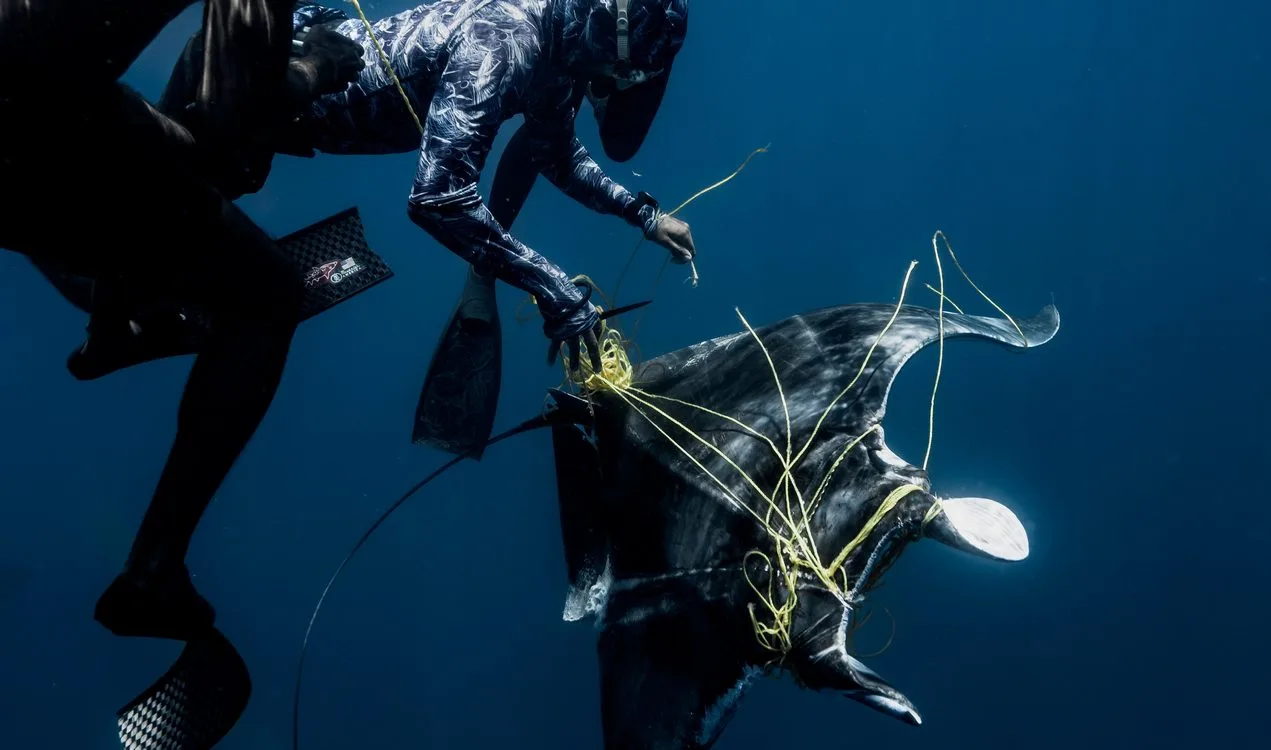
The ray was trapped more than 30 feet below the surface, completely tangled in thick rope attached to a shark fisherman’s buoy. To make matters worse, three silky sharks, each about 8 feet long, circled the scene as the rescue unfolded.
Racing Against Time
The group had been searching for marine life when they decided to investigate one of the floating buoys. That decision changed everything.
“Our guide jumped in to check the line,” said underwater photographer Andre Smits. “He popped up right away and said, ‘Guys, I need your help. There’s something stuck.’”
What they found was a distressed mobula ray, wrapped tightly in rope around nearly every part of its body.
A Delicate and Risky Rescue
Seven divers worked in shifts to free the animal. A free-diving trainer descended first, cutting the rope beneath the ray so the team could carefully lift it closer to the surface.
“It was completely entangled,” Smits said. “The animal panicked at first, trying to swim free. Then it seemed to realize it was stuck.”
Using dive knives, the team slowly cut away the rope. Every movement had to be precise. The artificial line could act like a blade if the ray suddenly bolted—and blood in the water would have attracted the sharks even more.
Understanding Mobula Rays
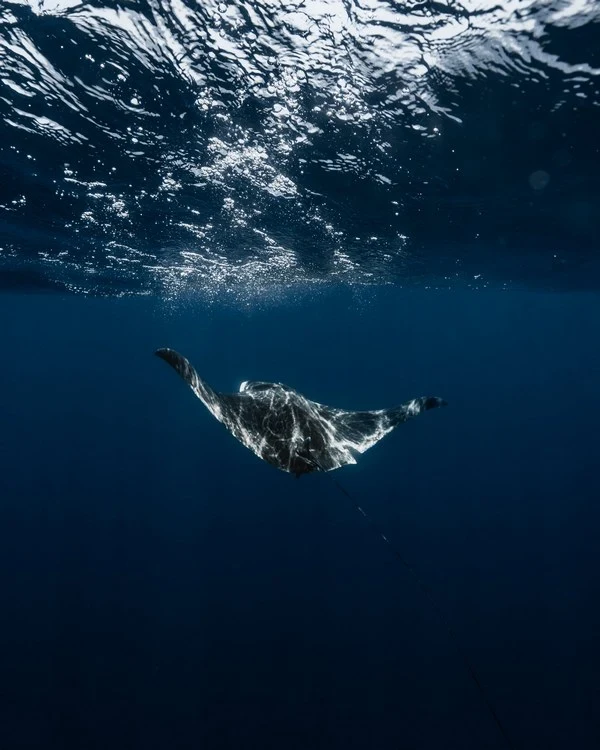
Mobula rays—also known as devil rays, flying rays, or eagle rays—are close relatives of manta rays. While smaller than mantas, they are far more diverse, with around 12 living species identified so far.
Like many marine animals, mobula rays are increasingly threatened by fishing gear, plastic waste, and ocean pollution.
An Unforgettable Moment
Once freed, the injured ray swam away, disappearing into the blue. The team assumed that was the end.
Then something extraordinary happened.
“She swam about 30 meters away,” Smits said. “Then it felt like she decided to come back.”
The ray returned, circling the divers and gliding close to their faces.
“She really came right between us,” Smits added. “It felt like a ‘thank you’—almost like a grateful hug.”
A Reminder of Human Impact
The ray survived its ordeal, carrying visible injuries but swimming strongly on its own.
For the divers, the encounter was both emotional and sobering—a powerful reminder of how human debris affects ocean life, and how compassion can sometimes bridge the gap between species.