

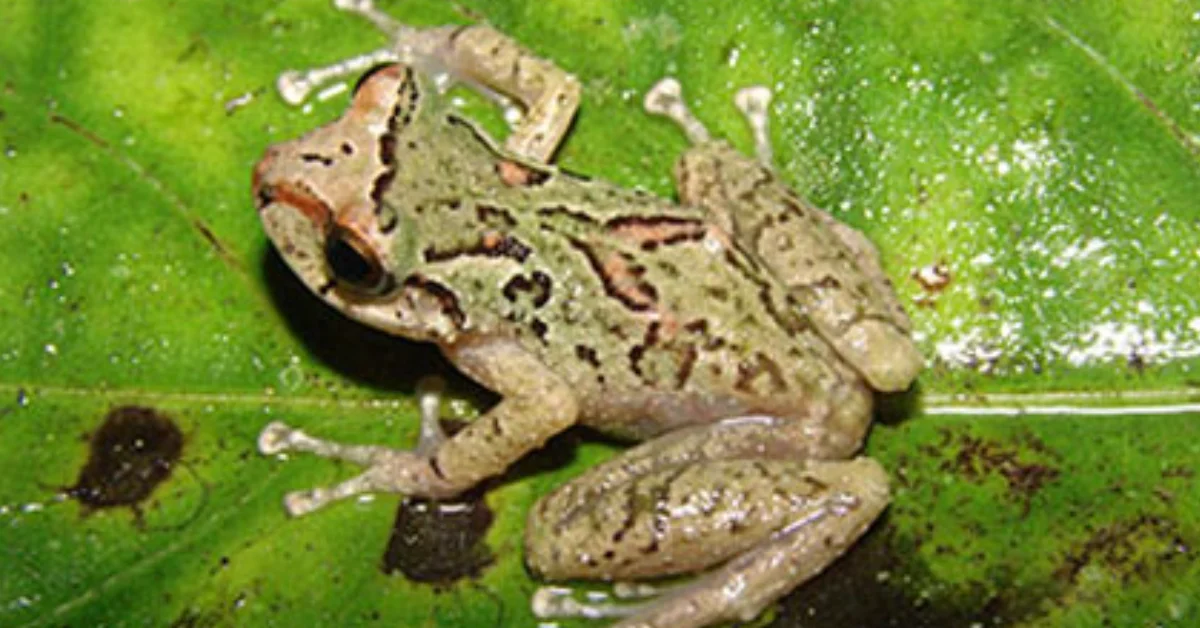
Deep in the forests and mountains of Peru, scientists are continuing to uncover species that have remained unknown to science — including five newly identified frogs that were recently discovered in the Peruvian Amazon.
The discoveries were made during years of fieldwork led by herpetologist Pablo J. Venegas, who serves as the Rainforest Partnership’s lead herpetologist in Peru. For nearly two decades, the organization has worked alongside Indigenous communities to protect rainforest ecosystems and combat deforestation.
At the same time, researchers have been exploring some of the country’s most remote landscapes, documenting amphibians and reptiles and trying to determine how vulnerable these animals may be to the threats facing their habitats.
Between 2021 and 2025, Venegas led teams on 10 expeditions across the Tropical Andes. Their journeys took them through isolated forests, remote mountain ranges and high-elevation grasslands in one of the most biologically diverse parts of the world.
The surveys revealed an extraordinary range of wildlife.
Researchers documented more than 80 amphibian species and over 30 reptiles, including approximately 50 frogs and 23 lizards that appeared to be previously unknown to science.
Many of those discoveries are still being formally studied. So far, scientists have officially described 20 of the newly identified amphibian species and eight reptiles in peer-reviewed scientific journals.
The latest findings add five more frogs to that growing list.
On October 16, Venegas and fellow researchers Luis A. García-Ayachi, Allesandro Catenazzi and Santiago Ron formally described five new species belonging to the Pristimantis lacrimosus group.
Their study was published in the scientific journal Zootaxa.
The researchers used several types of evidence to determine that the frogs represented distinct species. Their analysis included physical characteristics, genetic information and, for two of the species, differences in their calls.
The frogs could be distinguished from closely related species through a combination of traits, including the shape of their snouts, whether they had distinctive bumps around the nose, the texture of their skin, body size and patterns of coloration.
The newly described species are:
- Pristimantis basicordellum
- Pristimantis culmecordellum
- Pristimantis rhodocanthus
- Pristimantis solitarius
- Pristimantis aisatipoki
Together, the five frogs occupy a surprisingly broad range of elevations, from about 183 meters to 1,778 meters above sea level.
They were found across central Peru, from Amazonian lowlands in Huánuco to mountainous areas around Junín.
One of the frogs has a particularly meaningful connection to the conservation organization behind the expeditions.
The Rainforest Partnership highlighted Pristimantis aisatipoki after the species was formally described, noting that researchers first encountered it during a 2019 expedition in San Antonio, Satipo.
Satipo is especially significant to the organization because it is where the Rainforest Partnership’s conservation work in Peru began.
The frog lives in cloud forests and has so far been documented at three nearby locations along the Pampa Hermosa River. The known populations occur between approximately 1,466 and 1,723 meters in elevation.
Researchers observed the frogs calling after dark from leaves and branches of small trees and shrubs.
Even the species’ name carries a connection to the region.
According to the Rainforest Partnership, “aisatipoki” comes from the Asháninka language and refers to “those who arrive” or “those who settle.” The name was chosen to honor Satipo’s history and remarkable biodiversity.
The discovery is another reminder of how much remains hidden within tropical forests.
Although Peru is recognized as one of the world’s biodiversity hotspots, scientists continue to encounter species that have never been formally documented. In many cases, these animals can exist in highly localized habitats, making them particularly vulnerable if their forests disappear before researchers even know they are there.
For conservation groups, discovering a species is therefore only the beginning.
Understanding where an animal lives, how it behaves and how large its population is can provide researchers with the information needed to determine how it should be protected.
The Rainforest Partnership’s research has already contributed to 26 peer-reviewed scientific publications, with additional studies still underway.
Every newly identified frog adds another piece to the picture of Peru’s extraordinary biodiversity — and potentially another reason to protect the forests where these animals live.
As the organization has emphasized, conservation begins with knowledge.
If scientists don’t know a species exists, they cannot fully understand what could be lost when its habitat disappears.
For these five tiny frogs, being discovered may be the first step toward making sure they are not lost before the world has a chance to know them.