

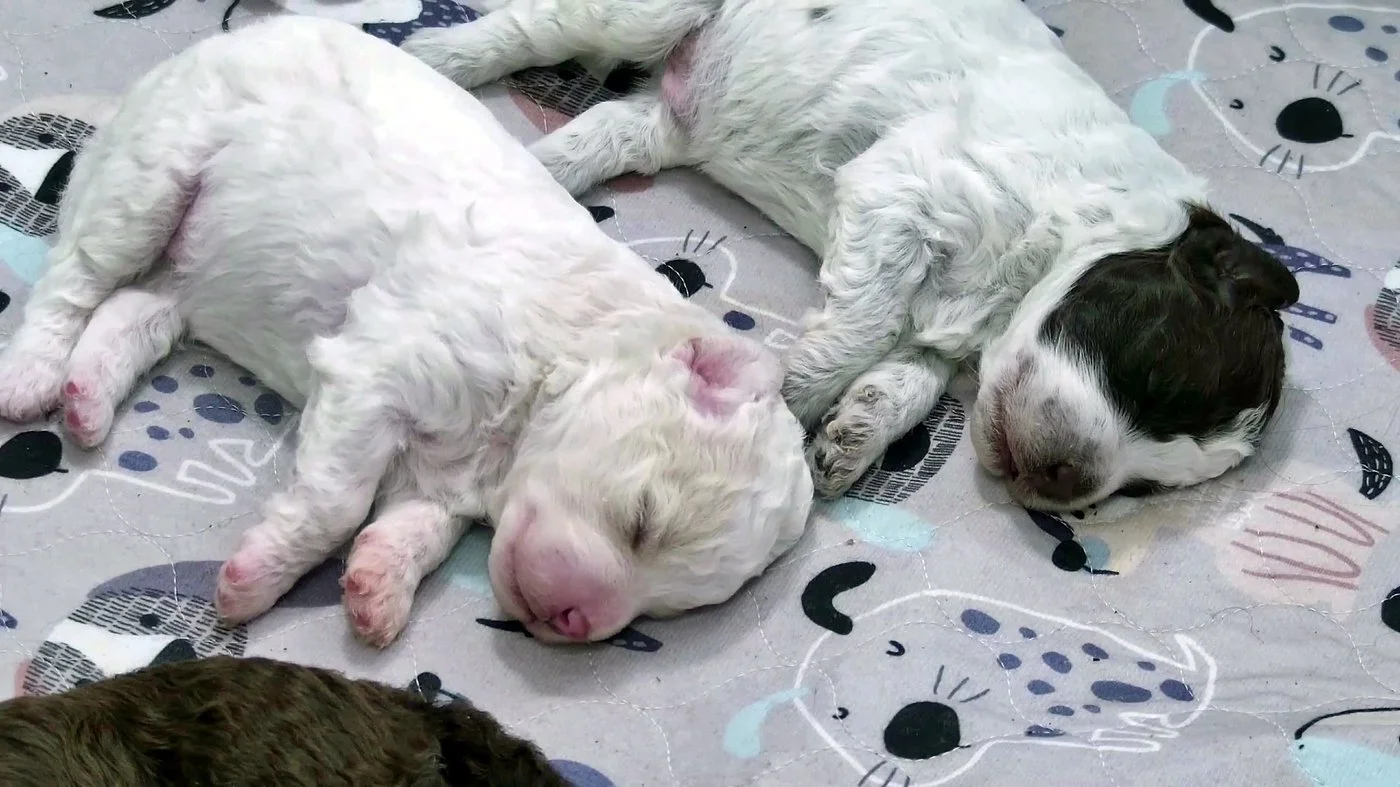
Six newborn puppies in Finland are spending their earliest days doing what newborn puppies do best: sleeping, nursing, squirming around and making tiny squeaks. But thanks to a round-the-clock camera, millions of people have been given a front-row seat to their first weeks of life — all in the name of science.
The puppies are being featured on “Pentulive,” a 24-hour livestream produced by Finland’s national public broadcaster, Yle. The Finnish word “pentu” translates to “puppy,” and the gentle, unhurried program has quickly become a sensation both in Finland and abroad.
For now, there isn’t much action. The puppies spend most of their time curled up together or feeding from their mother. Still, viewers have become fascinated by their gradual progress as they begin discovering the world around them.
Their mother, Hilkka, is a 5-year-old Lagotto Romagnolo who gave birth to six puppies on October 10. The litter consists of four boys and two girls, each with soft brown-and-white coats. By Thursday, they weighed approximately 1 kilogram (2.2 pounds) apiece.
Pirjo Koskinen, a Yle science journalist who developed the idea for “Pentulive,” said the puppies are already reaching some of their first important milestones. Their eyes and ears are beginning to open, and they are starting to experiment with their unsteady first steps.
The livestream is now in its sixth season, and it appears likely to set another viewing record. In less than two weeks, it had already collected more than 6 million social-media views in Finland, a country with a population of roughly 5.7 million people. A special ceremony to give the puppies their names is planned for Saturday.
Although watching puppies sleep may sound simple, Yle has built an educational project around the livestream. Scientists and journalists speak with viewers during online chat sessions several times a week, while podcasts and articles explain how the puppies’ bodies and behavior change as they grow.
That means viewers aren’t simply watching an adorable litter develop. They are also learning to recognize important stages in early canine development and following each puppy’s progress alongside the breeder and Yle’s science team.
And the project may offer benefits beyond understanding puppies.
For humans, watching young animals can produce a surprisingly strong emotional response. Koskinen explained that seeing the puppies struggle toward their mother for milk can increase levels of oxytocin in the human brain. Often called the “love hormone,” oxytocin is associated with social bonding and may also help ease feelings of anxiety.
For many viewers, however, the appeal is even simpler: the puppies offer a welcome break from an increasingly stressful world.
Jyri Loikkanen, the Yle producer behind “Pentulive,” said he sometimes watches the broadcast himself after finishing work. There is something comforting about seeing tiny noses, sleepy faces and constantly moving tails when the day’s news has been dominated by politics, economic concerns, conflict and war.
The livestream has therefore become more than a scientific observation. For its enormous audience, it provides a quiet little corner of the internet where nothing particularly dramatic happens — and that may be exactly why people love it.
The puppies are expected to leave for their permanent homes in mid-December. Their future owners are selected by the breeder before the livestream begins, and Yle has chosen not to reveal the breeder’s identity or location. The privacy measures are intended to keep attention focused on the puppies rather than the people caring for them.
“Pentulive” is part of a broader tradition known as slow TV, a style of programming built around real-life events unfolding naturally rather than fast-paced entertainment. The format gained international attention in 2009 when Norway’s public broadcaster NRK aired a seven-hour train journey in real time.
Since then, slow TV has appeared in countries around the world.
Sweden, for example, has used remote cameras to document “The Great Moose Migration,” allowing viewers to watch large groups of moose make their annual journey across the Ångerman River toward their summer grazing grounds.
Compared with a seven-hour train ride or a massive wildlife migration, six puppies sleeping in a pile might seem like a remarkably small event.
But for millions of viewers, watching those puppies grow one tiny milestone at a time has become a surprisingly joyful way to slow down.