

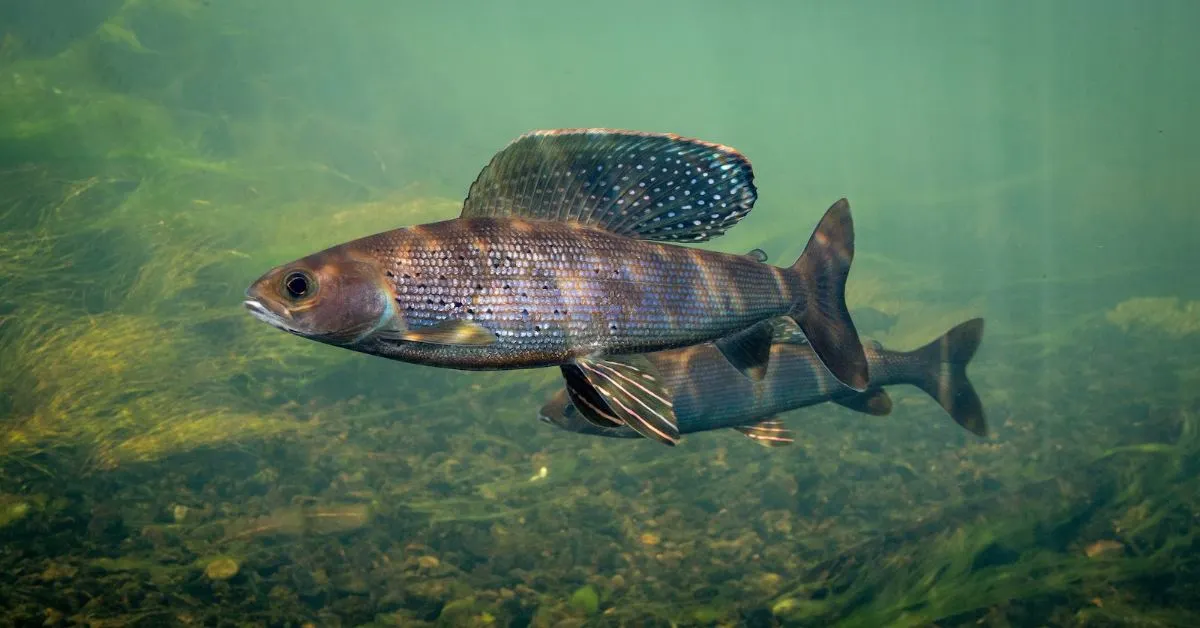
The young Arctic grayling swimming through tanks in northern Michigan may look ordinary at first glance. But when the light catches them just right, their distinctive shimmering colors become visible — a reminder of a fish that once thrived in Michigan’s rivers but has been absent for generations.
On a cool September morning, fish and wildlife biologist Sean Leask carefully counted and measured hundreds of the young fish at a streamside rearing facility operated by the Grand Traverse Band of Ottawa and Chippewa Indians near Traverse City.
Some of the fish could potentially reach a size suitable for anglers by the end of the following year, Leask said, although their eventual growth will depend heavily on how they adapt after being released into the wild.
That uncertainty is part of a much larger experiment.
Arctic grayling disappeared from Michigan waters nearly a century ago. By the 1930s, logging, overfishing and competition from introduced fish had contributed to the collapse of their populations.
Now, three northern Michigan tribes are working alongside the state to bring the species back.
For the tribes involved, the project is about much more than restoring a fish population.
“When we care for them and help them return, we’re also helping restore our own culture, traditions and connection to the land,” said Tina Frankenberger, the Grand Traverse Band’s tribal environmental resiliency lead.
The Michigan effort is part of a larger movement among Indigenous communities across the United States to restore native species that have deep cultural, ecological and economic importance. Similar projects have focused on salmon, oysters, condors and other animals whose survival is closely tied to the health of surrounding ecosystems.
But bringing a species back is rarely simple.
The Michigan tribes are now entering an important stage of the grayling project: determining whether the fish being released are actually surviving in the rivers.
During the summer and early fall, the Grand Traverse Band raised roughly 8,000 young grayling before releasing them into the Boardman-Ottaway River. The tribe is one of three northern Michigan tribal communities participating in the restoration effort, along with the Little River Band of Ottawa Indians and the Little Traverse Bay Bands of Odawa Indians.
The project has taken years of preparation and has received millions of dollars from state, federal and private sources.
The eggs used for Michigan’s restoration program originated in Alaska’s Chena River, where Arctic grayling remain abundant and retain greater genetic diversity than the species’ only surviving population in the Lower 48, located in Montana’s Big Hole River.
For the Grand Traverse Band, this year’s results already represent a major improvement.
A power failure at the tribe’s rearing facility the previous year killed most of its grayling. This time, the team produced roughly four times as many fish and was able to release a greater share of larger individuals.
For biologists, that’s encouraging because larger fish generally have a better chance of surviving after release.
But raising thousands of fish is only half the challenge.
The harder task may be finding them once they’re swimming freely through miles of river.
None of the three participating tribes has yet recaptured a released grayling.
Alex Ontkos, an inland fisheries biologist with the Little River Band of Ottawa Indians, compared the search to trying to find a single needle inside a haystack — except the haystack is an entire river.
The Little River Band took a different approach from the Grand Traverse Band. Earlier in the year, it placed approximately 391,000 grayling eggs into in-stream incubators along the Manistee River near Kalkaska.
Only about half to 60% of the eggs were expected to be viable. Even so, biologists watched tens of thousands of tiny grayling emerge from the incubators and enter the river.
So far, however, they haven’t been able to find the fish again.
Ontkos doesn’t necessarily see that as evidence of failure. The young grayling could simply be somewhere the survey teams haven’t reached at the right moment.
The search has been even more difficult for the Little Traverse Bay Bands of Odawa Indians.
Extreme weather has repeatedly disrupted parts of northern Michigan. Ice storms and major flooding have damaged areas of the watershed, leaving some sections difficult to access because of high water and piles of storm debris.
Kris Dey, the tribe’s hatchery manager, said locations that researchers spent years preparing have become difficult to reach, making it much harder to determine how the released fish are developing.
And weather isn’t the only climate-related concern.
Arctic grayling depend on cold water, which creates a significant challenge as Michigan’s rivers gradually become warmer.
Planning a restoration program around a future that is expected to be hotter is difficult, Dey said. The team is therefore considering ways to give the fish a stronger start before releasing them.
One idea is to improve the tribe’s existing egg-incubation system so the grayling can grow larger before entering the river. Giving them additional time to develop could improve their chances of surviving in the wild.
The project also illustrates a difficult reality of conservation: restoring a species once isn’t necessarily enough.
Other Indigenous restoration programs have successfully brought native fish populations back, only to face new questions about whether those populations can remain healthy as environmental conditions change.
Michigan’s grayling project is still in its early stages. Scientists believe it could take six to eight years before there is enough information to determine whether the reintroduction has truly succeeded.
For now, even a few encouraging signs matter.
Monitoring equipment along the Boardman-Ottaway River has detected signals from tags placed inside some grayling before their release the previous year.
There is a catch: researchers can’t yet prove that those signals came from living grayling. The signal might have originated from another animal, such as an otter that had eaten a tagged fish.
Still, Leask chooses to see the possibility as a reason for optimism.
There weren’t many signals, he said, but there were enough to provide a little hope.
The tribe plans to conduct studies examining predators next year, hoping to learn more about what may be happening to the grayling after they enter the river.
Later, after the young fish had been counted and measured, members of the Grand Traverse Band carried buckets of grayling into the North Branch of the Boardman-Ottaway River.
Before releasing them, Frankenberger scattered tobacco across the surface of the water as part of an Anishinaabe tradition. She explained that the practice helps their ancestors hear prayers more clearly.
She then offered a prayer and carefully tilted the bucket.
One by one, the young grayling slipped into the river and disappeared into the current.
For the people involved, the moment represented more than the release of another group of fish.
It was a symbolic return — the beginning of an attempt to reconnect a species with a river it had lost, and, at the same time, to strengthen an old relationship between the people and the waterways that have long been part of their culture.
Frankenberger said she likes to imagine that as the grayling rebuild their connection to the river, they may also help rebuild that connection for the people who have cared for them.
For now, the outcome remains uncertain.
But after nearly a century away, Arctic grayling are swimming through Michigan waters once again.