

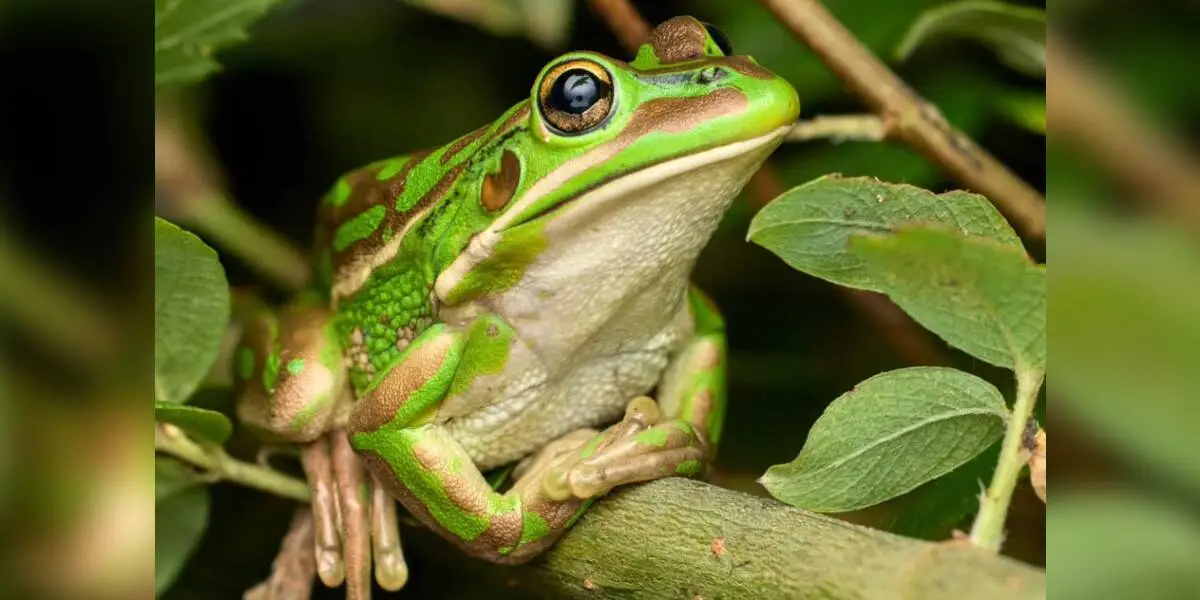
“At first, I thought it was a trick of the light …”
While examining green and golden bell frogs in Australia, conservation biologist John Gould noticed something he had never paid much attention to before: the skin on the frogs’ inner thighs seemed to shimmer and change color.
Gould, who works at the University of Newcastle, regularly monitors this vulnerable amphibian species. During a recent photography session, he observed that the frogs’ thighs reflected different colors depending on the angle from which they were viewed.
This effect, known as iridescence, occurs when light interacts with a surface in such a way that its color appears to shift as the viewing position changes. Two people looking at the same object from different angles may therefore see different colors at the same moment.
Initially, Gould wondered whether the colorful appearance was simply caused by lighting or moisture on the frogs’ skin. Iridescence is commonly associated with animals such as butterflies, beetles and hummingbirds, but it has rarely been recorded in amphibians.
However, the shimmering effect continued to appear in every frog he examined, including both males and females. After studying the animals more closely, Gould confirmed that the frogs’ inner thighs were genuinely iridescent.
The observation represents one of the strongest documented examples of iridescence in an amphibian. For Gould, the finding was especially surprising because he had worked with the species for a long time without fully recognizing this unusual feature.
Iridescent coloring is produced through a complicated biological process involving specialized structures inside the skin. Amphibians possess tiny crystal-like platelets that can reflect light and create structural colors. True iridescence develops when these platelets are arranged in an organized pattern rather than scattered randomly.
Gould now plans to examine samples of the frogs’ skin under a microscope. By studying how the tissues and crystal platelets are positioned, he hopes to better understand exactly how the color-changing effect is produced.
Researchers have not yet determined why the frogs developed iridescent thighs. One possibility is that the bright flashes of color serve as a defense mechanism. When threatened, a frog may suddenly reveal its colorful legs, potentially startling a predator or warning it that the frog could be unpleasant or dangerous to eat.
The discovery also highlights the importance of protecting green and golden bell frogs. Their populations have declined because of threats including invasive species, habitat pressures and deadly fungal diseases.
Gould hopes that greater awareness of the frogs’ remarkable appearance will encourage more people to appreciate and conserve them. His research shows that frogs can possess visual features every bit as striking as the metallic wings of butterflies or the shifting feathers of hummingbirds.