

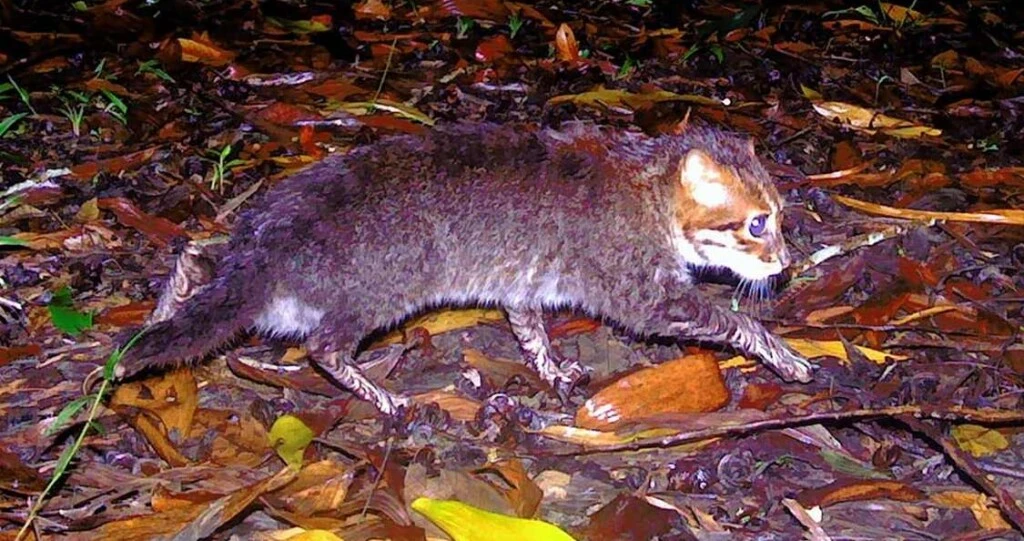
A rare and endangered wild cat native to Southeast Asia has been recorded in Thailand for the first time in three decades, according to the country’s wildlife authorities.
The elusive flat-headed cat, which depends on wetlands such as peat swamps, mangroves, and marshes, was long believed to have disappeared from Thailand. These habitats are remote and difficult to survey, contributing to fears that the species had vanished entirely from the country.
The last confirmed record of the cat in Thailand dated back to 1995. That changed recently when motion-activated cameras captured the animal in southern Thailand’s Princess Sirindhorn Wildlife Sanctuary. The camera trap survey documented 29 separate appearances, including footage of a female accompanied by her kitten — a promising sign for the species’ survival.
Thailand’s Department of National Parks, Wildlife and Plant Conservation announced the discovery alongside Panthera, a global leader in wild cat conservation.
While the finding has been celebrated, experts caution that it also raises serious concerns.
“The rediscovery is exciting, yet worrying at the same time,” said veterinarian and researcher Kaset Sutasha from Kasetsart University. “The next step is far more important — ensuring these cats can coexist with people without facing constant threats.”
Conservationists fear that decades of habitat loss and fragmentation may have left populations too isolated to maintain healthy breeding and sufficient hunting territory. Flat-headed cats are nocturnal predators that feed primarily on wetland species such as fish, frogs, and crustaceans, though they may also hunt rodents and occasionally poultry.
Perfectly adapted to aquatic environments, the species is known for its unusual hunting technique — fully submerging its head underwater to snatch fish.
Panthera’s focus on small wild cats gained renewed momentum in 2021 after businessman Jon Ayers, formerly the head of a major veterinary diagnostics company, joined the organization’s board, motivated by a personal interest in lesser-known feline species.
At the time, Panthera founder Dr. Thomas Kaplan explained that one of the biggest obstacles to protecting small wild cats is how little is known about them. Extensive camera-trap surveys, he said, were essential before effective conservation strategies could even begin — especially for animals as poorly studied as the flat-headed cat.
Panthera is widely respected for its work protecting iconic big cats such as lions, jaguars, and leopards. Conservation officials have often noted that if Panthera cannot safeguard a wild cat species, few organizations can.
In that sense, the most encouraging part of the discovery may not simply be that flat-headed cats still exist in Thailand — but that they were found by a group with the expertise and resources to help ensure their future.