

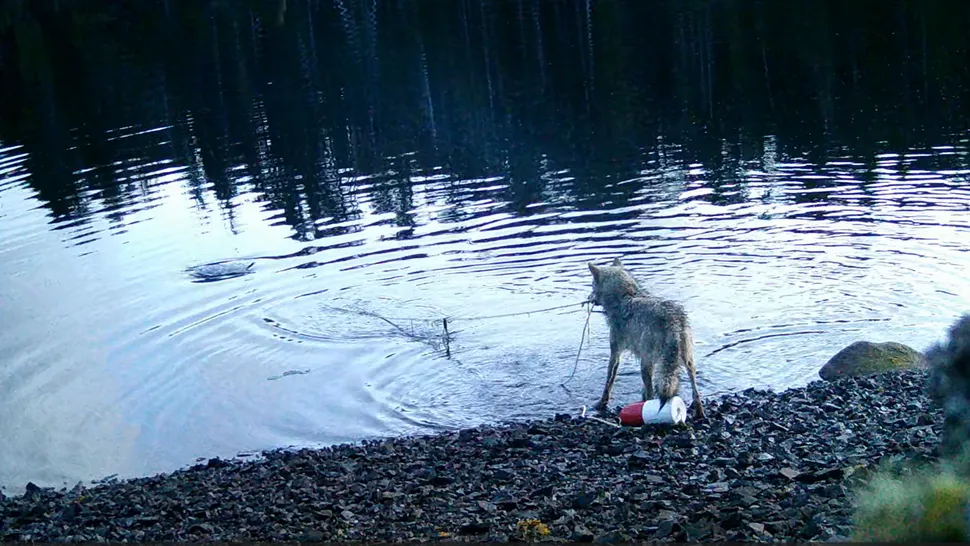
A video from the coast of British Columbia has revealed remarkable new behavior in wolves that could represent the first documented case of tool use by a wild member of the dog and wolf family — all for the sake of crab bait.
The footage shows a wolf swimming into deep water to retrieve a floating buoy connected to a submerged crab trap. Although the trap itself was hidden underwater, the wolf appeared to understand its presence and function. Once back on shore, it pulled in the line attached to the trap and successfully opened it to access the bait inside.
Wolves (Canis lupus) have been seen interacting with human objects before, but according to a study published Nov. 17 in Ecology and Evolution, this level of problem-solving is unprecedented for wild canids.
“This is a new dimension of wolf behavior we hadn’t observed before,” said Kyle Artelle, lead author of the study and assistant professor at the State University of New York College of Environmental Science and Forestry. “It highlights the intelligence of these animals and suggests there’s much more to learn about how they think and interact with their environment.”

The wolf in question is part of a population living within the Indigenous Haíɫzaqv Nation Territory, where coastal wolves frequently rely on marine resources. Researchers from the Haíɫzaqv Wolf and Biodiversity Project set up camera traps to investigate why crab traps used to control invasive European green crabs were being damaged. Initially, it was thought that marine mammals like seals or otters were responsible. However, within a day of deploying the cameras in May 2024, a wolf was recorded manipulating the trap.
Wolves are already known for their intelligence, but this behavior suggests a particularly sophisticated understanding of cause and effect. While domesticated dogs are well-documented tool users — for example, moving furniture to reach food — tool use has never before been observed in a wild canid. This makes the wolf’s actions potentially the first verified case.
The researchers caution that the wolf’s method may have been learned through trial and error, or by observing humans interacting with traps, but it still demonstrates an impressive cognitive ability.
Tool use in animals is generally defined as manipulating an object to achieve a specific goal with intent. While some behaviors, like pulling ropes, are sometimes excluded from this definition, the wolf’s use of the line to access the trap may qualify as a genuine example of tool use in the wild.
Camera traps remain in place in the Haíɫzaqv crab-hunting areas, and while no second incident has been fully captured yet, earlier footage hints that other wolves may be exploring similar strategies.