

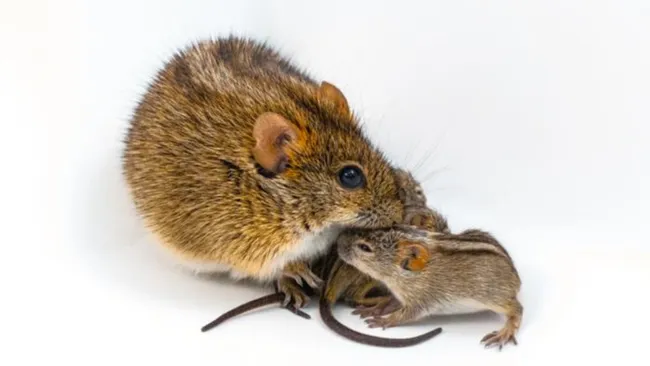
A new study suggests that flipping a single gene in the brain can transform devoted dads into aggressive attackers — at least in African striped mice.
But the gene doesn’t act alone. Social environment plays a powerful role in determining how fathers behave.
The research, published Feb. 18 in Nature, may help scientists better understand why paternal care is rare among mammals — and what biological mechanisms make some fathers attentive while others abandon or even harm their offspring.
Why Study Striped Mice?
Active fathering is unusual in mammals. Of the roughly 6,000 mammalian species, only about 5% involve males in raising young.
African striped mice (Rhabdomys pumilio) are especially useful for research because males show dramatic behavioral variation. Some cuddle and warm pups; others ignore them — and some attack.
In the study, researchers housed male mice either:
- Alone with pups
- In group settings with other fathers and pups
Males in group housing were significantly more likely to neglect or attempt to kill pups.
The Brain Region Behind Care
To investigate what drives this shift, researchers monitored brain activity after exposing males to pups.
They found that attentive fathers showed higher activity in a brain region called the medial preoptic area (MPOA) — long known to regulate maternal care in mammals.
Lead author Dr. Forrest Rogers of the Princeton Neuroscience Institute explained that decades of research have identified the MPOA as a central hub for parenting behavior.
Enter the Agouti Gene
When scientists examined gene activity inside the MPOA, one gene stood out: Agouti.
Agouti is typically known for its role in skin pigmentation and metabolism. Its involvement in parenting behavior was unexpected.
The researchers discovered:
- Males that attacked pups had higher Agouti activity in the MPOA.
- Males that cared for pups had lower Agouti activity.
To test whether Agouti truly caused the behavioral change, researchers artificially increased its expression using a viral injection. Afterward, formerly attentive males became aggressive toward pups.
The gene appeared to function as a behavioral “switch.”
But It’s Not That Simple
Despite the dramatic effect, Rogers cautioned that Agouti isn’t the whole story.
When males were moved from group housing into solitary cages, Agouti levels dropped — and caregiving behavior increased.
This suggests:
- Social environment influences gene expression.
- Behavior results from both genetics and context.
In other words, the switch is sensitive to surroundings.
What Does This Mean for Other Species?
While the findings are intriguing, researchers emphasize important limitations:
- The study examined only male African striped mice.
- There is currently no evidence that Agouti plays a similar role in humans or other mammals.
Still, the research opens new avenues for understanding how paternal care evolves — and why it remains rare across mammals.
A Window Into Evolutionary Parenting
For decades, scientists have understood maternal caregiving at a molecular level far better than paternal behavior.
This study suggests that fatherhood may hinge on specific neural circuits and gene expression patterns — but those systems are highly responsive to social conditions.
In African striped mice, a genetic switch can turn affection into aggression.
Whether similar biological levers shape fatherhood elsewhere remains a question for future research.