

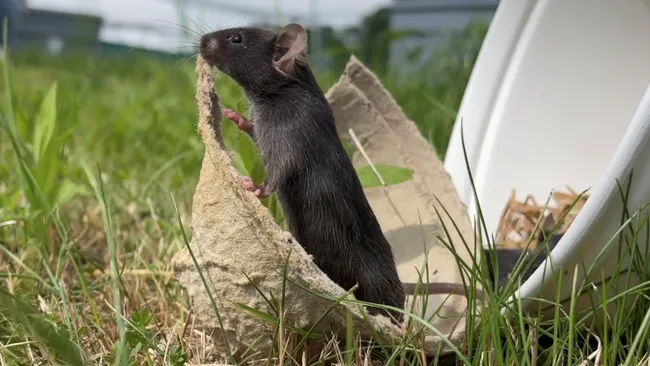
A new study suggests that mice raised in more natural, outdoor environments behave very differently from their caged laboratory counterparts — and that difference could have major implications for medical research.
The findings, published in Current Biology, hint that mice exposed to grass, dirt, weather and social complexity may be better models for studying human mental health and immune responses.
The “Touch Grass” Effect
Laboratory mice typically live in small, sterile cages with one or two same-sex companions. Food and water are delivered regularly, and predators are nonexistent. It’s a tightly controlled environment — but also an unusually sheltered one.
Matthew Zipple, a postdoctoral researcher at Cornell University and lead author of the study, questions whether this artificial setup contributes to the frequent mismatch between successful mouse trials and failed human drug trials.
“Why is there that huge gap between animal models and real-life human outcomes?” Zipple asked. “Much of it may be explained by this really artificial, standardized environment.”
To test this idea, researchers compared two groups of genetically similar lab mice:
- One group remained in standard indoor cages.
- The other group lived in outdoor enclosures with grass, dirt, exposure to sky, and complex social interactions.
Testing Anxiety in a Maze
The team used a common anxiety test called the elevated plus maze, which has:
- Two enclosed arms (safe spaces)
- Two open arms (exposed platforms)
Under bright lab lighting, cage-raised mice typically explore the open arms once, find them stressful, and then avoid them on future visits. This predictable behavior is widely used to measure anxiety levels.
But mice raised outdoors reacted very differently.
Outdoor mice showed little fear of the open arms. They continued exploring them across repeated visits, even under bright lights.
Even more striking, cage-raised mice that were moved outdoors for just one week showed a dramatic shift: their anxiety-like behavior dropped significantly, and they spent about twice as much time exploring open arms compared to mice that stayed indoors.
It’s Not Just Behavior — It’s Immunity
Behavior wasn’t the only difference.
Other research has shown that mice raised in naturalistic environments develop immune systems that look very different from those of cage-raised mice. Exposure to soil microbes, plants and diverse social contact alters immune responses in significant ways.
One cautionary example comes from 2006, when a drug called TGN1412 appeared safe and promising in lab mice. But when tested in healthy human volunteers, it triggered a severe and nearly fatal immune reaction.
Later studies suggested that standard lab mice responded differently to the drug than mice exposed to more natural environments — highlighting how simplified lab conditions may mask important biological responses.
The Trade-Off
Naturalistic enclosures are:
- More expensive
- Less tightly controlled
- Logistically more complex
They introduce variability — something biomedical researchers often try to eliminate.
However, Zipple and colleagues argue that incorporating more realistic living conditions could improve the translation of findings from mice to humans — potentially saving time and money in failed clinical trials.
Rethinking the “Standard” Mouse Model
The broader goal, Zipple says, is to identify:
- Traits that look similar in both lab and field conditions
- Traits that differ significantly
Understanding these differences could help researchers better predict which experimental results are likely to apply to humans.
Ultimately, the study raises an important question:
If lab mice live in environments that are biologically and psychologically unlike real life, how well can they model real human conditions?
Sometimes, it seems, touching grass really does change everything.