

Nature is often described through conflict: predators chasing prey, parasites exploiting hosts and species competing for the same resources. But there is another side to life on Earth that is just as important — cooperation between different species.
These partnerships are known as mutualisms. In a mutualism, two species interact in a way that benefits both of them. One well-known example is the relationship between leaf-cutter ants and fungi. The ants cannot digest leaves on their own, so they collect pieces of plants and use them to grow fungi inside their nests. The fungi receive food and protection, while the ants eat parts of the fungi to gain nutrients from the plants. Each species depends on the other to survive.
In his new book, The Call of the Honeyguide: What Science Tells Us About How to Live Well With the Rest of Life, Rob Dunn, a professor of applied ecology at North Carolina State University, explores these hidden connections throughout nature. His book looks not only at wild examples of mutualism, but also at the relationships humans have with other species, including dogs, cats, farm animals, food-producing microbes and the bacteria living inside our bodies.
Dunn explains that mutualism is usually defined as a relationship between two species in which both gain an advantage. Ecologists often measure that advantage by asking whether the partnership helps the organisms survive and reproduce. But when humans are involved, the question can become more complicated. What does it mean for a relationship between humans and dogs, wheat, cows or gut microbes to be truly beneficial?
For Dunn, the basic idea is that two species can sometimes do better together than they could alone.
His interest in mutualisms began early in his scientific career, especially during time spent in tropical environments where these relationships are often easy to observe. While nature is commonly portrayed as harsh and competitive, Dunn became fascinated by the many ways living things form partnerships.
He believes this topic is especially important now because modern life has made humans less aware of how connected they are to the rest of the living world. As people spend more time indoors, online and focused on screens, they may overlook the species they still rely on every day.
Dunn also draws on archaeology and anthropology to show that human relationships with other species have varied widely across history and culture. For example, our ancient relatives depended on fruiting trees, and those trees benefited when primates spread their seeds. Even today, humans continue to benefit from plants, though the relationship has changed over time.
Some mutualisms are even more complex. In certain places, humans and dolphins cooperate while fishing. Dolphins help herd fish toward people, and when the humans cast their nets, the dolphins also gain access to food. In these cases, the dolphins may even be the ones leading the interaction.
Other mutualisms began without either species consciously planning them. Humans, for example, developed relationships with yeasts and bacteria through fermented foods and drinks. Ancient people may have chosen fermented fruit because it provided extra calories or flavor, while the microbes benefited by being spread and maintained by humans.
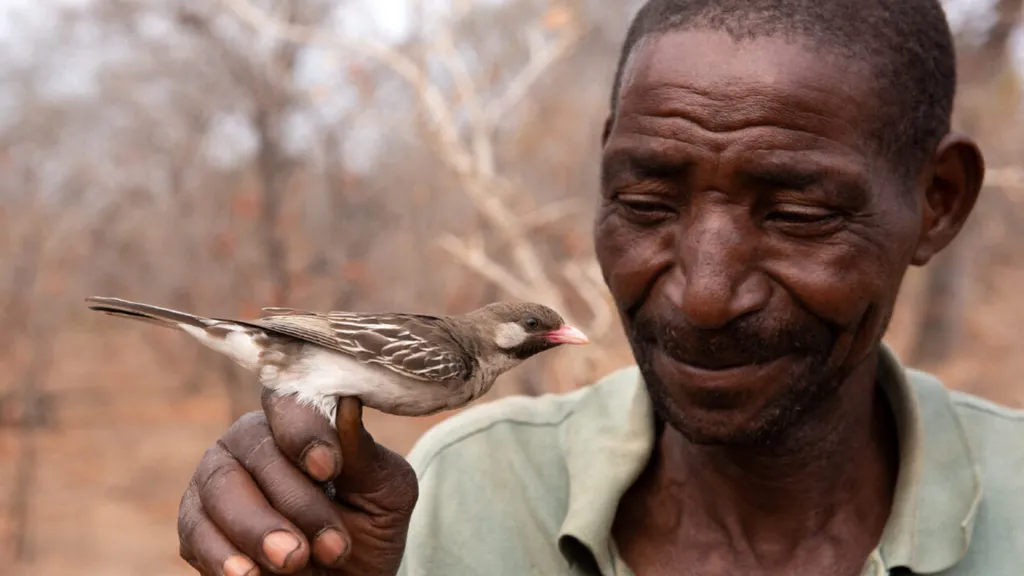
The honeyguide bird, which gives Dunn’s book its title, offers one of the most striking examples. Honeyguides live in parts of sub-Saharan Africa and eat beeswax, but they cannot easily open beehives alone. So they guide humans to hives using special calls and flight patterns. Humans collect the honey, and the birds feed on the leftover wax.
To Dunn, the honeyguide represents something larger: nature calling to people and asking them to respond. The question is whether modern humans are still paying enough attention to notice.
Dunn’s message is simple but powerful. He encourages readers to reconnect with the living world around them — the trees, insects, animals, microbes, pets and plants that shape daily life. In a time when many people feel isolated, he argues that connection with other humans matters, but connection with other species matters too.
For most of human history, people lived surrounded by other forms of life. Today, many are more separated from nature than ever before. Dunn hopes his book reminds readers that humans are not alone, and never have been. We are part of a vast network of relationships, many of them cooperative, that make life possible.