

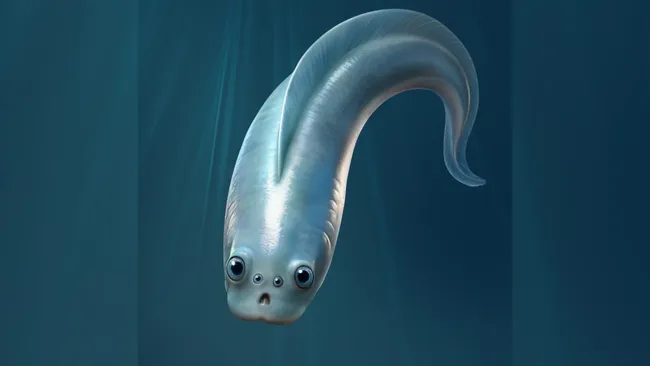
Half a billion years ago, some of the earliest vertebrates may have relied on not two — but four — eyes to survive in the predator-filled Cambrian oceans.
New fossil research from southern China suggests that ancient jawless fish called myllokunmingids were equipped with two large eyes on the sides of their heads and two smaller eyes positioned between them.
Scientists say this discovery reshapes how we understand the visual sophistication of our earliest ancestors.
“This changes how we think about the early evolution of vertebrates,” said Jakob Vinther, a macroevolution researcher at the University of Bristol. “It turns out our ancestors were visually sophisticated animals navigating a dangerous world.”
Who Were the Myllokunmingids?
These eel-like creatures lived around 518 million years ago during the Cambrian period — a time when complex predators were beginning to dominate marine ecosystems.
Two species examined in the study include:
- Haikouichthys ercaicunensis
- An unnamed species within the myllokunmingid group
The fossils were discovered in the Chengjiang fossil beds in China, a site famous for preserving delicate soft tissues — including rare eye structures.
Not Just Extra Spots — Fully Functional Eyes
Using high-powered microscopes and chemical analysis, researchers confirmed that the smaller, centrally positioned eyes were not decorative or vestigial.
They had:
- Circular shape
- Light-absorbing pigments
- Lenses capable of forming images
In other words, these weren’t primitive light sensors — they were working eyes.
Study lead author Peiyun Cong described the discovery as a complete surprise.
Seeing two additional, functional eyes nestled between the larger ones was “incredibly exciting,” the research team noted.
Why Four Eyes?
During the Cambrian, oceans were becoming increasingly dangerous as large predators evolved. A wider field of vision would have offered a survival advantage.
Four eyes likely meant:
- Better predator detection
- Enhanced awareness in multiple directions
- Improved reaction time in open water
For small, soft-bodied vertebrates, that could mean the difference between life and becoming lunch.
The Origin of Our “Third Eye” and Sleep Gland
Perhaps the most fascinating part of the discovery is what those extra eyes may have become.
Modern reptiles, amphibians and some fish possess a parietal eye — sometimes called a “third eye” — that can detect light but does not form images. This structure is connected to the pineal gland.
In humans, the pineal gland regulates melatonin production and controls sleep cycles.
Researchers believe the smaller pair of eyes in myllokunmingids represent the ancestral form of this system.
“What we’re seeing is that the pineal organs began as image-forming eyes,” Cong explained. “Only later in evolution did they shrink, lose visual power, and take on their modern role in regulating sleep.”
A Cute Beginning to a Complex Lineage
Humans trace their lineage back to these early vertebrates. While most vertebrates today have two eyes, it seems our distant ancestors briefly experimented with four.
The discovery highlights how evolution repurposes structures over time — transforming a predator-spotting eye into a hormone-regulating sleep center.
Half a billion years ago, survival required seeing everything.
Today, one of those ancient eyes helps us close ours at night.