

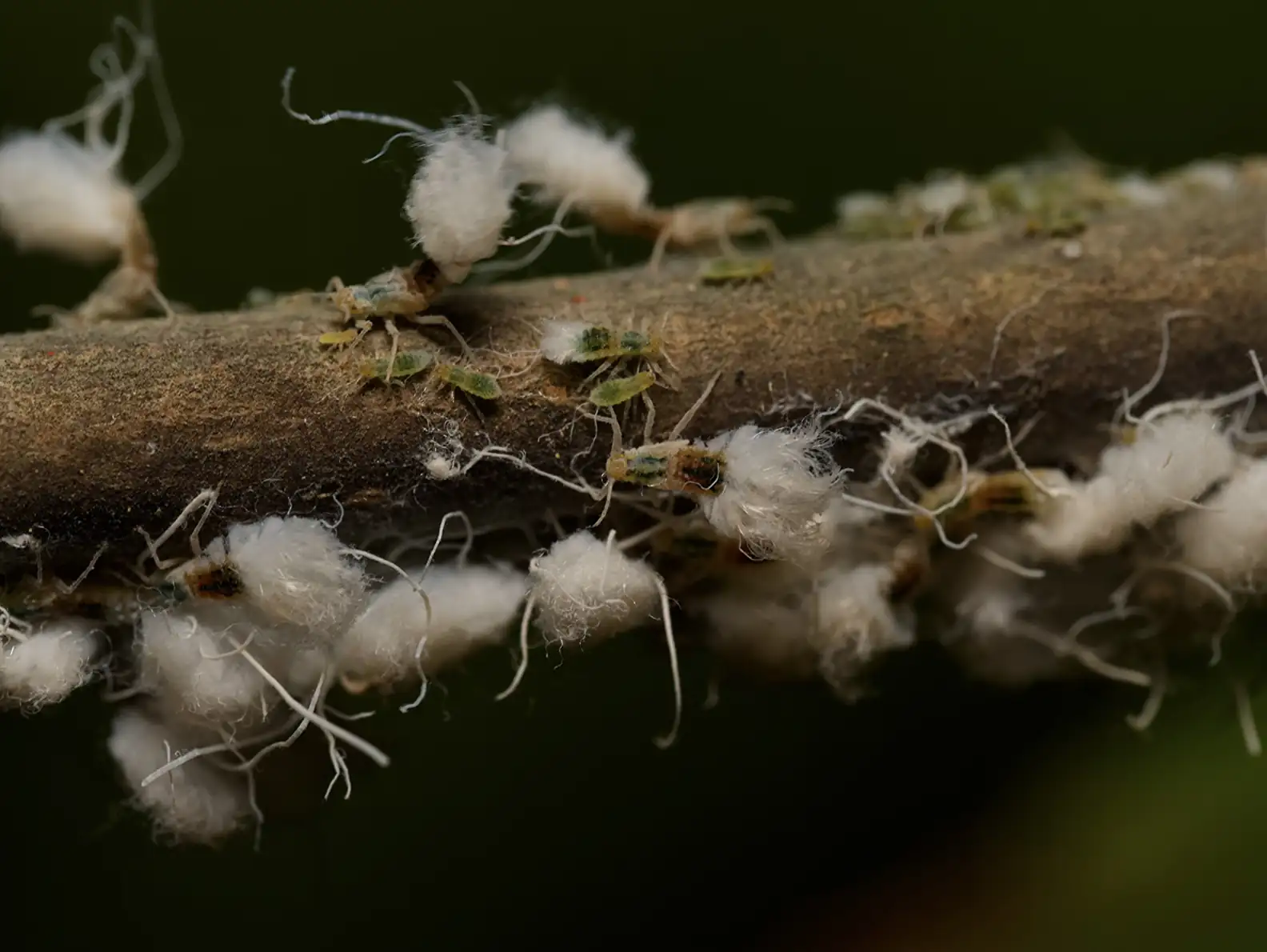
“I couldn’t even believe what I was seeing …”
Matt Jacobsen, an Ohio resident with a passion for macro photography, was taking a walk through a nature reserve near his home when he noticed a tiny aphid on the ground. Intrigued by the little insect, he stopped to take a closer look through his camera.
But as Jacobsen focused on the aphid, something else caught his attention. Nearby, a small twig appeared to be moving, and when he looked more closely, he realized it was covered in dozens of tiny white insects.
Curious, he picked up the twig. What happened next was something he had seen in videos before but never witnessed with his own eyes.
Suddenly, the insects began swaying back and forth in perfect unison. Their synchronized movements looked almost like a carefully choreographed dance, with the entire group moving together as if following the same rhythm.
“[W]hen I saw it, my first reaction was I couldn’t even believe what I was seeing because it just looked so unnatural,” Jacobsen told The Dodo.
He soon recognized the tiny performers as beech blight aphids. He already knew about their unusual dancing behavior, but seeing it happen right in front of him was an entirely different experience.
“I had seen videos of aphids doing their dance before on Instagram, but I’d never seen it before in person,” Jacobsen said.
The sight might look like something from a science-fiction movie, but this peculiar performance is actually a known behavior of the species. And while the insects may appear to be dancing simply for fun, researchers believe their synchronized movements could serve an important purpose.
One leading theory is that the unusual display helps protect them from predators.
“Scientists don’t really have a perfect explanation for why they do the dance, but the main theory is that … by doing their dance, it makes them a harder target for these predators,” Jacobsen explained.
When an insect-eating predator approaches, a group of aphids moving together may be more difficult to target than individual insects sitting still. Their coordinated movements could make it harder for a predator to single one out.
And dancing isn’t their only defense.
Beech blight aphids also produce a waxy substance that can help protect them from being eaten. The sticky material covering Jacobsen’s twig was a clue to this second line of defense.
“[T]hat substance [exists] so that when a predator such as a ladybug tries to grab the aphid, they just get a mouthful of wax,” Jacobsen said.
In other words, even if a predator manages to get close enough to strike, the aphids have another trick that may help them escape.
Despite their reputation, these tiny insects aren’t necessarily the destructive pests people might imagine when they hear the word “aphid.” Beech blight aphids are native to North America, and Jacobsen explained that they don’t have any major negative impacts.
“[T]hey’re a native species and they don’t have any major negative impacts,” he said.
Their strange synchronized movements have even earned them a playful nickname: “boogie-woogie aphids.”
It’s easy to understand why. Watching dozens of tiny insects sway together is an unexpectedly mesmerizing sight, especially when you realize that what looks like a miniature dance performance may actually be part of their survival strategy.
For Jacobsen, the encounter was a reminder of how much there is to discover in the natural world, even on an ordinary walk close to home.
“The movement that they make is honestly really mesmerizing,” he said.
Sometimes, the most fascinating wildlife encounters don’t involve large or exotic animals. Sometimes, all it takes is a tiny insect, a fallen twig and a curious person willing to stop and look a little closer.