

For the first time ever, researchers have managed to sequence RNA from a woolly mammoth — overturning the long-held belief that this delicate molecule couldn’t survive for tens of thousands of years.
RNA, or ribonucleic acid, serves as the intermediary between DNA and the cell’s protein-making machinery. It reveals which genes are active at specific moments and how those activity patterns shift, offering scientists a way to understand the cellular state of long-extinct organisms. While ancient DNA studies have advanced rapidly in recent decades, ancient RNA work has remained extremely limited due to RNA’s fragile, single-stranded structure.
“DNA gives you the blueprint, but RNA tells you how that blueprint was being used,” said study co-author Zoé Pochon, a doctoral researcher at Stockholm University. Messenger RNA (mRNA), she explained, carries instructions from the nucleus to the cell, where proteins are built.
The new study, published Nov. 14 in Cell, analyzed ten exceptionally preserved woolly mammoth (Mammuthus primigenius) specimens recovered from Siberian permafrost, dating from roughly 10,000 to 50,000 years ago. The deep freeze offered the researchers their best chance at retrieving intact RNA.
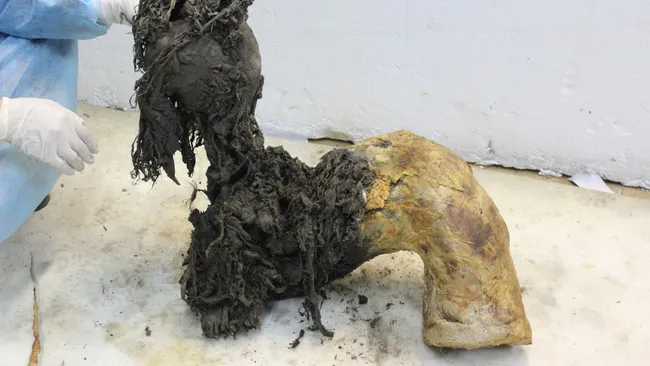
One juvenile mammoth in particular — Yuka, known for her reddish coat and impressive preservation — produced extraordinary results. At around 39,000 years old, Yuka now represents the oldest RNA sample ever sequenced, far surpassing the previous record of a roughly 14,300-year-old canid.
Unexpectedly, the genetic signals revealed through the RNA confirmed that Yuka, long assumed to be female based on appearance, was actually male.
The RNA also preserved details about Yuka’s muscle physiology — including transcripts responsible for proteins that control muscle contraction and relaxation. Lead author Emilio Mármol Sánchez, who conducted the work at the Center for Evolutionary Hologenomics at the University of Copenhagen, said the team also identified numerous regulatory genes still detectable within the tissue.
Because RNA captures the final activity of a cell before it dies, these molecular traces offer a moment-in-time snapshot of Yuka’s biological state. Intriguingly, the researchers found signs of metabolic stress in the mammoth’s muscle cells. This aligns with a 2021 study reporting claw marks likely left by cave lions (Panthera spelaea) and bite marks from smaller scavengers on Yuka’s body — though whether he was killed or scavenged after death remains unclear.
Paleogenomicist Federico Sánchez Quinto of UNAM, who was not part of the project, called the study a major milestone. Recovering RNA at such great age and in such abundance, he said, was once considered nearly impossible given the molecule’s extreme instability.
The discovery demonstrates that ancient RNA can indeed be preserved long-term and opens the door to a powerful new dimension of extinct-species research. The authors also provide a methodological guide to help other scientists attempt similar recoveries.
“Being able to extract RNA from ancient tissues — alongside DNA — is like opening an entirely new window into the biology of lost species,” said co-author Love Dalén, professor of evolutionary genetics at Stockholm University’s Centre for Palaeogenetics. “It lets us identify which genes were active in specific cell types and ultimately helps us understand what made a mammoth truly a mammoth.”