

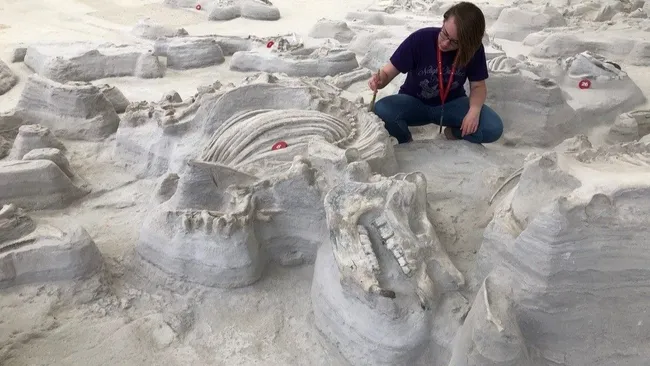
Researchers have found footprints of large, bone-crushing dogs in the 12 million-year-old Ashfall Fossil Beds in northeastern Nebraska, suggesting these large carnivores may have survived a cataclysmic Yellowstone eruption that covered parts of North America in ash.
Ancient footprints discovered in Nebraska have revealed that large, bone-crushing dogs roamed North America after a catastrophic Yellowstone supereruption around 12 million years ago. The tracks were found at the Ashfall Fossil Beds in northeastern Nebraska, a site often called “Rhino Pompeii” because it preserves the remains of many extinct rhinoceroses that were killed by heavy volcanic ashfall.
The footprints were discovered above layers containing skeletons of an extinct rhino species known as Teleoceras. This placement suggests that the dogs survived the eruption and moved through the area after many other animals had already died. The discovery provides the first direct evidence that large carnivores were present at the site, something scientists previously found surprising given the abundance of preserved prey animals but lack of predator remains.
According to Ashley Poust, a curator of vertebrate paleontology at the University of Nebraska State Museum, the Yellowstone eruption was so powerful that ash fell like snow more than 1,000 miles from the volcano. The ash would have darkened the sky, buried vegetation and water sources, and caused severe breathing problems for many animals.
The footprints measure up to 3.2 inches long and about 3 inches wide, matching those of extinct dog-like predators such as Aelurodon taxoides and Epicyon saevus. These animals were powerful carnivores capable of crushing bones, much like modern hyenas. Their tracks appearing above the rhino layers indicate that they may have outlived the initial environmental collapse.
Poust explained that the survival of large predators after such a disaster is unexpected, as animals at the top of the food chain usually struggle when ecosystems collapse. Their presence offers valuable insight into how life responds and adapts after major environmental catastrophes.
The footprints were uncovered during excavations in 2014 and 2023 and have since been laser-scanned in public view at Ashfall Fossil Beds State Historical Park. Although the findings have not yet been peer-reviewed, they were presented at the 2025 Society of Vertebrate Paleontology annual meeting in Birmingham, England.
Millions of years ago, the area resembled the African savanna, with a seasonal lake attracting many animals, including camels, horses, birds, turtles, and herds of short-legged rhinos. Researchers believe the dogs may have returned repeatedly to the site, possibly scavenging the remains of animals that died during the eruption.
While no bones of these predators have yet been found, scientists suspect they may have survived by feeding on carcasses buried beneath the ash. Further research will be needed to determine whether these animals were able to persist in the devastated landscape or eventually moved on to other areas.