

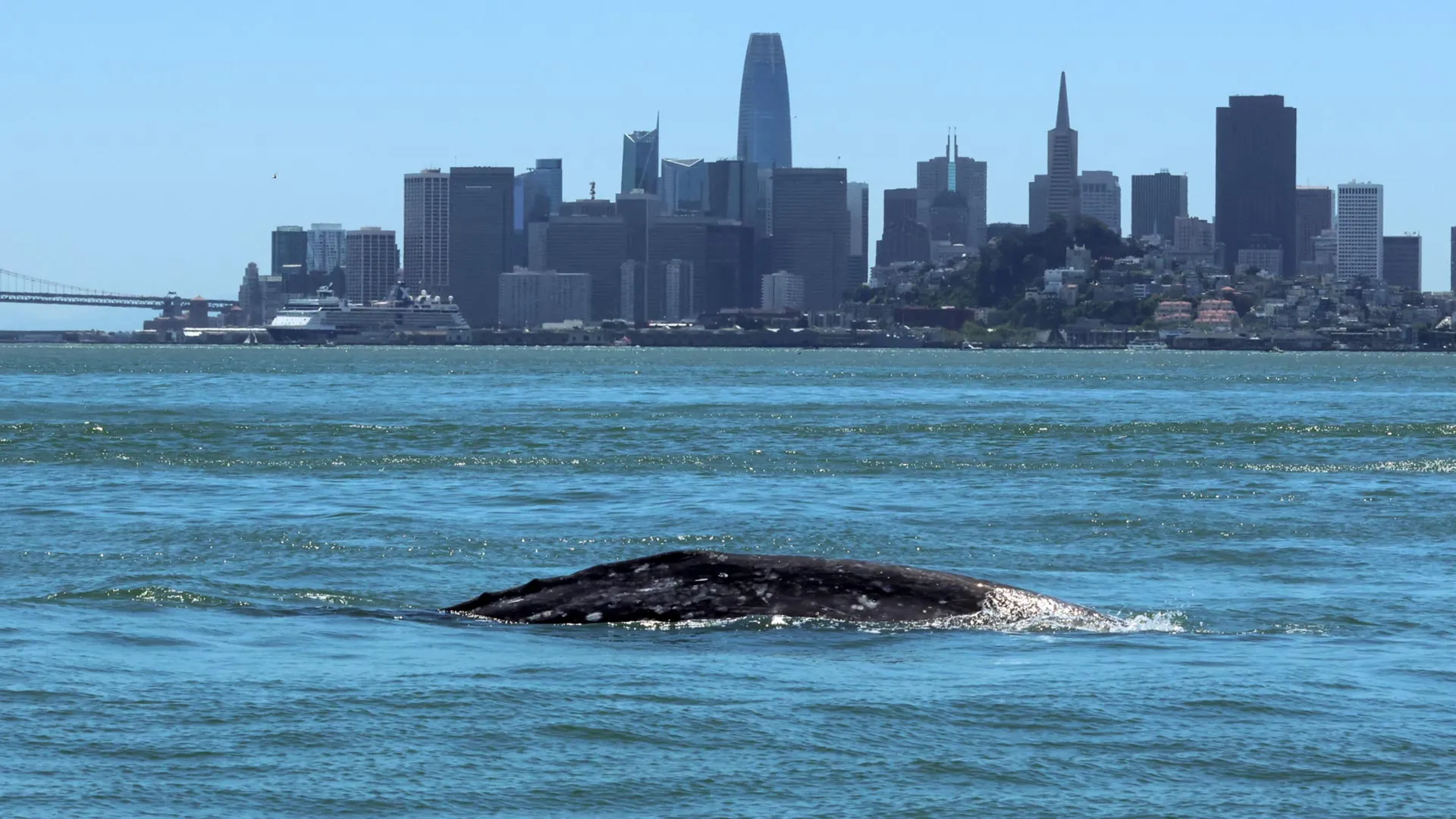
Gray whales are famous for their long seasonal journey between Arctic feeding grounds and the breeding lagoons of Baja California. But as ocean conditions shift, some of these whales are beginning to behave in unusual ways. In recent years, more gray whales have been seen feeding in places they did not commonly use before, including busy waters inside San Francisco Bay. Researchers examining this pattern found a troubling outcome: nearly one in five gray whales recorded entering the Bay later died there, many after being hit by boats.
Josephine Slaathaug of Sonoma State University, lead author of the study published in Frontiers in Marine Science, explained that gray whales can be especially hard to spot in San Francisco Bay because they ride low in the water when surfacing. In a place often affected by fog and filled with vessel traffic, that makes them especially vulnerable. She noted that the Golden Gate Strait creates a narrow passage where both ships and whales must pass through, increasing the danger.
Traditionally, gray whales depend on the energy they build up while feeding in Arctic waters, rather than stopping to eat during migration. But climate-related changes are disrupting those northern food sources. Federal data cited in the report indicate that the gray whale population has fallen by more than half since 2016, and calves are being seen far less often.
San Francisco Bay was not once considered part of the gray whale migration corridor. That began to change in 2018, when whales started appearing there more often and local deaths rose as well. To investigate, scientists created an identification catalog using public sightings and photographs collected between 2018 and 2023, then added more organized surveys from 2023 through 2025. They compared those records with data from stranded whales to see which animals had later died.
The study documented 114 individual gray whales in the Bay. Only four were seen in more than one year, suggesting that most of the whales entering the area do not return. Researchers suspect the Bay may be acting as a kind of emergency feeding stop for animals already in poor condition, especially since unusually thin whales have also been seen feeding in other nontraditional places.
The mortality numbers were severe. Between 2018 and 2025, 70 gray whales were found dead in the surrounding region. Thirty of those were confirmed to have died after vessel strikes. Among others where a cause could be identified, many showed signs of starvation or poor body condition. Scientists matched 21 of 45 identifiable dead whales to individuals previously recorded in their Bay catalog.
Bekah Lane of the Center for Coastal Studies, a co-author of the research, said that at least 18 percent of the whales identified in San Francisco Bay later died locally. Looking more broadly at strandings both inside and outside the Bay, the team found that over 40 percent of those whales died from trauma caused by boats.
Researchers say stronger protective action is urgently needed. In 2025 alone, 36 gray whales entered the Bay, and some arrived in groups of more than 10. The team believes more detailed tracking and additional necropsies could help clarify whether the low return rate is mostly due to starvation, ship strikes, or a combination of both. They also note that whales in weakened condition may be less able to avoid fast-moving vessels.
Possible solutions include better education for vessel operators, changes to ferry routes, and speed limits in areas where whales face the greatest risk. Lane said vessel traffic remains the most immediate danger for these animals in San Francisco Bay, and that continued monitoring will be essential for understanding their movements and reducing future deaths.
The researchers stress that there is still much they do not know about how these whales move through the Bay day by day. Even so, the findings offer an important look at how gray whales are responding as climate change reshapes their environment in real time.