

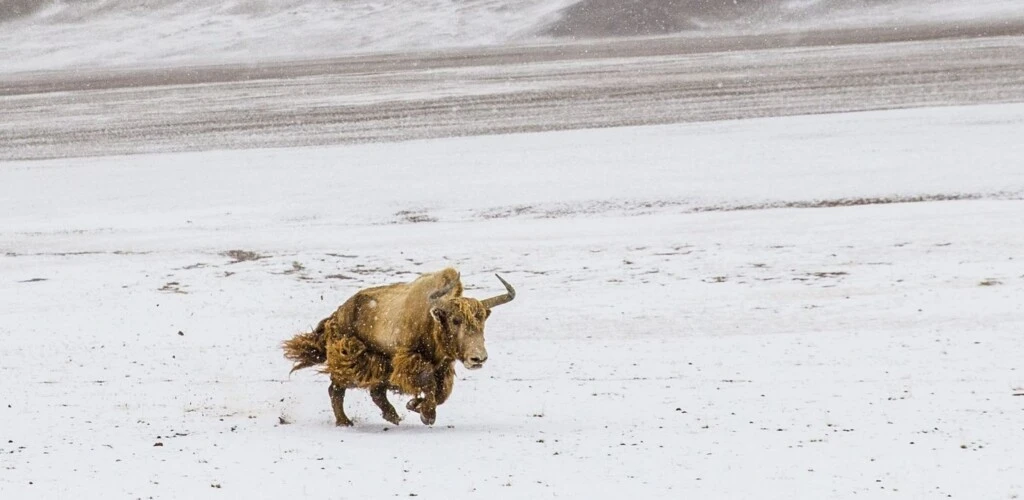
China has taken a major step in wildlife conservation by successfully cloning wild yaks for the first time. Scientists hope the breakthrough could help protect one of the country’s most remarkable and endangered animals — the golden wild yak.
According to local legend, when Mount Buye on the Tibetan Plateau married Mount Zhaxiangqian, seven golden wild yaks were given as a dowry. That story is said to explain why these rare golden animals are found only high in the mountains.
Conservationists, however, point to a more difficult reality. Golden wild yaks now survive in such limited areas because they have faced hunting, competition, hybridization with domestic yaks and habitat pressures. Today, they are considered critically endangered.
Now, a cloning program in China may offer new hope.
Researchers have successfully produced wild yak embryos that were carried and delivered naturally by female yaks. This shows that cloning could become a useful tool for strengthening wild yak populations and, eventually, helping conserve the extremely rare golden wild yak.
Wild yaks are native to the Qinghai-Tibet Plateau, where they evolved to survive extreme cold, high altitude and harsh mountain conditions. They are the ancestors of domestic yaks, which have long been essential to people living in the Himalayas. Domestic yaks provide wool for clothing, milk for food and oil, and dung that can be used as fuel.
Golden wild yaks are a genetically distinct form of wild yak found in the highest areas of the plateau. Their coats have a striking golden color, and research suggests they may have special genetic traits that help them survive in their high-altitude environment.
Despite strict protection under Chinese law, their numbers remain dangerously low. Some estimates suggest only about 170 to 300 golden wild yaks may remain. Local herders and farmers help protect them by keeping domestic yaks away from their habitat in Changtang National Park and patrolling the vast region for poachers.
Scientists have also confirmed that golden wild yaks are not simply ordinary wild yaks with unusual coloring. Genomic studies show they are genetically distinct, but also vulnerable to inbreeding because their population is so small.
In 2023, researchers from Zhejiang University and the Institute of Plateau Biology of Xizang began building a detailed genetic inventory by sequencing the genomes of nearly 9,000 wild yaks. This work laid the foundation for a cloning program designed to preserve genetic diversity.
Cloning is often misunderstood as creating an exact copy of a living animal in a simple sense. In conservation, however, it can be used to preserve or reintroduce valuable genetic lines, especially when wild populations have become too small or inbred.
The Chinese team achieved the first successful wild yak cloning in July. More recently, they advanced the work by cloning 10 wild yaks at once. Their goal is to establish a new wild herd using genes from across the broader wild yak gene pool. After that, they hope to turn more attention toward the golden wild yak.
The golden wild yak’s genome has already been sequenced, and scientists have identified traits linked to its golden coat and resilience in extreme mountain environments. Researchers have described it as an evolutionarily significant unit with high conservation value.
Experts say protecting the golden wild yak will require preventing further inbreeding and reducing the risk of hybridization with more common wild yaks or domestic yaks. The animal also carries unique traits connected to high-altitude survival, including tolerance to low oxygen, immune function and reproduction.
With advanced genetic science, careful conservation and continued protection of its mountain habitat, the golden wild yak may still have a future. The legendary animal that locals once described as a mountain dowry could remain part of the Tibetan Plateau’s wild landscape for generations to come.