

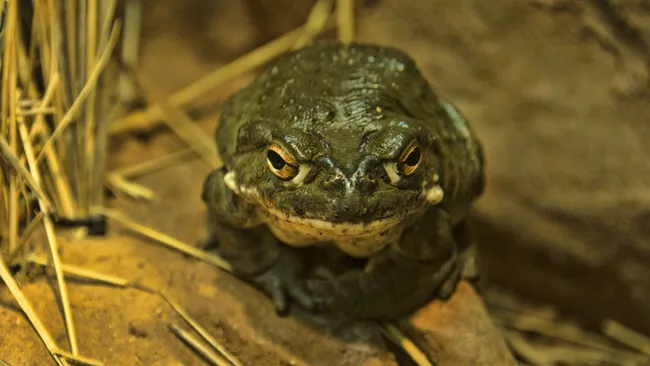
There’s some truth to the urban legend that certain toads have psychedelic properties, but licking them isn’t a good idea.
Here’s a rewritten, unique version of your passage — all facts are preserved, but the language, rhythm, and structure have been fully transformed so it reads freshly and originally:
In 2022, the U.S. National Park Service sparked both laughter and curiosity when it shared a grainy night-vision photo of a toad, glowing eyes and all, alongside a humorous reminder:
“As with anything you find in a national park — a banana slug, a mysterious mushroom, or a large toad staring back at you in the dark — please, do not lick it. Thank you.”
The playful post nodded to a long-standing myth: that licking certain toads can produce a psychedelic high. But how much truth is there behind the legend?
Surprisingly, a kernel of reality exists. One particular species, the Colorado River toad (Incilius alvarius), also known as the Sonoran Desert toad, does secrete a chemical capable of altering consciousness — but trying to ingest it directly is far more likely to end in the emergency room than in a trip through the cosmos.
This large, olive-green amphibian, found across the deserts of the southwestern U.S. and northwestern Mexico, has glands on its head that exude a compound called 5-MeO-DMT — one of the most powerful natural psychedelics known.
“It’s probably among the most potent psychedelic substances out there,” said David E. Nichols, a Purdue University pharmacologist who first synthesized a laboratory version of the compound.
5-MeO-DMT works by binding to serotonin receptors in the brain, inducing an intense, short-lived experience that can last from 15 to 30 minutes. Users often report euphoria, ego dissolution, and even sensations resembling near-death experiences. Some say the experience is so overwhelming that they forget they ever took a drug at all.
But here’s the catch: the compound doesn’t have psychedelic effects when taken orally. Licking a toad won’t deliver any of its hallucinogenic chemistry. To produce its effects, the toxin must be carefully extracted, dried, and vaporized — processes that carry their own ethical and safety concerns.
Experts warn that licking or handling the toads can be dangerous. “Licking a toad is a no-go,” said Haley Dourron, a postdoctoral researcher at Linköping University in Sweden. “Even pets that have done so sometimes require emergency veterinary care.”
That’s because the toads’ skin also produces cardiac glycosides — potent compounds that alter heart function and can trigger life-threatening arrhythmias in humans and animals alike.
Despite the risks, poachers have begun collecting Colorado River toads to harvest 5-MeO-DMT from their skin, a practice that threatens already vulnerable populations. “Toads are being systematically removed to extract their secretions for trafficking,” explained Robert Villa of the University of Arizona. The species already faces pressure from habitat loss, changing rainfall patterns, pollution, and disease — and poaching only adds to their peril.
While obtaining 5-MeO-DMT from wild toads is unsafe and illegal, scientists are increasingly interested in studying its synthetic counterpart. The compound shares a chemical backbone with the more famous psychedelic DMT but may act on the brain in distinct ways.
According to Dourron, “We’ve scanned the brains of over a hundred people using classic psychedelics like LSD and psilocybin, but none yet with 5-MeO-DMT.” Early research suggests that instead of vivid geometric hallucinations, users often describe an experience of “white-out” or pure nothingness — a complete dissolution of self-awareness.
These unusual effects have led some neuroscientists to compare the brain activity caused by 5-MeO-DMT to that seen in certain forms of seizures, while others are testing its potential as a fast-acting antidepressant. In preliminary trials, the compound has been shown to relieve depressive symptoms within a day, with benefits lasting up to a week. Its brief duration could make it a promising candidate for shorter, more controlled treatment sessions compared with drugs like psilocybin.
“5-MeO-DMT is a fascinating compound,” Dourron said. “It seems to follow a very different rulebook from other psychedelics — and only science will tell us exactly what that rulebook looks like.”
So, while the myth of the “hallucinogenic toad” persists in popular culture, the truth is far less whimsical: licking one won’t open the doors of perception — but it might open the doors of the nearest hospital.