

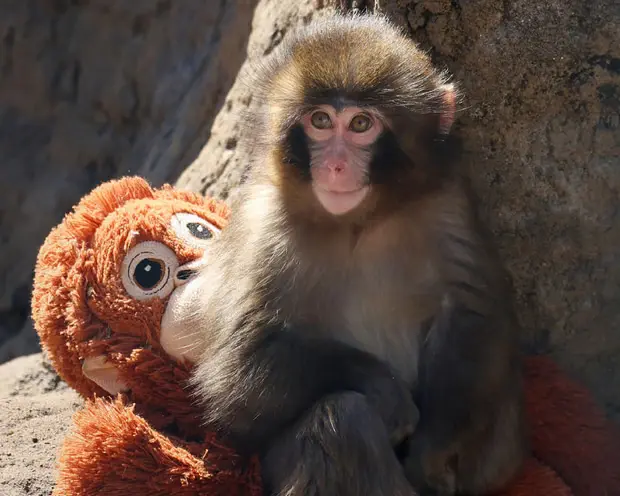
A seven-month-old Japanese macaque named Punch has drawn global attention after videos showed him alone in his enclosure at Ichikawa City Zoo, clutching a stuffed orangutan for comfort.
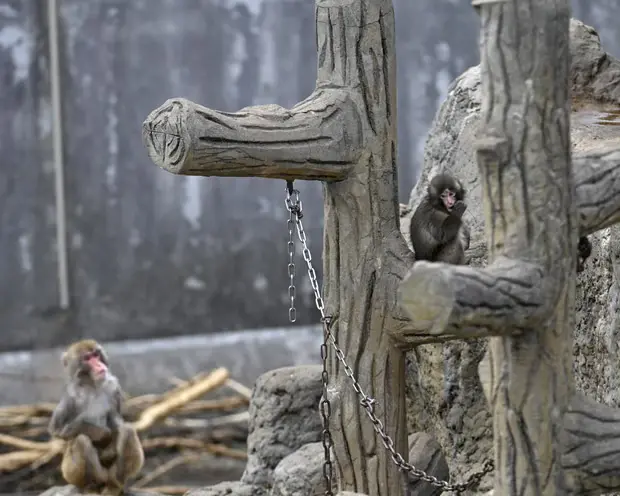
Born last July, Punch was rejected by his mother shortly after birth. Without maternal care to help him integrate into his troop, he has struggled socially. Footage circulating online shows him being chased and dragged by older macaques, then retreating to hug his toy.
The images are difficult to watch — a small monkey gripping a plush animal like a lifeline.
But why would a mother abandon her baby in the first place?
Why Do Mothers Reject Their Offspring?
According to Alison Behie, a primatology expert at the Australian National University, abandonment in Japanese macaques is uncommon but not unheard of.
Several factors can contribute:
- Inexperience: Punch’s mother was reportedly a first-time parent.
- Health concerns: If an infant appears weak, mothers may reduce investment.
- Environmental stress: Punch was born during a heatwave, which may have increased physical strain.
In harsh conditions, a mother may prioritize her own survival and future reproductive chances. While emotionally difficult for humans to witness, such decisions can reflect evolutionary survival strategies.
The Role of the Stuffed Toy
After Punch was rejected, zookeepers tried different methods to provide comfort — including rolled towels for him to cling to. Eventually, they introduced a stuffed orangutan.
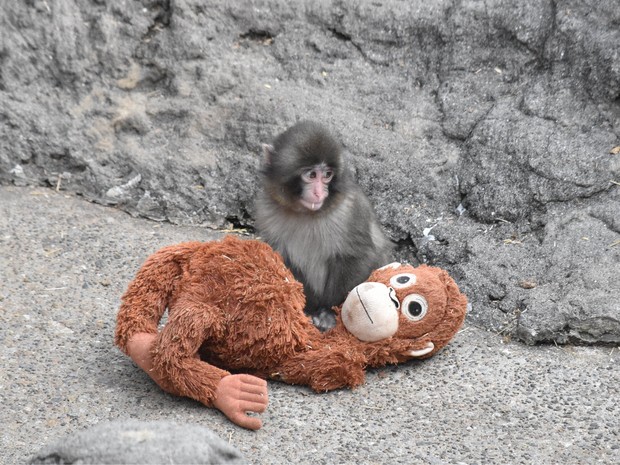
Baby macaques instinctively cling to their mothers immediately after birth. The physical act of gripping helps build muscle strength and provides a sense of safety. Without a mother, Punch had nothing to hold on to.
The plush toy appears to function as an attachment object — offering tactile comfort during a developmental stage when infants typically still nurse and depend on maternal contact.
Zookeepers have also said they hoped a monkey-shaped toy might support future integration into the troop.
Is It Bullying?
To many viewers, the videos look like bullying. However, Behie explains that what we see may be typical macaque social dynamics.
Japanese macaques live in strict matrilineal hierarchies. Dominance is passed down family lines, and lower-ranking individuals are often subjected to aggression by higher-ranking ones.
Even if Punch’s mother had not rejected him, he likely would still experience social correction and displays of dominance. The concern, however, is that without maternal guidance, he may not learn appropriate submissive behaviors — which could complicate his long-term social integration.
The Social Media Effect
Punch’s story has triggered a surge of visitors to the zoo and widespread online engagement. Officials have tightened viewing restrictions, urging quiet behavior and limiting photography equipment.
Carla Litchfield, a conservation psychologist at the University of Adelaide, notes that Japanese macaques are highly intelligent animals — which contributes both to their popularity and to ethical complexities. They are used in biomedical research in Japan and are sometimes culled due to crop raiding.
She cautions that viral attention can have unintended consequences.
Millions of likes may raise awareness — but they can also fuel demand in the illegal exotic pet trade, where infant monkeys are often trafficked because they appear “cute.” Monkeys mature quickly, becoming large, complex, highly social animals unsuited to private ownership.
“Monkeys belong with other monkeys,” Litchfield emphasizes. They require social structures and relationships with their own species to thrive physically and psychologically.
A Complicated Story
Punch’s bond with a stuffed toy is emotionally powerful because we recognize something childlike in it. But while the images resonate deeply with human instincts, the underlying situation reflects natural primate behavior, environmental stress and the realities of captive life.
Punch is not the first zoo animal to capture global fascination — recent viral sensations like Moo Deng, a pygmy hippo in Thailand, show how quickly online audiences connect with individual animals.
The challenge is balancing empathy with understanding: remembering that while we may see ourselves in Punch, he remains a wild animal navigating a complex social world very different from our own.