

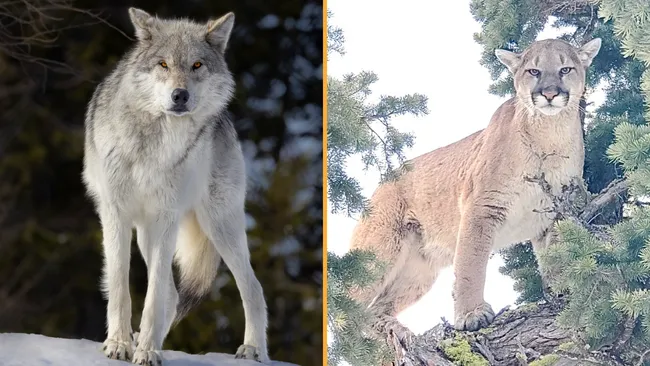
Large carnivores are both clashing and coexisting in the western United States. Although wolves dominate cougars and steal their prey, cougars’ shift from elk- to deer-heavy diets, paired with a rugged landscape for escape, might help cougars avoid violent wolf encounters.
After wolves were reintroduced to Yellowstone National Park, cougars — which had only recently regained a foothold — have managed to coexist with their new neighbors. According to recent research, this harmony is largely due to shifts in cougars’ diets and the park’s varied landscape.
Predator Interactions: Wolves Dominate, Cougars Adapt
Encounters between wolves (Canis lupus) and cougars (Puma concolor) occur when wolves steal prey from — or occasionally kill — cougars. The new study, published January 26 in PNAS, shows that coexistence improves when cougars focus on smaller prey rather than large elk.
“Yellowstone is a fascinating system because it has the full complement of large carnivores and migratory ungulates that North America used to have,” said Chris Wilmers, wildlife ecologist at the University of California, Santa Cruz. “As these populations restore themselves, it’s super interesting to look at these species’ effects on each other.”
A History of Recovery
Cougars and wolves were nearly eradicated from the western U.S. during the first half of the 20th century, primarily due to hunting. Cougar populations began recovering in the 1960s under new protections, while wolves were reintroduced in the 1990s and benefited from expanded legal safeguards.
Today, both species are prevalent across the western U.S., but scientists continue studying their population dynamics and ecological impacts within Yellowstone.
GPS Data Reveal Predation Patterns
The researchers analyzed nine years of GPS tracking data from collared wolves and cougars, along with observations at nearly 4,000 sites throughout the park. They confirmed that while wolves occasionally kill cougars, the reverse does not occur.
“These interactions are very one-sided,” said lead author Wesley Binder, a doctoral student at Oregon State University. “But cougars have the ability to adapt in some ways.”
Diet Shifts Reduce Conflicts
Both species have altered their diets over time. Between 1998 and 2024:
- Wolves: Elk decreased from 95% to 64% of their diet.
- Cougars: Elk decreased from 80% to 53% of their diet.
As elk populations declined, cougars turned to smaller prey like deer, while wolves began consuming more bison. This shift reduced encounters between the two predators.
“If cougars kill larger prey like elk, that gives wolves more opportunity to find and scavenge from their kills,” Binder explained. “Deer are smaller, so cougars eat them faster, and wolves have less chance to interact.”
Terrain Matters
Yellowstone’s landscape also plays a key role in predator coexistence. Cougars are less likely to encounter wolves in rugged areas or trees they can climb, providing them with refuge from conflict.
“Wolves and cougars prefer different habitat, and Yellowstone has different habitat that suits each of these carnivores,” Binder said.
Implications for Predator Management
The findings suggest that prey diversity and availability of escape terrain are crucial for stable coexistence between large carnivores. Understanding these interactions helps ecologists predict the impact of predators on prey populations and the broader ecosystem.
“We’re beginning to unravel the story between wolves and cougars,” Wilmers said. “These interactions combine or cancel out each other’s influence on prey — it’s a fascinating ecological puzzle.”