

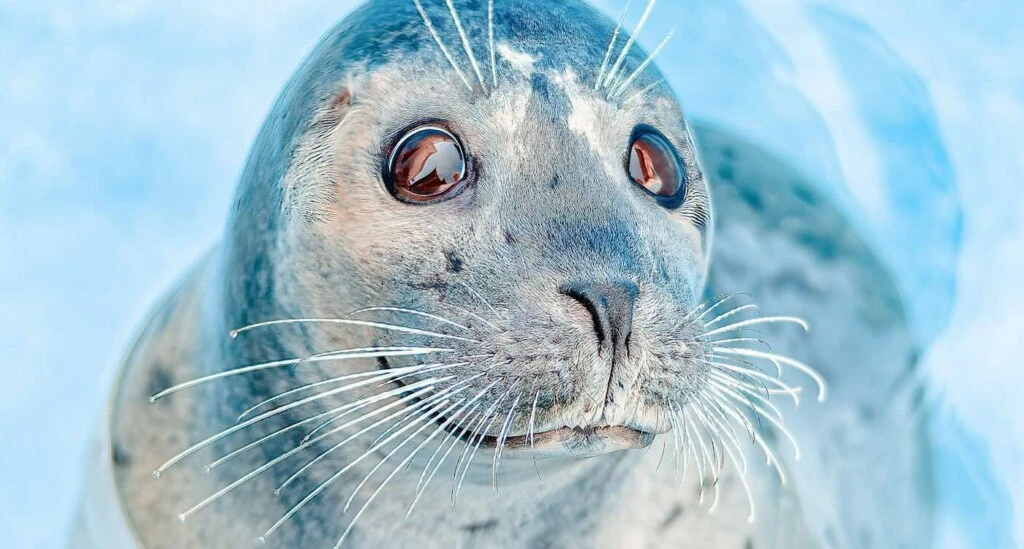
A seasoned wildlife photographer with a deep love for marine mammals, especially whales, recently witnessed a dramatic and unlikely escape at sea—one in which a lone seal survived an attack from eight orcas, thanks in part to her presence.
Charvet Drucker, who shared her account with the Associated Press, explained that the encounter unfolded during a whale-watching trip in the Salish Sea, roughly 40 miles northwest of Seattle. From a distance, she spotted a pod of orcas—also known as killer whales—displaying behavior that strongly suggested they were in hunting mode.
With practiced speed, Drucker attached her telephoto lens and began documenting the scene. The orcas burst into action, thrashing through the water as they targeted an adult seal. She watched through her camera as the seal was flung into the air amid the swirling mass of sleek black-and-white bodies. The shutter clicked rapidly, capturing what she believed were the final, frantic moments of the animal’s life.
But in an instant, the orcas shifted direction and charged straight toward the whale-watching boat. That was when Drucker realized the chase wasn’t over—the seal was still alive. In accordance with marine wildlife rules, the captain cut the engine to avoid injuring the oncoming orcas.
Seizing the opportunity, the terrified seal launched itself out of the water and onto the boat’s rear platform, as though climbing onto a floating chunk of ice. A video recording caught Drucker speaking softly to the shivering animal: “You poor thing… You’re good, just stay, buddy.”
In the wild, orcas are experts at knocking seals off small ice floes. They quickly switched to this well-known technique, circling the boat and performing staggered dives beneath it. These coordinated dives generate underwater waves capable of rocking a seal off its refuge—and the method had been documented as far back as 1980.
It worked. Several times, the incoming waves managed to slide the seal back into the water. But each time the seal fell, the orcas weren’t quick enough to capitalize on the brief window. After roughly 15 minutes of attempts, the frustrated orca pod eventually moved on.
For Drucker, this wasn’t an entirely unfamiliar scenario; she has seen similar hunts before and normally accepts the predator-prey cycle as a natural part of life in the ocean. She even admits that she typically roots for the orcas.
“I’m definitely Team Orca, all day, every day,” she told AP. “But once that seal was on the boat, I kind of turned into Team Seal.”
Marine experts note that orcas hunting seals in Washington waters are part of a migratory population known as “transient” orcas. These groups often have more consistent food supplies than the region’s “resident” orcas, which rely heavily on salmon—an increasingly scarce resource.
For Drucker, this encounter became yet another reminder of how unpredictable and breathtaking wildlife moments can be, especially when humans find themselves in the middle of unfolding drama at sea.