

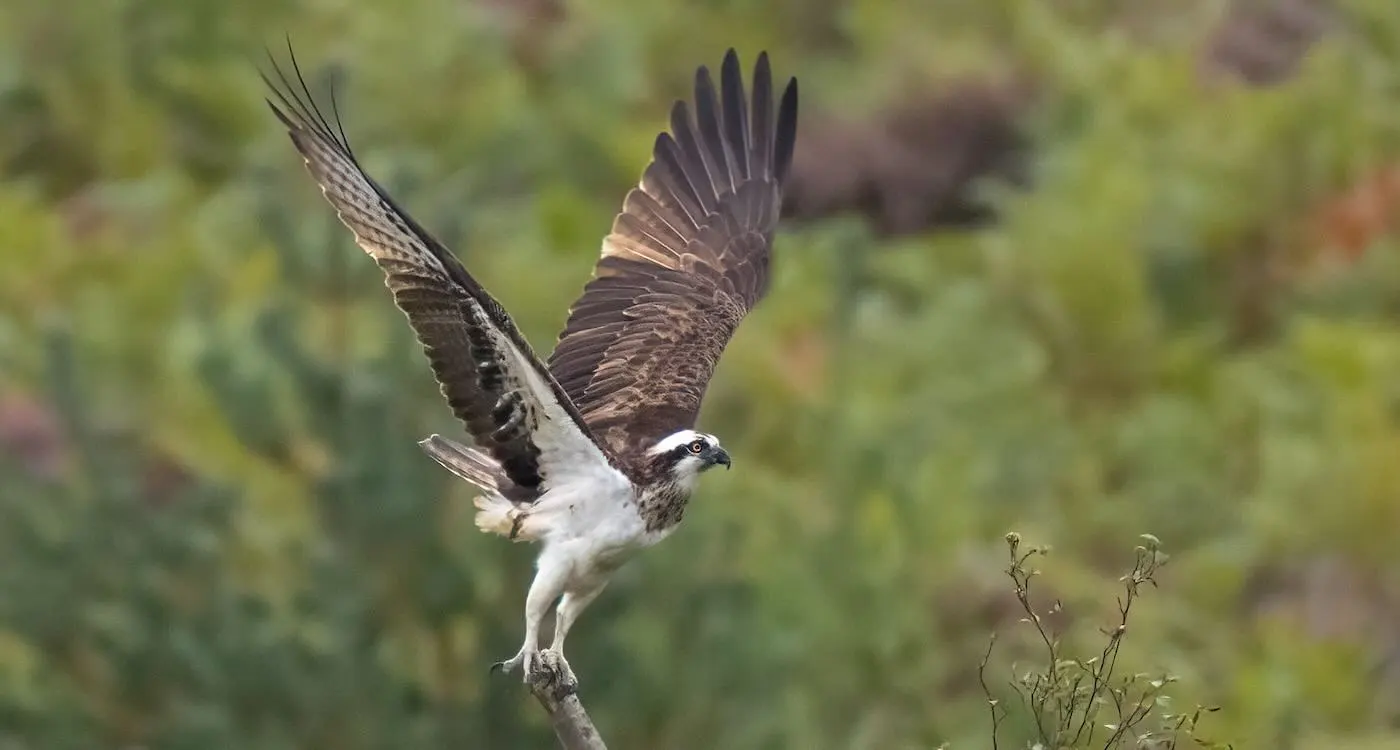
A small number of adventurous ospreys may be playing an outsized role in the species’ recovery across Britain.
New research suggests that “pioneering pairs” — birds that choose to nest far away from established osprey populations — are helping the raptors spread into new areas much faster than they otherwise would.
The findings could offer conservationists a valuable blueprint for restoring ospreys to parts of Britain and Europe where they are still absent.
Five Decades of Osprey Recovery Studied
Researchers examined an unusually detailed dataset covering 54 years of osprey recolonization in northern Scotland.
They looked at where nests were established, how densely birds settled and how the population gradually expanded across the landscape.
The study, published in the Journal of Animal Ecology, was led by Bournemouth University PhD researcher Brittany Maxted in collaboration with Birds of Poole Harbour and the Roy Dennis Wildlife Foundation.
The decades of records allowed scientists to study not just whether the population was growing, but exactly how it was spreading.
Most Ospreys Prefer Familiar Territory
One reason osprey expansion can be slow is that the birds generally prefer to settle near others of their species.
Male ospreys also often return to breed close to where they were born, a behavior known as natal philopatry.
Together, those tendencies can keep new nests clustered around existing populations, even though ospreys are capable of traveling enormous distances.
But researchers found that a small number of birds were behaving very differently.
Some Pairs Travel Far Beyond the Main Population
In Scotland, several pairs established breeding territories more than 20 kilometers, or around 12 miles, from the nearest other ospreys.
With little competition in these new areas, the birds effectively became the founders of separate populations.
Researchers dubbed them “pioneering pairs.”
By establishing breeding sites away from the main population, these birds can create new centers of osprey activity that may eventually grow and connect with other colonies.
Rare Pioneers Can Speed Up Recovery
The study found that these long-distance movements are particularly important for expanding the species’ geographic range.
While most birds remain relatively close to established nesting areas, the occasional pioneer can leap far ahead and open up an entirely new region.
Researchers noted that this pattern resembles other forms of population expansion seen in nature.
For conservationists, that raises an important question: can those pioneering movements be encouraged?
Artificial Nests Could Attract New Breeding Pairs
One possible strategy is to install artificial nest platforms in suitable habitats where ospreys have not yet returned.
Because ospreys often respond to signs that an area is suitable for breeding, providing ready-made nesting sites may encourage wandering birds to stop and establish a territory.
Another approach is translocation — moving young birds to regions where conservationists want to establish a new population.
Dr. Tim Mackrill of the Roy Dennis Wildlife Foundation said such methods can effectively recreate the movements made naturally by rare pioneering individuals.
Ospreys Once Disappeared From Britain
Ospreys were once widespread across Britain, but persecution, hunting and egg collecting caused their population to collapse.
By 1916, the species had disappeared as a breeding bird in Britain.
Their comeback began in 1954, when a pair naturally returned to Loch Garten in Scotland.
That event sparked decades of conservation work focused on protecting nesting birds and helping the population rebuild.
Dr. Roy Dennis has monitored Scottish ospreys since the 1960s, contributing to the long-term records used in the new research.
Decades of Monitoring Are Still Paying Off
Those historical records are now providing insights that would have been impossible to obtain from a short-term study.
Scientists can trace how individual breeding areas formed, how quickly the population spread and which birds played the biggest role in opening new territory.
The findings suggest that conservation efforts should not focus only on protecting existing colonies.
Creating opportunities for birds to establish themselves elsewhere may be just as important.
Poole Harbour Became a Real-World Test
One of the clearest examples can be found in Poole Harbour, Dorset.
Beginning in 2017, the Roy Dennis Wildlife Foundation and Birds of Poole Harbour launched a five-year translocation project designed to restore ospreys to southern England.
Young birds were moved from established nests in northern Scotland when they were around seven weeks old.
They then grew up in Dorset, learning to recognize the area before eventually beginning their natural migrations.
Translocation Created a New Breeding Population
The project eventually produced a major conservation milestone.
The first breeding pair at Poole Harbour consisted of a male translocated from Scotland and a female that had traveled roughly 200 kilometers from another population.
In 2022, the pair successfully raised two chicks.
They became the first ospreys to breed in southern England since 1847.
Researchers believe that without the translocation project, natural recolonization of the area could have taken many more decades.
Twelve Chicks in Three Years
The success did not stop with a single breeding season.
The original Poole Harbour pair has continued returning to the same nest, producing chicks year after year.
This summer, they hatched four young for the third consecutive year — a total of 12 chicks in three years.
The juveniles will remain dependent on their parents until they begin migrating in September.
A New Generation Is Starting to Spread
Perhaps even more encouragingly, birds connected with the Poole Harbour population are beginning to establish themselves elsewhere.
A second pair has started breeding away from the harbour, while the first wild-born chick from Poole has now begun breeding in the East Midlands.
Those movements are exactly the kind of pioneering behavior highlighted in the new study.
Each new breeding territory creates another potential stepping stone in the species’ expansion.
Closing the Gaps Between Populations
The emerging subpopulations are also beginning to reduce the distance between Poole Harbour and the established osprey population at Rutland Water.
Over time, these separate groups could become part of a more connected network of breeding birds across England.
That connectivity could make the overall population more resilient and allow the species to reclaim more of its historic range.
New Nest Sites Are Already Waiting
Conservationists have installed artificial nests in nearby counties including Devon and Hampshire in hopes that wandering birds will settle there next.
If successful, those locations could become new breeding centers along England’s south coast.
The researchers hope similar strategies will be used more widely across Europe, where ospreys remain absent from large parts of their former range.
A Few Adventurous Birds Can Transform a Population
Britain’s osprey recovery has taken decades, but the new research shows that expansion does not always happen gradually.
Sometimes, a single pair willing to travel farther than the rest can establish a completely new foothold.
By protecting those pioneers — and encouraging more birds to follow their example — conservationists may be able to accelerate one of Britain’s most impressive wildlife comeback stories.
More than a century after ospreys disappeared from the country, a handful of adventurous birds are helping lead them home.