

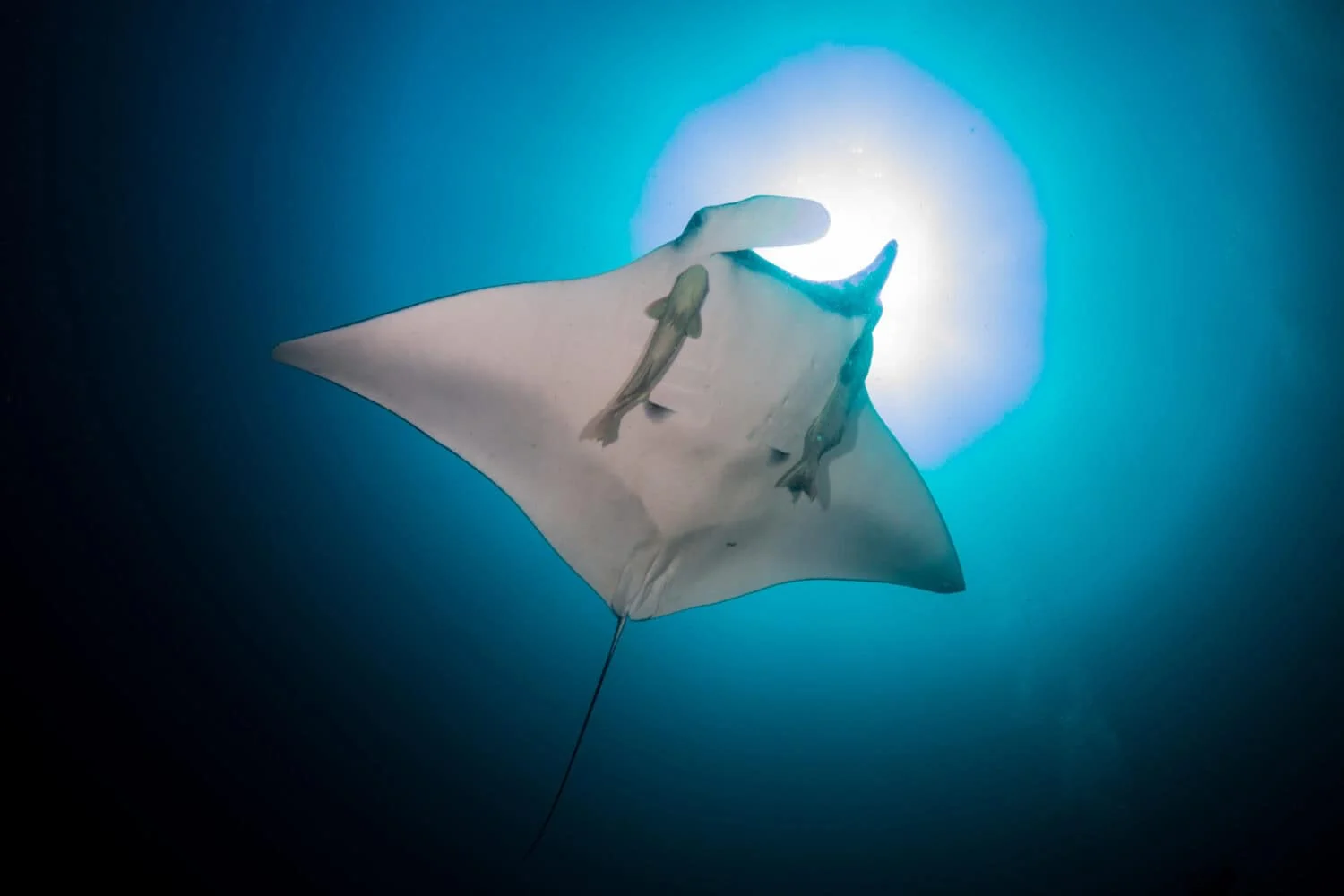
A remarkable underwater encounter has revealed just how closely some fish can attach themselves to giant ocean animals. Marine biologist Michel Guerrero was observing oceanic manta rays in the Pacific when he captured an unusual sight: one enormous manta ray carrying more than 15 remoras across its body.
These small fish are famous for hitching rides on much larger marine animals, using specialized suction organs to hold on even while their hosts swim through the water. But their relationship with manta rays is more complicated than a simple case of free transportation.
While remoras can help remove parasites and unwanted organisms, recent observations have revealed that some venture into places researchers never expected — including the body openings of their hosts.
A manta ray carrying a crowd of passengers
Manta rays are among the ocean’s most graceful giants. Their enormous bodies and slow, powerful movements make them attractive hosts for smaller fish looking for transportation, protection and an easy source of food.
Remoras are particularly well adapted to this lifestyle. Instead of swimming alongside their hosts, they attach themselves directly to their skin, often gathering underneath the body where they are less exposed to predators.
In Guerrero’s footage, however, the number of hitchhikers was especially striking. More than 15 remoras could be seen attached across the manta ray, making it appear almost completely covered in fish.
The Manta Trust also took notice of the unusual sight, commenting that the remoras were making excellent use of the ray’s enormous surface area.
For the remoras, the arrangement offers several advantages. They receive a convenient ride, access to food and protection from predators that might otherwise consider them an easy meal.
The manta ray may benefit as well. Remoras feed on parasites, dead skin and other unwanted material found on the bodies of larger marine animals, potentially helping their hosts stay cleaner.
But not every interaction between these two species is necessarily harmless.
Some remoras venture into places scientists never expected
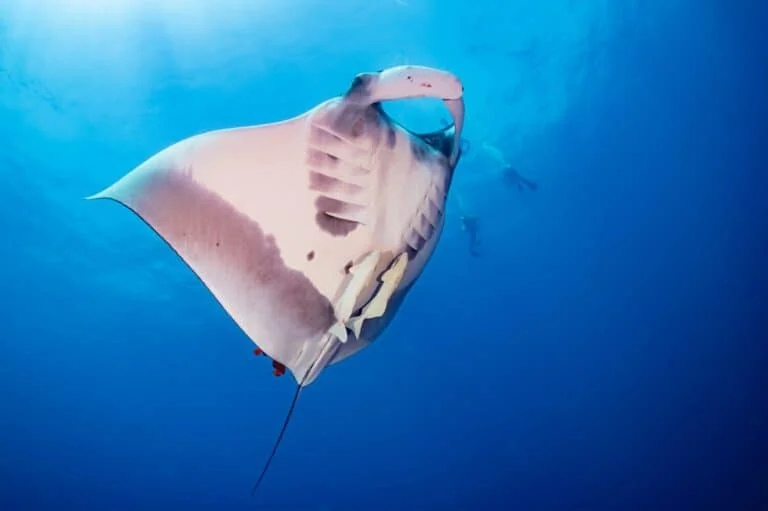
Although most remoras remain attached to the outside of their hosts, researchers have recently documented behavior that raises new questions about their relationship with manta rays.
Scientists from the University of Miami’s Shark Research and Conservation Program observed remoras entering the cloaca of manta rays. This opening, located on the underside of the body, serves several biological functions, including the release of waste and reproduction.
The observations were particularly surprising because the fish were not simply attaching themselves to the ray’s skin. They were swimming directly into an opening in its body.
Researchers also noticed that some manta rays responded with sudden, jerky movements, suggesting the encounters could cause discomfort or stress.
These observations have prompted scientists to reconsider whether the relationship between remoras and manta rays is always beneficial.
Is this friendship actually helping the manta ray?
In biology, relationships between different species can take several forms.
In mutualism, both animals benefit. Remoras receive food and transportation, while manta rays may benefit from having parasites and other unwanted organisms removed.
In commensalism, one species benefits while the other is neither significantly helped nor harmed. This could also describe many ordinary remora encounters, particularly when the fish simply use their hosts for transportation.
Parasitism, however, occurs when one organism benefits at the expense of another. If remoras cause internal damage or repeated stress, some of their interactions with manta rays could potentially fall into this category.
Scientists still need more evidence to understand the long-term consequences of remoras entering manta rays’ body openings. The behavior does not automatically mean that every remora is harmful, but it does show that this relationship may be more complicated than previously assumed.
The remarkable suction system that keeps remoras attached
One reason remoras are such successful hitchhikers is their extraordinary anatomy.
Over evolutionary time, their dorsal fin has transformed into a specialized suction disc positioned on top of the head. Rather than functioning like an ordinary fin, this structure allows the fish to attach firmly to the bodies of sharks, manta rays and other large marine animals.
The disc contains specialized plates called lamellae, which can be adjusted to create suction. Tiny structures known as spinules provide additional friction, helping the remora maintain its grip as its host moves through the water.
Once attached, a remora can remain in place even when its host is swimming quickly. When it wants to leave, it can simply release its hold and swim away.
This remarkable adaptation gives remoras access to food they might struggle to find independently. Depending on the species and circumstances, their diet can include parasites, small crustaceans, leftover food and other organic material.
For a manta ray carrying more than 15 of them, the benefits could include considerable cleaning assistance. However, having so many passengers may also create additional drag, potentially making swimming less efficient.
The footage captured by Guerrero offers a fascinating glimpse into a relationship that humans rarely get to observe so closely. What appears to be a simple group of fish enjoying a free ride may actually involve a much more complicated balance between cooperation, convenience and potential harm.