

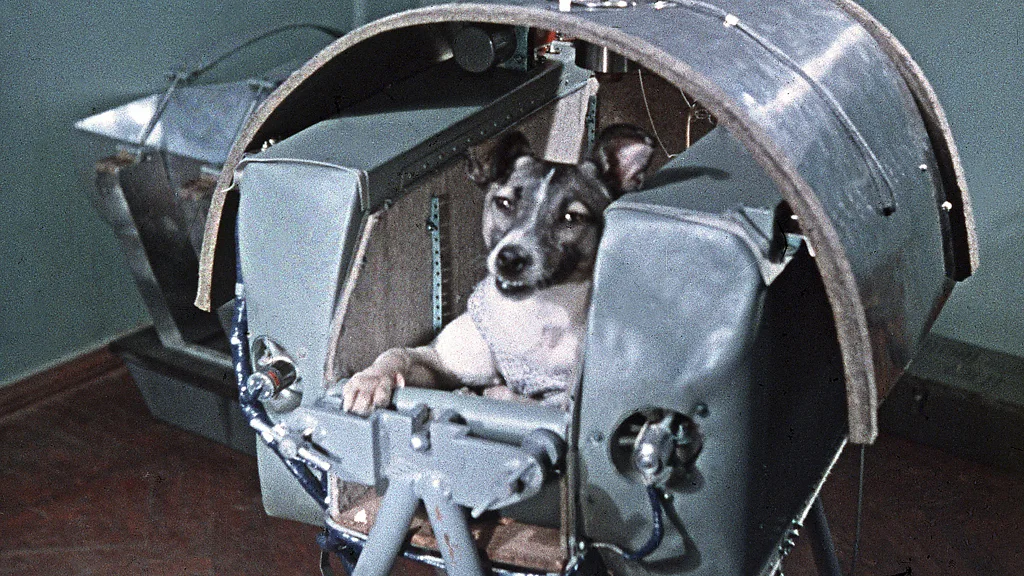
Before humans ever traveled into space, a small stray dog from the streets of Moscow became the first living creature to orbit Earth. Her name was Laika, and although her journey helped open the door to human spaceflight, it was also a mission from which she was never expected to return.
On November 3, 1957, Laika was launched aboard the Soviet spacecraft Sputnik 2 from the Baikonur Cosmodrome. Her flight made her an international symbol of scientific achievement, but behind the historic milestone was a heartbreaking reality: Soviet scientists knew they had no way to bring her safely back to Earth.
Nearly six decades later, Viktor Yazdovsky, whose father helped oversee the medical side of the Soviet space programme, shared a deeply personal memory of the dog. As a nine-year-old boy, he had actually played with Laika shortly before her historic launch.
A special dog chosen for an extraordinary mission
Laika had originally been a homeless dog wandering the streets of Moscow. Like many other strays, she was brought into the Soviet space programme because scientists believed animals that had survived life outdoors would be resilient, adaptable and able to endure difficult conditions.
Soviet researchers deliberately selected female dogs weighing between six and seven kilograms. Their smaller size made them easier to accommodate inside the spacecraft, while their temperament and physical characteristics made them suitable for training.
Viktor remembered Laika as an affectionate and intelligent animal.
“She was a very patient dog, very affectionate. She was easy to train,” he recalled. He also remembered her expressive dark eyes and how his father brought her to his grandmother’s home outside Moscow so the children could spend time with her.
His father believed that experiencing an ordinary family environment before the mission would be beneficial for the dog.
For the young Viktor and his sisters, however, Laika was simply a friendly dog they could play with. They could hardly have imagined that she would soon become one of the most recognizable animals in history.
A political deadline that changed everything
Laika’s mission followed the successful launch of Sputnik 1 on October 4, 1957, which made the Soviet Union the first country to place an artificial satellite into orbit.
The achievement was a major victory in the Cold War space race. Soviet leader Nikita Khrushchev quickly demanded another spectacular accomplishment to mark the 40th anniversary of the Russian Revolution on November 7.
Engineers were given only a few weeks to prepare a new mission.
Georgi Grechko, an engineer involved in the Sputnik programme, later recalled that Khrushchev wanted something new launched in time for the anniversary.
The project was overseen by Sergei Korolev, the brilliant engineer widely regarded as the founder of the Soviet space programme. Korolev had spent much of his life dreaming of space exploration, long before rockets became powerful enough to make it possible.
His daughter, Natalya Koroleva, remembered that her father had always wanted to reach the stars. He had originally dreamed of becoming a pilot before turning his attention to aircraft and rocket design.
For Korolev, rockets were not simply weapons or instruments of military power. They were a way to explore beyond Earth.
The rushed timetable, however, meant that important aspects of Laika’s mission were not properly developed.
Why the Soviets chose stray dogs
Between 1951 and 1965, the Soviet Union sent more than 50 dogs into space, beginning with shorter suborbital flights before attempting orbital missions.
Dogs were selected partly because Soviet researchers already had extensive knowledge of their physiology. Earlier research by Russian scientist Ivan Pavlov had provided valuable information about their circulation, digestion and nervous systems.
Scientists also considered other animals, including monkeys, but believed dogs were more suitable for the experiments they wanted to conduct.
Street dogs were preferred over pedigree animals because they were considered physically tough and capable of surviving difficult conditions. Researchers believed that their experience living outdoors made them particularly adaptable.
Before being approved for flight, the dogs underwent intensive training. They spent extended periods inside small pressurized capsules, where scientists monitored their reactions to noise, changing air pressure, confinement and weightlessness.
Viktor Yazdovsky remembered seeing groups of dogs arriving at his father’s laboratory in cars. They would rush into a clearing near the family home, wagging their tails and greeting the children before being fed and returned to the laboratory.
Those ordinary moments became especially poignant when he later understood what awaited Laika.
The heartbreaking truth about Laika’s final hours
When the public was introduced to the dog before her mission, she was initially known as Kudryavka, meaning Little Curly. After barking during a radio broadcast, she became known as Laika, a name associated with barking in Russian.
She quickly became a national hero.
But the spacecraft carrying her had serious limitations. The mission was prepared so quickly that its thermal insulation system was not properly developed, leaving the animal vulnerable to extreme temperatures.
For years, Soviet authorities claimed that Laika had survived for several days in orbit. The truth was finally acknowledged in 2002: she died just five to seven hours after launch, most likely from overheating and stress.
Although her flight successfully demonstrated that a living creature could survive the launch and reach orbit, there had never been a realistic plan to bring her home.
Laika had been sent on a one-way journey.
The world mourned the little space dog
News of Laika’s fate sparked widespread anger among animal lovers and animal welfare organizations.
In Britain, protesters gathered outside the Soviet embassy, while some groups encouraged dog owners to observe a minute of silence in her memory. In New York, people marched with their pets near the United Nations, and the American Society for the Prevention of Cruelty to Animals sent an official protest to the Soviet authorities.
Her death also raised difficult questions about the treatment of animals in scientific research.
The experience influenced later missions, which increasingly incorporated systems designed to bring animals safely back to Earth.
On August 19, 1960, Soviet dogs Belka and Strelka became the first animals to complete an orbital mission and return alive. They circled Earth 17 times before landing the following day.
Their successful return represented a major step forward, but Laika’s fate remained a painful reminder of the cost of the earliest experiments.
A legacy that continues to be remembered
Despite the circumstances of her death, Laika became one of the most enduring symbols of the Soviet space programme.
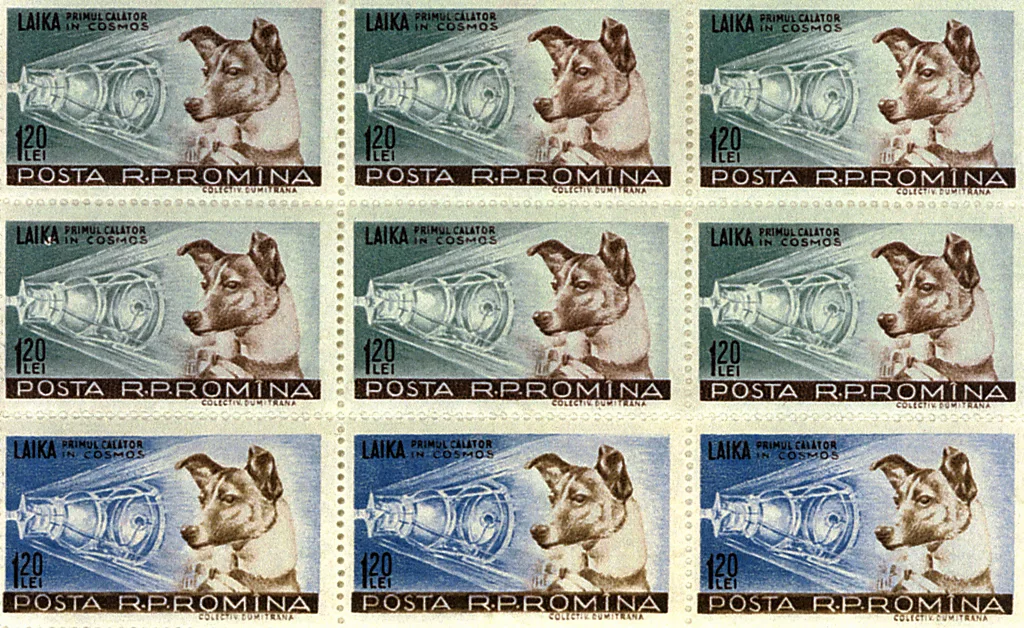
Her image appeared on commemorative stamps and envelopes, while her name was used on various Soviet products. In 2008, Moscow unveiled a monument honoring her, depicting a dog standing in the palm of a hand that transforms into a rocket.
For Viktor Yazdovsky, her mission represented a turning point in human history. He believed that Laika’s flight demonstrated that living organisms could withstand the conditions of space, helping pave the way for astronauts.
Yet even some of the scientists involved eventually questioned whether her death had been justified.
Oleg Gazenko, who helped lead the programme responsible for selecting and training Soviet space dogs, later expressed deep regret over the mission. He acknowledged that the experiment had not produced enough scientific knowledge to justify Laika’s suffering and death.
Her journey remains both a remarkable scientific milestone and a tragic chapter in the history of exploration.
Laika never returned to the family home where a little boy and his sisters had once played with her. But more than half a century later, the memory of that gentle stray dog continues to remind the world that behind some of humanity’s greatest achievements are sacrifices that should never be forgotten.