

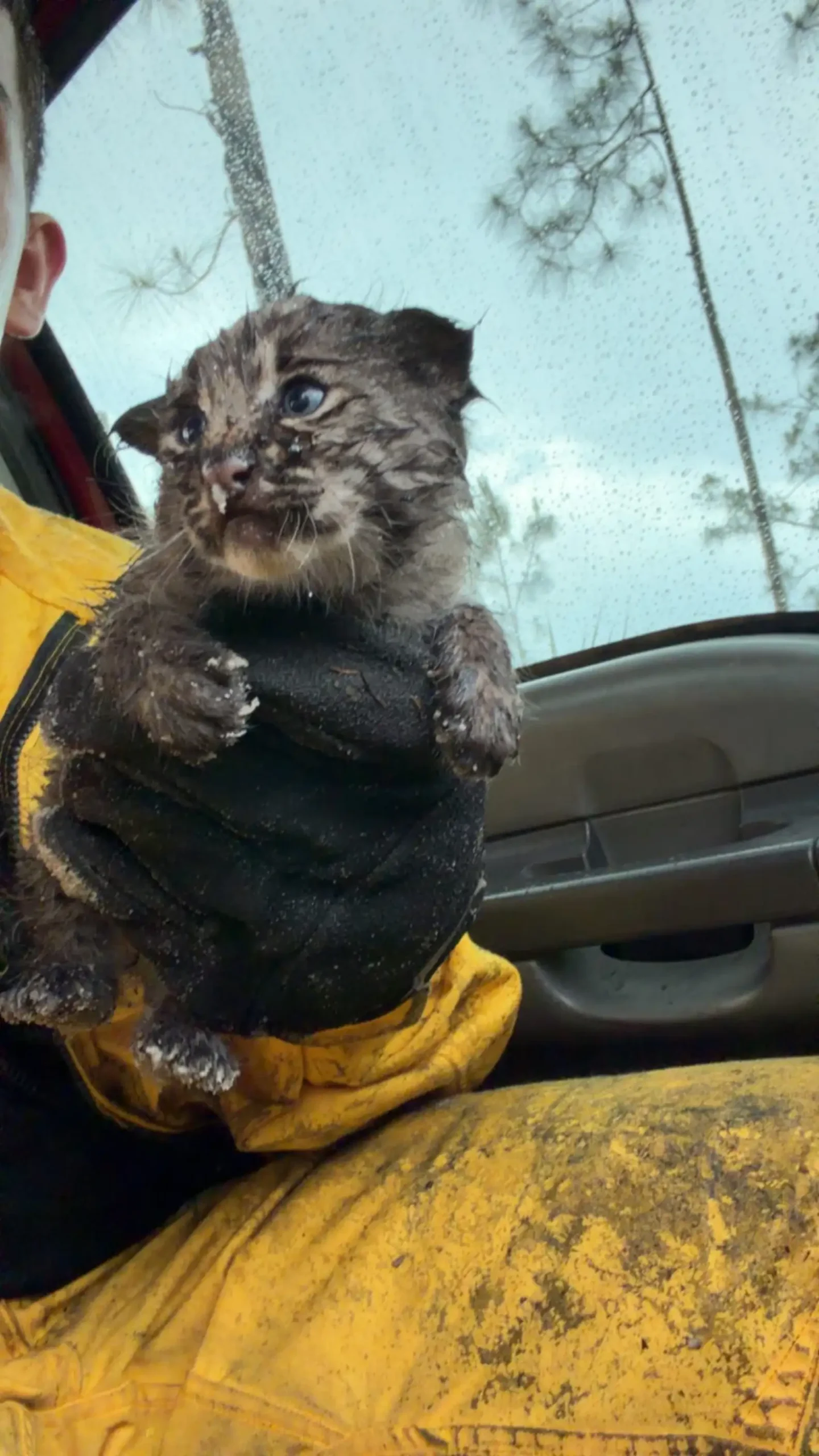
“She was cold to the touch …” 😰
When a brush fire broke out last month along Orange Blossom Boulevard in Sanibel, Florida, the Bayshore Fire Department quickly arrived to bring the flames under control. Among the responders was Julian Roman-Kulwicki, a new volunteer firefighter who had joined the department only a month earlier.
He was prepared to help fight the fire — but he never expected to find a tiny life hidden in the ashes.
While working near the burned area, Roman-Kulwicki suddenly heard faint cries. Then he saw what looked like a small kitten crawling out from a pile of ash.
Without hesitation, he scooped up the fragile animal and wrapped her in his jacket to keep her warm. She felt cold and weak, and at first, he believed he had rescued an ordinary kitten. But after looking more closely and doing some research, he realized the baby was actually a young bobcat.
The discovery stunned him. He had never handled an orphaned wild animal like this before, so he reached out to experienced wildlife rescuer Kaitlyn Doherty for help.
Doherty, who had spent years bringing injured and sick animals to the Clinic for the Rehabilitation of Wildlife, immediately understood how serious the situation could be. She quickly transported the exhausted baby bobcat to CROW’s facility, where the veterinary team was ready to examine her.
Considering she had survived a brush fire, the little bobcat was in better condition than rescuers feared. She had no visible burns or obvious injuries, and her lungs initially sounded clear. Still, the team knew the danger was not over. Smoke inhalation can cause problems later, even when an animal seems stable at first, so the staff monitored her closely.
At the time of her rescue, the bobcat kitten was estimated to be around 4 to 6 weeks old. Over the following weeks, she received constant care, food, warmth and medical observation.
The tiny survivor, whom Roman-Kulwicki named Ash, slowly began to grow stronger.
After about a month at CROW, Ash was doing very well. She had gained weight, her lungs remained clear and she showed no signs of lasting complications from smoke exposure. Her caregivers were encouraged by her progress and hopeful about her future.
Even though Ash is being cared for by humans, the team is being very careful to make sure she stays wild. Staff members cover their faces when handling her whenever possible, helping prevent her from becoming too comfortable around people. This is important because one day, Ash will need to return to the wild where she belongs.
In just a few weeks, Ash’s weight more than doubled, going from 600 grams to 1,250 grams. Her caretakers are continuing to feed her bottles and solid food as she grows and learns the skills she will need as a bobcat.
When she is ready, Ash will be moved to another facility where she can be raised alongside other young bobcats. That next step will help prepare her for eventual release back into her natural habitat.
For now, Ash is safe, healing and getting stronger every day.
And from a distance, Roman-Kulwicki is still cheering for the tiny bobcat he found in the ashes — grateful that she made it out alive and is now receiving the best care possible.