

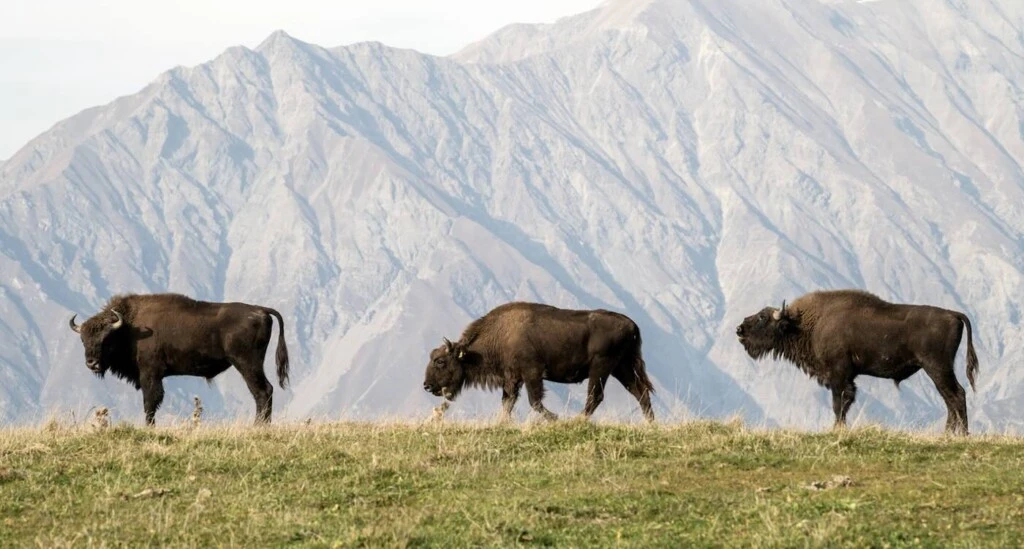
Seven years ago, a quiet but historic moment unfolded on the slopes of Shahdagh, also known as the King’s Mountain, in northern Azerbaijan. The doors of several large wooden transport crates were opened, and 12 European bison stepped out into a world they had never known.
These animals had been raised in zoos, but now they were standing in the wild — in a landscape chosen to become their new home.
Their release was part of a major conservation effort led by the World Wildlife Fund, together with the UN Environment Programme and Azerbaijan’s Ministry of Ecology and Natural Resources. The goal was to bring European bison back to the South Caucasus, where they had once belonged.
Long ago, bison roamed across much of Eurasia. These powerful animals played an important role in shaping forests and grasslands, but hunting, habitat destruction and isolation slowly pushed them out of many regions. Eventually, the Caucasian bison disappeared from the wild.
The restoration effort began in 2012. Conservationists relied on careful breeding work, including descendants connected to the last remaining male of the Caucasian bison line, who had survived in a Western European zoo. Years of planning finally led to the first release in Azerbaijan in 2019.
Since then, the herd in Shahdagh has continued to grow. WWF Azerbaijan has monitored the animals closely, and so far, 25 calves have been born in the wild.
For conservationists, this is more than the return of a single species. It is a chance to repair an entire ecosystem.
During the Soviet period, the Shahdagh region suffered heavy environmental damage. Forests and soils were overused, and many wild animals lost the habitats they depended on. The return of bison offers hope that the land can slowly recover.
Bison are often called ecosystem engineers because of the way they transform the places they live. As they move through the landscape, their thick coats carry seeds from one area to another. Their grazing helps control dense vegetation and may reduce fire risk. Their dung feeds insects and enriches the soil, while their heavy bodies open paths and create a natural mix of grassland and woodland.
That kind of varied habitat gives many other plants and animals a better chance to thrive.
The success in Azerbaijan is now being seen as a possible example for other countries in the Caucasus. Conservationists hope that one day, separate herds across the region may grow, connect and form a strong, self-sustaining bison population.
For now, the bison of Shahdagh continue to do what their ancestors once did — roam, graze and slowly bring balance back to the wild places that had been missing them for generations.