

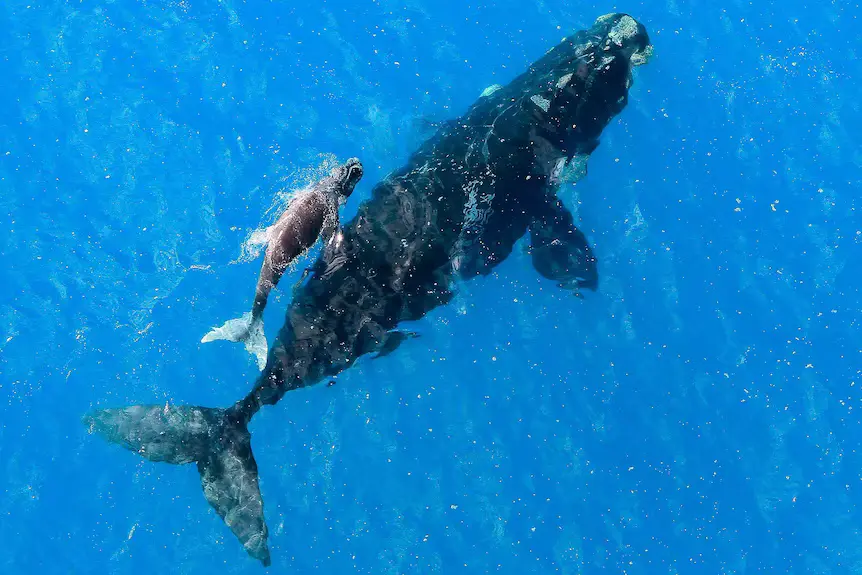
Each winter, southern right whales leave the icy waters of Antarctica and travel north to the warmer coastline of southern Australia, where they gather to breed and give birth.
For half a century, researchers have tracked their movements between Fremantle in Western Australia and Ceduna on South Australia’s far west coast. That long-running research is now revealing a concerning change: female whales appear to be waiting longer between calves.
Murdoch University senior researcher Joshua Smith, who led this year’s aerial census, recorded 520 southern right whales across the south-west, including 235 mother-and-calf pairs.
That was down from last year’s count of 646 whales and 304 calves, while the number of individual whale sightings has fallen by about 20 per cent compared with a decade ago.
“Since 2011, there has been a stalling in the population,” Dr Smith said.
Despite the overall decline, some important breeding areas continue to support large numbers of whales.
Australian Right Whale Research Program chief scientist Claire Charlton has been conducting land-based monitoring from the Head of Bight in the Great Australian Bight Commonwealth Marine Park, within the Yalata Indigenous Protected Area.
This year, researchers recorded 61 mother-and-calf pairs in the Bight — more than 30 per cent of the total recorded across the south-west.
“It’s a conservation success story for the marine park,” Dr Charlton said.
The census also identified about 50 unaccompanied whales without calves.
Traditional calving grounds, including the Head of Bight and Israelite Bay in Western Australia, remained active, but Dr Smith said whale activity elsewhere was unusually quiet.
Whales are waiting longer between calves
One of the most significant findings to emerge from decades of monitoring is a change in how often female southern right whales reproduce.
“The population isn’t really increasing to any extent,” Dr Smith said.
“There’s actually indication that calving rates are dropping.”
About a decade ago, researchers believed females generally returned to breed every three to four years.
Long-term observations now suggest those intervals are stretching closer to five years.
“The three-year cycle that we used to always pride ourselves on is extending,” Dr Smith said.
The shift can produce dramatic fluctuations in whale numbers from one year to the next, making decades of monitoring essential for understanding the broader trend.
“It takes 10 years and maybe two or three cycles of a reproductive female coming back to the coast before you can really see what’s going on in the population,” Dr Smith said.
“That’s why it’s so important to have this long-term data.”
Why are breeding cycles getting longer?
Researchers believe the answer may lie thousands of kilometres south, in the whales’ Antarctic feeding grounds.
Dr Charlton said a southern right whale’s ability to reproduce is closely tied to its physical condition — and therefore to how successfully it can feed.
“Their breeding cycle is directly linked to their body condition, and their body condition is linked to their feeding success,” she said.
Southern right whales depend heavily on krill and other prey in cold Southern Ocean waters. But warming oceans and declining sea ice can disrupt the marine food web and reduce the availability of krill.
Whales may also face additional competition for food from commercial krill fisheries.
“[Whales] are also under pressure from krill fisheries and have less prey available,” Dr Charlton said. “That’s causing stresses to them and their long-term recovery.”
If females are unable to build up enough energy reserves, researchers believe they may delay breeding until their body condition improves.
That could help explain why the traditional three-year reproductive cycle is increasingly stretching toward five years.
The concern is not limited to the Great Australian Bight.
Dr Charlton said southern right whale populations along Australia’s south-east coast also require close attention.
“South-eastern populations of southern right whales have experienced low sightings and no female calf pairs,” she said.
Australia’s key southern right whale hotspots
Some of the strongest remaining gathering places include Israelite Bay, Point Ann and Point Charles along Western Australia’s south coast, as well as the Head of Bight in South Australia.
These protected areas have become especially important for a species still recovering from centuries of commercial whaling.
Southern right whales are listed as endangered in Australia. Their numbers were devastated by whaling, but increasing sightings along Western Australia’s coast during the 1970s offered early signs of recovery.
Those observations prompted scientist John Bannister to begin an aerial survey in 1976.
Five decades later, the Western Australian Museum’s annual southern right whale survey continues to provide an invaluable record of how the population is changing.
The latest findings suggest the whales’ recovery may be more fragile than once hoped.
While hundreds continue to return to southern Australia each winter, longer intervals between calves and declining sightings raise questions about how a warming ocean and changing food supply could shape their future.
For researchers, the message from 50 years of observations is clear: understanding the fate of southern right whales requires watching not just where they go, but how often they are able to return with a new calf beside them.