

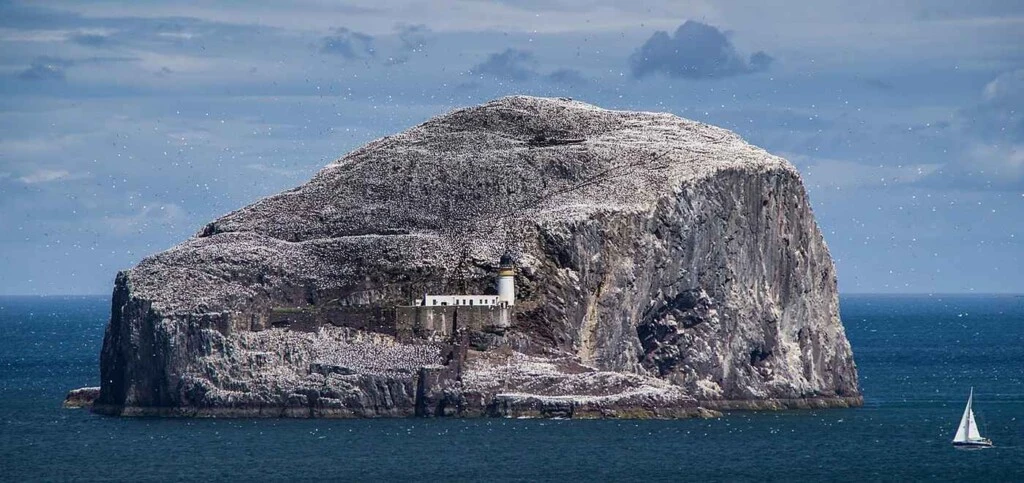
Two of Scotland’s most important seabird islands have been sold to the Royal Society for the Protection of Birds so their wildlife can receive stronger long-term protection.
Bass Rock and nearby Craigleith, both located in the Firth of Forth, are home to huge seabird colonies, including around 100,000 gannets and 10,000 puffins. Bass Rock is especially famous for its enormous gannet population, which has made the island known around the world.
For more than 300 years, the islands were owned by the Dalrymple family, a Scottish noble family that had cared for them for generations. But with seabirds facing growing threats, Sir Hew Dalrymple decided it was time to place the islands in the hands of conservation experts.
Bass Rock has long been a dramatic and historic place. The birds nest among the remains of a 14th-century castle and a 17th-century prison once known as “Scotland’s Alcatraz.” The island has also inspired writers, musicians and nature lovers for generations. Sir David Attenborough once described it as one of the world’s great wildlife wonders.
Although the Dalrymple family had worked with the Scottish Seabird Centre for many years to protect the islands, increasing dangers to seabirds helped lead to the sale. Conservation work had already helped Craigleith’s puffin population grow significantly and had also helped remove invasive plant species.
But new concerns, including the approval of a large offshore wind farm nearby and its possible effect on the gannet colony, made stronger protection even more important.
Sir Hew Dalrymple said he made the decision because of the risks facing the birds. He believed an organization such as the RSPB would be better prepared to protect the islands and their wildlife than a private owner.
The RSPB purchased Bass Rock and Craigleith with support from heritage and lottery funds. Conservation leaders described the sale as a rare chance to secure the islands’ future and make sure they remain safe sanctuaries for seabirds.
With RSPB Scotland and the Scottish Seabird Centre involved, the islands’ globally important bird colonies will now be managed with conservation as the top priority.