

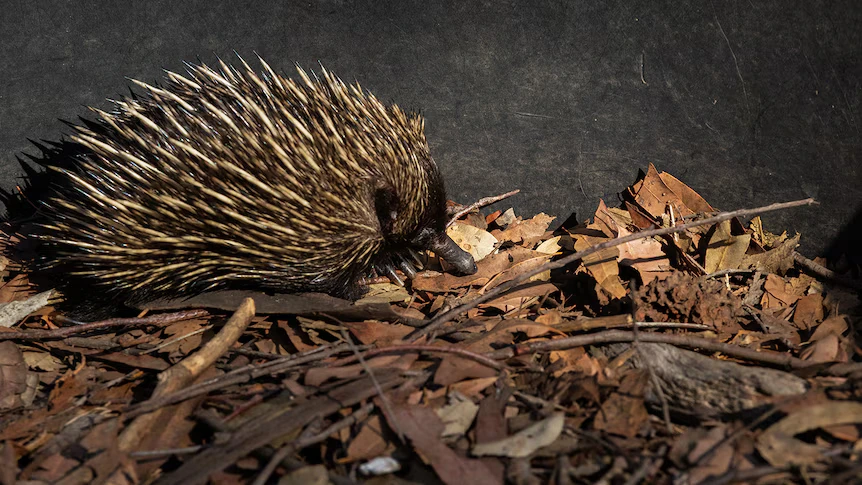
Echidnas may be one of Australia’s most recognisable native animals, but scientists still know surprisingly little about how many exist in the wild — a gap in knowledge that has researchers concerned the species could decline without warning.
University of Queensland ecologist Dr Kate Dutton-Regester is leading a pioneering population survey of echidnas in south-east Queensland, aiming to establish the first reliable baseline data for the region. Without these numbers, she said it is difficult to identify long-term trends or detect population declines early enough to intervene.
Although echidnas are the most widely distributed mammal in Australia, Dr Dutton-Regester said that widespread presence does not necessarily mean the species is common.
“It would be amazing if they are common, but regardless we need that baseline to monitor them over time,” she said. “Without it, we risk reaching a point decades from now where alarm bells are ringing because echidnas have quietly disappeared from places where they once lived.”
Echidnas are one of only two mammals in the world that lay eggs, alongside the platypus, yet they remain elusive and rarely seen in the wild. Dr Dutton-Regester said threats such as urban expansion, land clearing and climate change are placing increasing pressure on the species.
Habitat fragmentation can reduce food availability, increase vehicle strikes and expose echidnas to greater risks, while rising temperatures pose an additional challenge. Echidnas are highly sensitive to heat and are generally only active during their breeding season, which runs from May to early October.
Dr Dutton-Regester said warmer conditions could shorten that already limited breeding window, potentially reducing reproduction rates. Echidnas reproduce only once every two to six years in the wild, meaning even small changes to breeding conditions could have serious long-term impacts.
To address the lack of data, Dr Dutton-Regester has partnered with the Wildlife Preservation Society of Queensland on EchidnaWatch, a citizen-science project that encourages the public to report sightings, diggings and scats. She has also received funding support from Logan City Council to expand the research.
By collecting information from across the community, researchers hope to build a clearer picture of where echidnas live and how frequently they are encountered. Reports of deceased echidnas are also important, as they help identify roadkill hotspots where warning signs or other protective measures may be needed.
Sightings can be logged through the iNaturalist app or the EchidnaWatch website, and Dr Dutton-Regester and her team regularly host public talks, workshops and guided field trips across south-east Queensland to teach people how to recognise signs of echidna activity.
During a recent community search in Kimberley Forest at Shailer Park, participants did not spot an echidna but learned how to identify burrows and scats. For many, the experience highlighted how little they knew about the species.
Participant Belinda Neal said she had only ever seen an echidna once in the wild and wanted to learn how to help protect them locally. Ecologist Chris Urbanek, who attended the event, said even professionals can have knowledge gaps about the animal’s behaviour and physiology.
Dr Dutton-Regester said echidnas’ unique biology has made them a lifelong fascination. Females develop a temporary pouch only when pregnant, and the animals are capable of burrowing up to a metre underground to regulate their body temperature.
“They’re just so unique,” she said. “There are aspects of echidnas that you don’t see in other mammals at all, and that makes protecting them even more important.”