

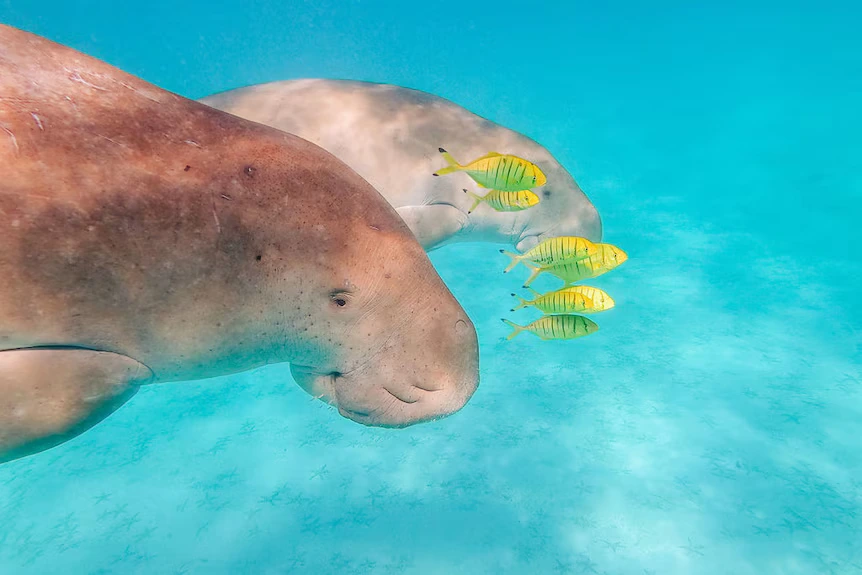
Researchers have reported encouraging signs of dugong recovery in south-east Queensland, with more animals spotted in Hervey Bay and the Great Sandy Strait. However, a decline in calf sightings has raised concerns about the long-term future of the local population.
The findings come from aerial surveys conducted by James Cook University (JCU) and TropWATER in 2024.
Researchers investigated how dugongs were recovering after severe flooding in 2022 damaged large areas of seagrass, their primary food source.
Although the results suggest improving habitat conditions, scientists warn that more monitoring is needed before confirming a sustained population recovery.
Dugong Sightings Increase in Queensland
The latest research found a small increase in dugong sightings across Hervey Bay and the Great Sandy Strait.
During the 2024 aerial survey, researchers recorded approximately 109 dugongs, compared with 103 observed in 2022.
The animals were also found across a wider geographic area.
In 2022, most sightings were concentrated in the central part of Hervey Bay. By 2024, dugongs had spread farther south toward the Great Sandy Strait.
Researchers believe this movement may be connected to the recovery of seagrass habitats following the devastating floods.
However, an increase in sightings does not necessarily prove that the overall population has grown.
How Scientists Monitor Dugong Populations
Researchers used aerial surveys to study the distribution and estimated abundance of dugongs along the Queensland coastline.
Two methods were used to collect and analyse the data.
1. Direct observations
Researchers counted the dugongs they could see from an aircraft flying over the survey area.
2. Population estimates
Scientists applied correction factors to the observations to estimate the number of animals that may have been present but were not visible.
These corrections are important because dugongs can be difficult to detect when feeding underwater or swimming through deep, murky water.
Combining both methods provides a more complete picture of the population.
Dugong Survey Results
| Survey findings | 2022 | 2024 |
|---|---|---|
| Dugongs directly observed | 103 | 109 |
| Calves observed | 9 | 3 |
| Main distribution | Central Hervey Bay | Hervey Bay and farther south |
| Seagrass conditions | Flood-affected | Showing signs of recovery |
The figures suggest improving conditions in some areas, but the declining number of calves remains an important concern.
Seagrass Recovery Offers Hope for Dugongs
Seagrass meadows are essential to dugong survival.
These underwater plants provide the animals with their main food source and support healthy coastal ecosystems.
However, major flooding in 2022 damaged extensive seagrass habitats in south-east Queensland.
The destruction reduced food availability and placed additional pressure on the region’s dugong population.
Researchers now believe that recovering seagrass meadows may be encouraging dugongs to return to previously affected areas.
Dr Christophe Cleguer, principal research officer at James Cook University, suggested that improving seagrass conditions could explain the animals’ wider distribution.
The findings highlight the close relationship between healthy marine habitats and dugong populations.
Why Are Scientists Concerned About Dugong Calves?
Despite the increase in overall sightings, researchers recorded a concerning decline in the number of young dugongs.
Only three calves were observed in 2024, compared with nine in 2022.
This has raised questions about whether the local dugong population is experiencing a sustainable recovery.
Scientists believe the low number of calves may be connected to the effects of earlier food shortages.
Dugongs that experienced nutritional stress after the flooding may need additional time to regain sufficient health before reproducing successfully.
As a result, improvements in seagrass habitats may not immediately lead to higher birth rates.
Simon Miller, the Australian Marine Conservation Society’s Great Barrier Reef campaign manager, expressed concern about the limited evidence of population recovery.
Researchers agree that further surveys are necessary to determine whether the observed improvements will continue.
Traditional Owners Support Dugong Conservation
The research also involved consultation with the Butchulla people, the Traditional Owners of the coastal region extending from Burrum Heads to Rainbow Beach.
For the Butchulla people, dugongs are known as yuangan and have an important connection to their traditional Sea Country.
Butchulla Native Title Aboriginal Corporation chair Shawn Wondunna-Foley emphasised the importance of protecting seagrass habitats to ensure the survival of dugongs.
The involvement of Traditional Owners highlights the value of combining scientific research with Indigenous knowledge and environmental management.
Protecting seagrass also supports the wider health of coastal ecosystems and the marine species that depend on them.
Future Research and Dugong Protection
James Cook University hopes to secure additional funding for another aerial survey covering the coastline from the southern Great Barrier Reef to Moreton Bay.
However, financial limitations and unpredictable weather could affect future research schedules.
To improve monitoring, scientists are considering closer cooperation with local conservation organisations.
These partnerships could involve using drones and research vessels to collect additional information about dugong movements and habitat conditions.
Local monitoring could help researchers identify population changes between major aerial surveys.
Conservation experts have also highlighted the importance of responsible boating practices.
Reducing boat speeds in areas inhabited by dugongs can help lower the risk of collisions and protect these vulnerable marine mammals.
Why Dugong Conservation Matters
Dugongs are vulnerable marine mammals that depend heavily on healthy seagrass ecosystems.
Protecting their feeding grounds is essential for supporting population recovery.
The Queensland research demonstrates how environmental damage can affect dugong distribution and potentially influence reproduction.
It also shows why regular wildlife monitoring is necessary to understand changes in marine animal populations.
Effective conservation requires habitat restoration, scientific research, cooperation with Traditional Owners and responsible human activity in coastal environments.
Conclusion
The latest dugong survey in south-east Queensland provides encouraging evidence that conditions may be improving in Hervey Bay and the Great Sandy Strait.
More dugongs were observed in 2024, and their wider distribution suggests that recovering seagrass meadows may be attracting the animals back to previously affected areas.
However, the significant decline in calf sightings indicates that the population may still face reproductive challenges.
Scientists stress that continued monitoring and seagrass protection are essential before declaring a sustained recovery.
The findings demonstrate the importance of restoring marine habitats and protecting the vulnerable wildlife that depends on them.