

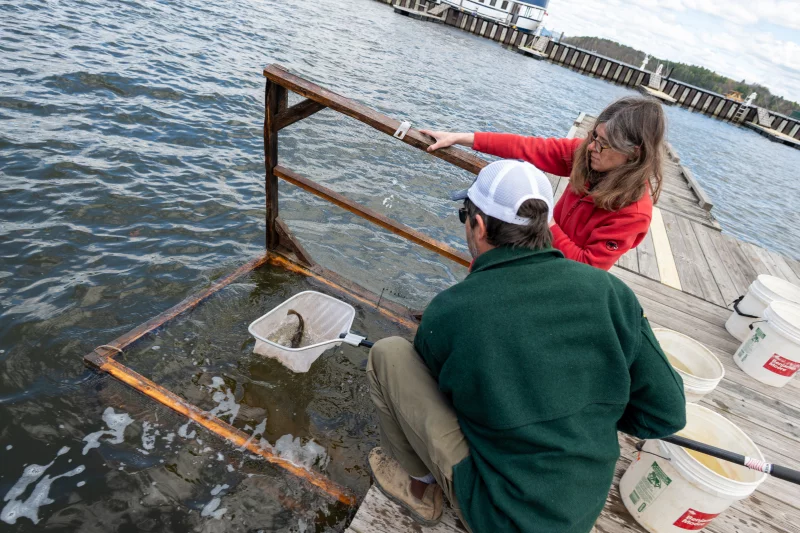
During an annual fish survey in Lake Memphremagog — a large body of water shared by northern Vermont and Quebec, Canada — researchers made a disturbing discovery.
In 2013, scientists from the Vermont Fish & Wildlife Department noticed something unusual about the lake’s brown bullhead catfish. Many of the fish had strange dark streaks and patches covering parts of their bodies.
The marks looked almost like black tar spread across their skin, appearing on their mouths, fins, gills, and even over their eyes.
“It wasn’t something you would normally expect to see on a healthy fish,” explained Peter Emerson, a fish biologist who has participated in the lake’s surveys for years.
A Sudden Appearance of Dark Lesions
The unusual condition appeared almost overnight. Although anglers had reported seeing affected fish the year before, there had been no previous signs of the problem.
When researchers examined the population, they found that more than a quarter of the catfish were covered in the strange black growths.
At first, scientists suspected the cause could be something in the environment — perhaps a chemical or pollutant entering the lake. The nearby Coventry Landfill raised concerns that toxic substances could be affecting the fish.
However, after testing the catfish, researchers found little evidence of harmful chemicals inside their bodies.
Scientists Identify a Rare Form of Cancer
Further investigation revealed that the dark patches were actually melanomas, a type of skin cancer.
The discovery was surprising because brown bullhead catfish typically spend much of their time away from the water’s surface, meaning they have limited exposure to sunlight and the ultraviolet radiation that can contribute to melanoma.
Seeking answers, researchers teamed up with Julie Dragon, a data scientist at the University of Vermont, to uncover what was causing the strange outbreak.
At first, scientists searched for signs of a cancer-causing virus, but no viral explanation was found.
A Cancer Unlike Any Other
The breakthrough came when researchers used advanced genome sequencing to compare the tumors with the fish themselves.
Normally, a tumor develops from the host’s own cells, meaning its genetic makeup should closely match the animal it grows inside.
But these catfish tumors were different.
Scientists discovered that the cancer cells did not genetically resemble the fish carrying them. Instead, tumors from different catfish were remarkably similar to one another.
This suggested something extraordinary: the cancer itself was spreading between animals.
Researchers believe the tumors may have originated from a single fish many years ago, with the cancer cells multiplying and passing from catfish to catfish like a living lineage.
A “Living” Cancer That Can Move Between Animals
Transmissible cancers are extremely rare. Before this discovery, they had only been documented in a few animals, including Tasmanian devils, dogs, and some marine creatures.
The catfish melanoma appears to represent another example of a cancer that can survive beyond its original host.
Julie Dragon believes the cancer cells may escape from one fish and enter another, possibly during spawning season when catfish gather closely together.
During this process, the fish often rub against one another, and their sharp fin structures may create small injuries that allow cancer cells to enter a new host.
How the Disease Spreads Remains a Mystery
Scientists are still investigating exactly how the cancer moves between fish and whether environmental factors may be weakening the catfish immune systems.
Today, the melanoma affects around 30% of brown bullhead catfish throughout Lake Memphremagog, on both the U.S. and Canadian sides.
Despite the alarming appearance of the tumors, researchers say many affected fish appear able to survive with the condition for long periods.
Why These Catfish Could Help Human Cancer Research
Although the discovery sounds frightening, scientists believe these unusual fish tumors could provide important clues about cancer in humans.
Vincent Lynch, an evolutionary biologist at the University at Buffalo, explained that most cancers die when their host dies. But a cancer capable of moving into new hosts gains a form of independence.
“The cancer wants to survive,” Lynch said. “Now it has a life of its own.”
Studying these catfish tumors may help researchers better understand how cancer cells invade new areas of the body, spread, and avoid the immune system — processes that are also involved in human cancer metastasis.
Researchers Continue Searching for Answers
The mystery of the catfish cancer is far from solved. Scientists are now examining similar melanomas found in other lakes and ponds to determine how widespread this phenomenon may be.
Interestingly, researchers believe a similar condition may have been observed centuries ago. They point to a description by writer Henry David Thoreau, who once recorded seeing a catfish with an “inky-black” disease-like appearance in Massachusetts.
The discovery raises an important question: are transmissible cancers truly rare, or have scientists simply not recognized them before?
As researchers continue studying these unusual catfish, they hope the answers could reveal more about how cancer evolves, spreads, and survives.